Third-Party Management
Guide to Accessibility Standards for Storage Facilities
Curious about what accessibility standards are common for storage facilities? Below, we break down key ADA standards and how to make your storage facility accessible for all customers.

As one of the leading self storage operators, Extra Space Storage understands that accessibility is more than a legal requirement—it's an essential part of storage facility management and creating a positive customer experience. The Americans with Disabilities Act (ADA) outlines specific accessibility standards for self storage facilities—such as parking lot layouts to unit door clearances. Meeting these standards not only helps compliance but also improves safety, usability, and customer satisfaction. In this guide, we'll cover the key ADA requirements for storage facilities and share insights from our operational experience to help you design or upgrade your property for accessibility and success.
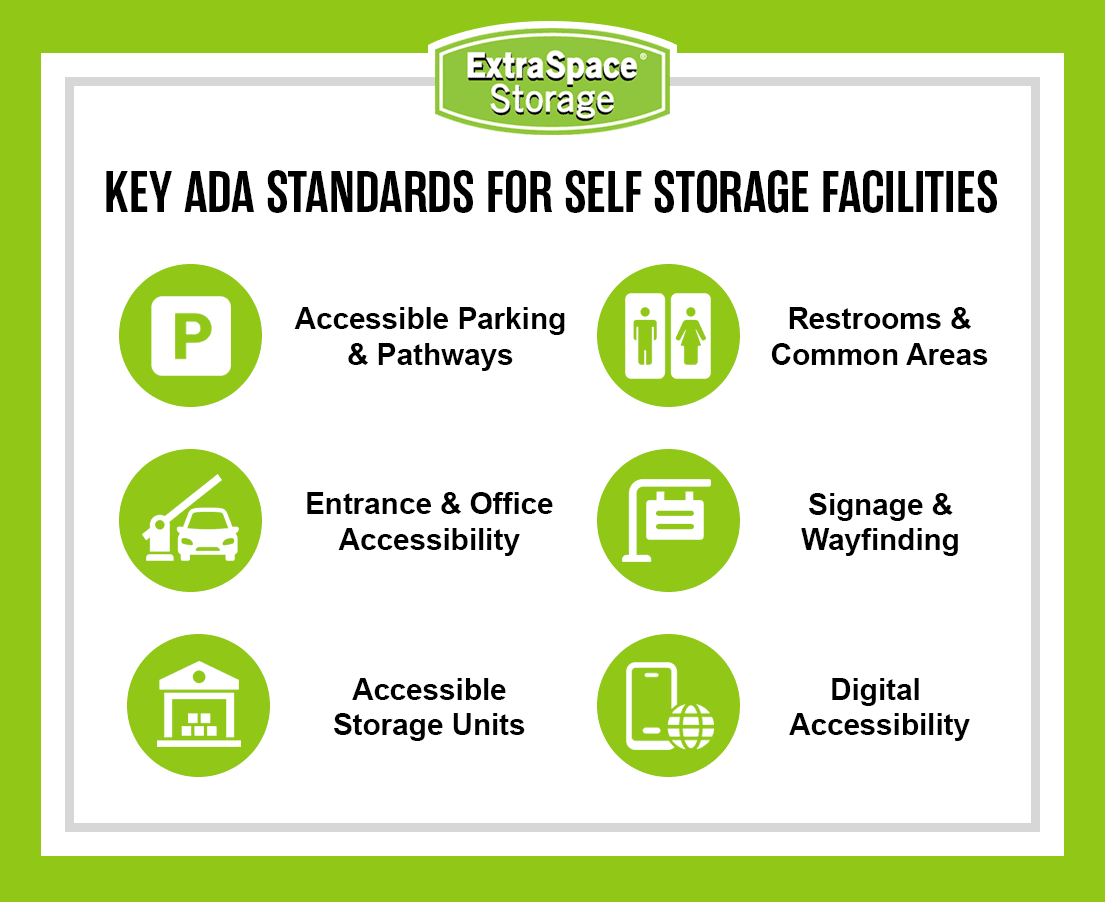
Key ADA Standards for Self Storage Facilities
The Americans with Disabilities Act (ADA) applies to both new construction and existing storage properties, requiring facilities to make reasonable accommodations that support accessibility for all customers. When reviewing your property for ADA compliance, it's important to evaluate how each area meets federal design standards. Here's a list of what operators should look for during inspections or renovations.
Accessible Parking & Pathways
Accessible parking spaces are one of the first indicators that your facility meets ADA accessibility standards. Under federal guidelines, self storage facilities must provide a specific number of accessible parking spaces based on their total parking count, with at least one van-accessible spot. Each space must include proper signage and an adjacent access aisle wide enough for wheelchairs or mobility devices. From these spaces, customers should be able to travel along a smooth, unobstructed pathway leading directly to the facility's main entrance and any accessible storage units.
Entrance & Office Accessibility
Your facility's main entrance and leasing office set the tone for the customer experience, so having these areas meet ADA accessibility standards is essential. Both new and existing self storage properties should be designed to allow all customers—regardless of ability—to enter, navigate, and conduct business comfortably. When assessing your office and entryway, pay close attention to the following ADA design considerations:
Doorways: Must be at least 32 inches wide with easy-to-grip handles rather than round knobs to accommodate customers with limited dexterity.
Automatic or Low-Resistance Doors: Install automatic doors or low-resistance push handles to reduce barriers for those using mobility aids.
Door Force: The required force to open a manual door should not exceed five pounds to maintain accessibility for all users.
Ramps: Entrance ramps must have a slope no steeper than 1:12, providing a safe and gradual incline for wheelchairs and carts.
Service Counters: Include at least one section that's 36 inches high or lower to serve customers who use wheelchairs or other mobility devices.
Accessible Storage Units
Under ADA standards, a portion of all self storage units must be designed for full accessibility. The exact number can vary depending on your facility's size, layout, and construction date, but as a general guideline, at least five percent of all units—or one of each unit size category—should be accessible to customers with disabilities. These designated units and their surrounding areas should include:
Level drive-up access: Provide smooth, even surfaces free of curbs, steps, or uneven thresholds.
Wide driveways and pathways: Allow sufficient clearance for vehicles and mobility devices.
Accessible doors and handles: Make sure handles can be operated with one hand and minimal force (e.g., rope-operated roll-up doors).
Easy-to-use locking systems: Install locks and latches positioned within ADA-recommended height ranges.
Enhanced lighting: Maintain bright, consistent lighting throughout hallways and units for improved visibility.
Audio and visual alarms: Include dual-sensory alerts for emergencies or security notifications.
ADA-compliant elevators: In multi-story facilities, elevators should meet ADA requirements for car size, button placement, and control height.
Restrooms & Common Areas
Common areas—including hallways, elevators, and waiting spaces—play a major role in how customers experience your facility. To meet ADA standards and create a safe, accessible environment, these shared spaces should be wide, well-lit, and free of barriers that could impede movement.
If your property includes public restrooms, those spaces must also comply with ADA restroom design standards, including:
Accessible stalls: Provide at least one stall with horizontal grab bars and a 60-inch minimum wheelchair turning radius.
Sink and mirror height: Verify sink counters and mirrors are positioned no higher than 34 inches from the floor for easy reach.
Clear pathways: Keep hallways, walkways, and restroom approaches free of obstructions and clutter at all times.
Signage & Wayfinding
Wayfinding signage is another essential component of ADA compliance for self storage facilities. Clear, accessible signage helps all customers—especially those with visual or mobility impairments—navigate your property confidently and safely. To meet ADA signage standards, permanent and temporary signs throughout your facility should include:
Tactile elements: Raised lettering and Braille for essential information such as unit numbers, restrooms, and exits.
High-contrast design: Use color combinations that clearly distinguish text from background surfaces for improved readability.
Proper placement: Mount signs between 48 and 60 inches from the floor, ensuring they're within easy reach and visible to all users.
Digital Accessibility
ADA compliance doesn't stop at your facility's physical design—your digital presence matters, too. A self storage website must be accessible to all users, including those with visual, auditory, or motor impairments. Following the Web Content Accessibility Guidelines (WCAG) helps make sure your website can be read, navigated, and interacted with by everyone. To meet ADA website accessibility standards, storage operators should:
Add descriptive alt text: Include meaningful alternative text for all images so screen readers can convey visual information accurately.
Use accessible color contrast: Choose text and background color combinations that meet WCAG contrast ratios for legibility.
Avoid disruptive visuals: Refrain from using flashing elements or auto-playing videos that may interfere with assistive technologies.
Support keyboard navigation: Make sure all site functions—including forms, menus, and links—can be completed without a mouse.
Maintaining ADA Compliance at Your Storage Facility
ADA compliance isn't a one-time project—it's an ongoing process that requires regular attention, documentation, and staff awareness. As standards evolve and facilities age, proactive monitoring helps you stay compliant while continuing to provide a safe, inclusive experience for every customer. Here are a few steps storage operators can take to maintain compliance long term:
Schedule regular accessibility audits: Partner with a qualified ADA specialist to assess both physical and digital spaces for compliance gaps or outdated features.
Train your on-site staff: Provide ongoing training so employees understand accessibility requirements and can confidently assist customers with disabilities.
Document updates and inspections: Keep detailed records of audits, upgrades, and maintenance to demonstrate compliance and due diligence.
Review digital accessibility annually: Audit your website and online rental process regularly to maintain WCAG standards and ADA guidelines.
By staying proactive and informed, operators can reduce compliance risks, improve customer satisfaction, and uphold a strong reputation for professionalism and care.
Need help meeting ADA requirements at your storage facility? Extra Space Storage's Third-Party Management Program can help provide operators with expert guidance on accessibility, compliance, and operational excellence. Partner with us today! For more information about ADA design requirements for storage facilities, visit the official ADA website.