Vehicle Storage
Motorcycle Size Guide: Average Motorcycle Dimensions & Best Storage Unit Sizes

Read Time: 13 min read
Summary: To find the right size motorcycle for you and your storage space, start by learning typical dimensions: most bikes run 78 to 100 inches long, 28 to 36 inches wide, and 300 to 900+ pounds. Next, measure your inseam and multiply it by 0.85 to 0.90 to find your ideal seat height, then match a bike type to your skill level. Before buying, test bikes in person and make sure you can balance the weight while stationary. Most motorcycles fit a 5x10 unit, though touring bikes may need a 10x10. For best results, consider climate-controlled storage, and remember to cover your bike with a breathable cover.
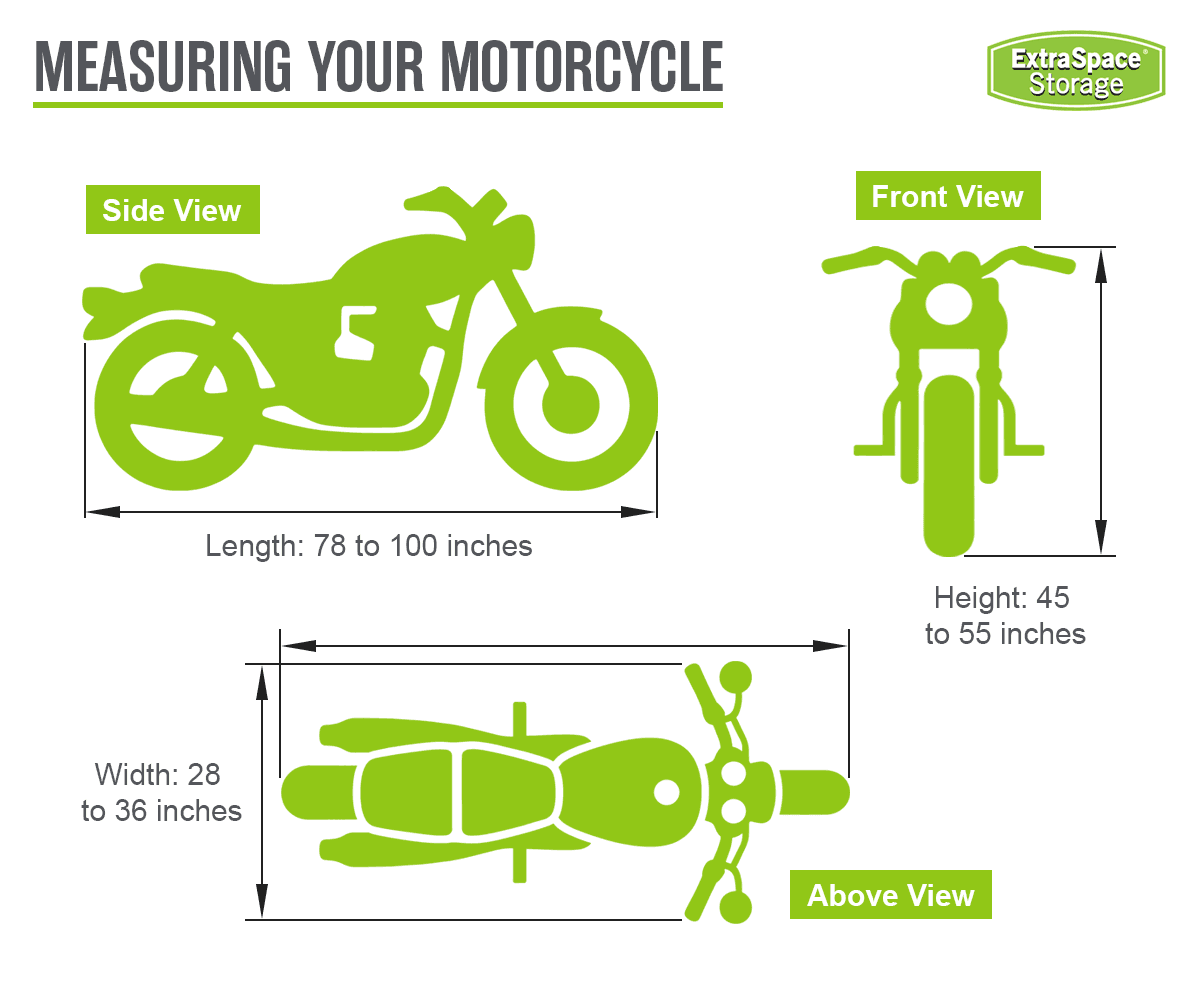
Motorcycles typically range between 78 and 100 inches long and 28 to 36 inches wide, with an overall height of 45 to 55 inches, a seat height of 25 to 36 inches, and a weight of 300 to 900+ pounds. These measurements vary based on different motorcycle types and specific motorcycle models. Finding the right size motorcycle is incredibly important for rider comfort and safety, as well as for finding the right size storage unit for your bike. From cruisers and sport bikes to motorized scooters and off-road bikes, get to know different sizes and types of motorcycles—as well as what types are best for your needs and skill level!
What Is the Average Motorcycle Length?
The average motorcycle length is around 78 to 100 inches. Here are the average lengths of different types of motorcycles:
Standard Motorcycle: 78 to 85 in
Cruiser Motorcycle: 90 to 110 in
Touring Motorcycle: 95 to 103 in
Sport Bike: 80 to 85 in
Motor Scooter: 60 to 72 in
Off-Road Bike: 85 to 90 in
What Is the Average Motorcycle Width?
The average motorcycle width is between 28 and 36 inches. Motorcycle width is usually measured at the handlebars or mirrors—whichever is the widest point of the vehicle. Here are the average widths of different types of motorcycles:
Standard Motorcycle: 28 to 32 in
Cruiser Motorcycle: 28 to 37 in
Touring Motorcycle: 34 to 40 in
Sport Bike: 28 to 30 in
Motor Scooter: 25 to 30 in
Off-Road Bike: 31 to 35 in
Motorcycle tire width—generally measured in millimeters—is also an important measurement when considering the type of motorcycle you need. Off-road bikes, as well as some beginner street bikes, often have the slimmest tires, with modern sport bikes and standard bikes falling in the middle range of tire widths and large cruisers having the thickest tires. Front and back tires also differ in width—the average width for front tires ranges from 80 mm to 130 mm, while back tire widths can fall between 130 mm and 240 mm.
What Is the Average Motorcycle Height?
The average motorcycle height is around 45 to 55 inches overall, with the seat height averaging between 25 and 36 inches. Both measurements are important for different reasons—overall height is a good indicator of how your motorcycle will fit in a self storage unit or garage, and seat height helps determine if a rider can fit the vehicle. These are the average overall and seat heights for different types of motorcycles:
Standard Motorcycle:
Overall: 42 to 48 in
Seat Height: 28 to 33 in
Cruiser Motorcycle:
Overall: 43 to 51 in
Seat Height: 26 to 28 in
Touring Motorcycle:
Overall: 51 and 56 in
Seat Height: 26 to 29 in
Sport Bike:
Overall: 43 to 45 in
Seat Height: 30 and 34 in
Motor Scooter:
Overall: 40 and 52 in
Seat Height: 28 to 31 in
Off-Road Bike:
Overall: 45 to 50 in
Seat Height: 35 to 39 in
The measurement you'll need to pay the most attention to when choosing the right motorcycle for you is the seat height—you should be able to comfortably rest flat-footed when the bike is stationary. Take your barefoot inseam measurement multiplied by 0.85 to 0.90 to find your ideal motorcycle seat height. Here's a guide for determining your ideal motorcycle type based on your height and corresponding inseams:
Under 5'7" (Inseam under 30 in): Cruisers, motor scooters, and compact naked bikes. Cruisers and motor scooters often have the lowest seat heights, and compact naked bikes have narrow frames that allow your legs to go straight down rather than bowing out.
5'7" to 6'0" (Inseam 30 to 32 in): Sport bikes and standard bikes. Seat height falls in a great spot for this height range—you'll just need to choose between a forward-leaning or upright riding position.
6'1" and Taller (Inseam 33+ in): Off-road bikes, large sport bikes, large cruisers, and touring bikes. Off-road bikes and sport bikes have the highest seat heights, giving you more legroom, and large cruisers have more floorboard and legroom so long legs can stretch out.
What Is the Average Motorcycle Weight?
On average, a motorcycle weighs 300 to 900+ pounds "dry," which is the base weight with no fluids or accessories. Weight is an important aspect of motorcycle dimensions because it can change how well the vehicle fits the rider, as well as how the bike will accelerate and handle. Here are average dry weights based on the type of motorcycle:
Standard Motorcycle: 350 and 500 lbs
Cruiser Motorcycle: 500 to 700 lbs
Touring Motorcycle: 650 to 950 lbs
Sport Bike: 350 to 420 lbs
Motor Scooter: 140 to 270 lbs
Off-Road Bike: 190 to 260 lbs
Motorcycles also have a "wet weight", or "curb weight," which is the weight of the bike plus all its accessories and fluids like engine oil, coolant, and a full tank of gas. Each motorcycle has a Gross Vehicle Weight Rating (GVWR), which refers to the maximum safe operating weight of the vehicle with all fluids and accessories, also indicating its maximum carrying capacity. You can find this measurement on your VIN plate.
What Are Typical Motorcycle Engine Sizes?
Measured in cubic centimeters (CCs), motorcycle engine sizes can vary widely from 50cc to 800cc and up. These measurements indicate an engine's cylinder volume and engine displacement, which is how much air and fuel the cylinders can take in and burn. A larger CC means a larger engine, more power and acceleration, and often a larger overall motorcycle.
50cc to 125cc: Lightweight, ideal for city commutes and low speeds, beginner-friendly riding. Includes scooters or small mini-bikes.
250cc to 400cc: Lightweight, maneuverable, and forgiving. Highly beginner-friendly.
400cc to 500cc: Enough power for the highway, but not over the top. The sweet spot for daily commuting.
600cc – 750cc: Substantial power and acceleration. Found in mid-range sport bikes and cruisers, making them great for intermediate riders.
800cc and up: Designed for experienced riders, highway touring, and carrying passengers with luggage. Includes heavyweight cruisers, touring, and superbikes.
Keep in mind that different motorcycle types and specific models with the same engine size can still handle differently depending on how they distribute power.
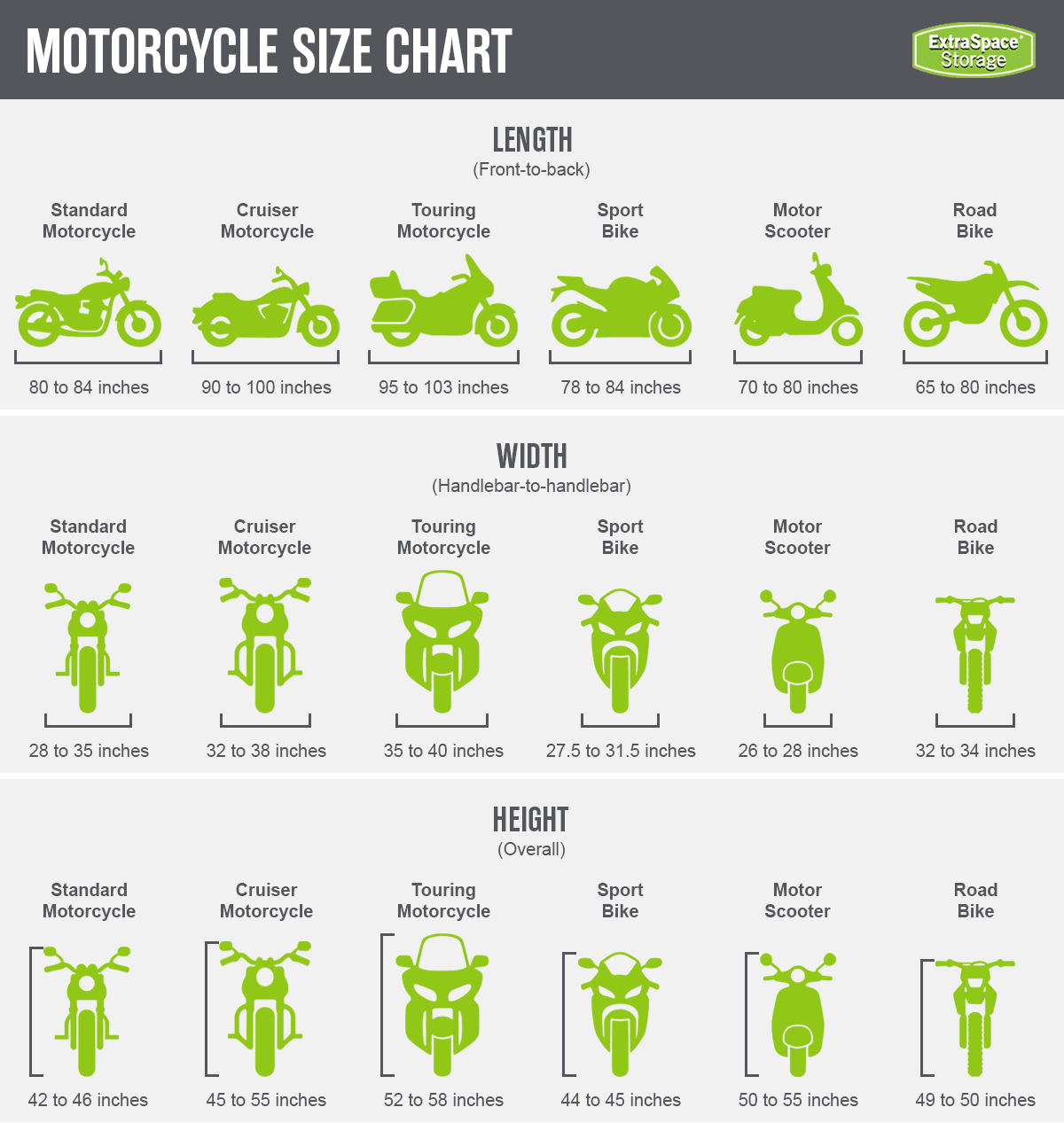
Motorcycle Size Comparison by Type
Motorcycle Type | Standard Motorcycle | Cruiser Motorcycle | Touring Motorcycle | Sport Bike | Motor Scooter | Off-Road Bike |
Length | 80 to 84 in | 90 to 100 in | 95 to 103 in | 78 to 84 in | 70 to 80 in | 65 to 80 in |
Width | 28 to 35 in | 32 to 38 in | 35 to 40 in | 27.5 and 31.5 in | 26 to 28 in | 32 to 34 in |
Overall Height | 42 to 46 in | 45 to 55 in | 52 to 58 in | 44 to 45 in | 50 to 55 in | 49 to 50 in |
Seat Height | 30 to 32 in | 25 to 29 in | 27 to 30 in | 32 to 33 in | 28 to 31 in | 35 to 39 in |
Weight | 350 to 500 lbs | 500 to 700 lbs | 800 to 1,000 lbs | 350 lbs to 450 lbs | 150 to 300 lbs | 200 to 400 lbs |
Engine Size | 300cc to 900cc | 750cc to 1200cc | 800cc to 1800cc | 600cc to 1000cc | 50cc to 150cc | 250cc to 450cc |
Model Examples | Yamaha MT-07, Honda CB500F, Royal Enfield Continental GT 650, Norton Commando 961 Sport | Indian Chief Dark Horse, Harley-Davidson Softail Slim, Kawasaki Vulcan S, Harley-Davidson Road King, Triumph Bonneville Bobber | Honda Gold Wing Tour, Kawasaki Vulcan 1700 Voyager, KTM 1290 Super Duke GT, Ducati Multistrada 1260 | Suzuki GSXR-600, Kawasaki Ninja ZX-10R, BMW R 1200 GS | Piaggio Fly 150, Suzuki Address 110, Honda Ruckus, ONYX CTY | Honda CRF250L, KTM 690 Enduro R |
Best For | Daily commutes, weekend adventures | Daily commutes, weekend adventures | Long-distance trips | High-speed riding, daily commutes | City commutes, short-distance drives | Trail riding, weekend adventures |
Standard Motorcycle
Rider Level: Beginner
Riding Position: Neutral pegs, mid to low handlebars, upright seat
Standard Motorcycle Types: Cafe Racer, Roadster, Naked Motorcycle
Standard motorcycles are some of the easiest to ride—thanks to their upright seats, average-sized engines, comfortable handlebar and peg positions, and lighter body style. They're often the best type of motorcycle for short commutes, but they can also be modified for longer trips.
Cruiser Motorcycle
Rider Level: Intermediate
Riding Position: Forward pegs, high handlebars, reclined seat
Cruiser Motorcycle Types: Power Cruiser, Chopper, Bobber
Leaned-back seats make cruisers some of the most comfortable motorcycles for relaxed weekend rides and carefree commutes to work without looking overly bulky. They can come with a hefty price tag, large engines, and a heavy body. However, those looking for lots of low-end torque and a powerful yet comfy way to get around will love cruisers.
Touring Motorcycle
Rider Level: Beginner to Intermediate
Riding Position: Forward pegs, mid-height handlebars, neutral seat
Touring Motorcycle Types: Sport Touring
Of all the different types of motorcycles, touring bikes are ideal if you're looking for a big motorcycle that offers ultimate comfort. Touring bikes are the best long-distance motorcycles because they have large engines and fuel tanks, as well as expansive front fairings complete with bug screens to help protect you from the elements. Seats tend to be wider with back rests, and there's space for saddlebags and a passenger. Touring motorcycles are also known for having all the luxury bells and whistles, including heated seats and handlebars, GPS systems, and satellite radio.
Sport Bike
Rider Level: Intermediate to Advanced
Riding Position: Rear pegs, low handlebars, forward-leaning seat
Sport Bike Types: Dual Sport
If high-speed performance is a priority, and you plan to ride on paved streets, a sport bike could be right for you. Known for impeccable braking, high-performance engines, having one of the lightest body styles, and being excellent at tight turns, sport bikes are made for adrenaline-filled rides. However, of all the different types of motorcycles, these can be trickier to drive, and the crouched position can be strenuous for some.
Motor Scooter
Rider Level: Beginner
Riding Position: Neutral pegs, mid-height handlebars, neutral seat
Motor Scooter Types: Moped
If you're searching for a less intimidating two-wheeled ride, there are many types of scooters that could be right for you. Motor scooters are ideal if you live in a city with narrow streets or if you're looking for a more eco-friendly way to get around town. Not only do these scooters produce significantly fewer emissions than a car, but they're much more affordable to buy and can cut down on monthly commuting expenses. Scooters run on much smaller engines, so they promise a quieter and more relaxed ride.
Off-Road Bikes
Rider Level: Intermediate
Riding Position: Rear pegs, mid-height handlebars, neutral seat
Off-Road Bike Types: Adventure (ADV) bikes
Off-road motorcycles (or dirt bikes) are best for unpaved road riding. Their elevated height, lighter body style, knobby tires, and high suspension make riding over rough terrain easier. Whether you're planning on trail riding or hoping to get involved with competitive off-road racing, most dirt bikes require slightly more training and experience than an on-road motorcycle. Keep in mind that many off-road bikes aren't street legal, so they're not ideal if you need a motorcycle for daily commutes.
What Size Motorcycle Should I Get Based on Skill Level?
Beginner motorcyclists should start with lower power levels and easier handling options, while experts can level up to bigger acceleration and higher speeds. Here are the best types of motorcycles for you based on your experience:
Beginner: Compact sport bike, ADV bikes, standard, cruiser, off-road bike
Intermediate: Standard, middleweight sport bike, ADV bikes, cruiser
Advanced: Liter-class sport bike, ADV bikes, power cruiser, sport-tourers
How to Choose the Right Motorcycle Size
Not sure what motorcycle size is right for you? Here are some tips for finding the right motorcycle size.
Be honest about your skill level: Getting a bike that's too big, too fast, or that requires more skilled handling is an unsafe choice for you and others on the road.
Measure your inseam to calculate seat height range: Measure your inseam, then multiply the measurement by 0.85 and 0.90 and you'll have your comfortable seat height range.
Consider upper body reach and seated position: Consider whether you're more comfortable with an upright or forward-leaning seated position, and test bikes in person to make sure you can reach handlebars and operate controls without stretching or shifting.
Make sure you can hold the weight while stationary: Balance on the bike without its kickstand while stationary to be sure you can hold it upright comfortably. If you can't balance it stationary, it's too heavy.
Think about how you're using your bike: Factor in whether you'll be using your motorcycle for a short commute, a freeway commute, city driving, long-haul road tripping on a highway or interstate, or with an additional passenger. Each option fits different types of motorcycles better, and you may need other added features like a windscreen, different levels of suspension, or accessories like saddlebags.
What Size Storage Unit Do I Need for a Motorcycle?
Most motorcycles will fit in a 5x10 storage unit, but if you need to store multiple motorcycles or have a larger type of motorcycle like a touring bike, you may need a 10x10 storage unit or larger.
5x10 unit: Fits 1 standard motorcycle with room for gear
10x10 unit: Fits 1 large/touring motorcycle with gear or 2 small bikes
10x15 or 10x20 unit: Fits 2+ motorcycles, sidecar rigs, or multiple bikes and accessories
How Much Does Motorcycle Storage Cost?
Motorcycle storage prices can range anywhere from $35 to over $400 monthly, depending on your location and the amenities included. Climate control and indoor storage units are common storage options that often cost more but provide additional protection for your vehicle. To find exact pricing in your area, call your nearest Extra Space Storage facility!
Size | Standard Storage Unit Cost | Climate-Controlled Storage Unit Cost |
5x10 | $69 | $80 |
10x10 | $118 | $124 |
10x15 | $163 | $167 |
10x20 | $209 | $227 |
Note: All prices are for reference only and are subject to change without notice.
Where Can I Find Vehicle Storage for My Motorcycle?
There are plenty of ways to safely store your motorcycle—including in your garage, your shed, at a local dealership, or at a storage facility like Extra Space Storage. Motorcycles are the smallest type of vehicle, which gives you a good variety of options for places to store a motorcycle, as well as a wide range of suitable storage unit sizes. Storage facilities also usually have additional security measures that make them ideal for motorcycle storage. Here are some popular markets for motorcycle storage units:
Frequently Asked Questions
How do I read motorcycle tire size?
Motorcycle tire size can be read by deciphering a series of numbers and letters on the sidewall of the tire, measured in metric format. The numbers and letters are in this standard order: [Width (mm)] / [Aspect Ratio (%)] [Speed Rating (alphabetical)] [Construction] [Rim Diameter (in)]
Example:
180: Tire width at widest point in millimeters
55: Aspect ratio as percentage (sidewall height is 55% of the tire's width)
Z: Speed rating of maximum speed the tire is tested to handle (A-Z, Z = over 149 mph).
R: Construction type; 'R' stands for Radial, A 'B' or a dash (-) indicates a bias-ply tire
17: The diameter of the wheel rim in inches
What size motorcycle helmet do I need?
To find what size motorcycle helmet you need, measure the fullest part of your head about an inch above your eyebrows and right above your ears, and compare your measurements to the sizing chart provided by the specific brand. A new helmet should fit snugly around the crown of your head with no gaps, applying firm, even pressure with no painful pressure points.
Helmets also come in different internal head shapes (Round Oval, Intermediate Oval, Long Oval), so you may need to check different head shapes if a standard size is causing you pain. Use the Roll Test to check fit by fastening the chin strap, grabbing the back of the helmet, and trying to roll the helmet forward. If it shifts too much, it's too big.
What size motorcycle requires a license?
Any motorcycle that's larger than 50cc or can exceed speeds of 30 mph requires a motorcycle class driver's license, which is separate from a standard driver's license. Most states will allow you to drive bikes under 50cc with a standard driver's license.
How wide are motorcycle parking spaces?
Motorcycle parking spaces are generally 4 feet wide and range from 7 to 9 feet long. These are smaller than standard parking spaces, but you are also allowed to park motorcycles in parking spaces designed for full-size cars.
How wide should motorcycle handlebars be?
Motorcycle handlebars are usually anywhere from 25 to 36 inches wide. The ideal handlebar width for you depends on the type of motorcycle, the width of your shoulders, and the type of riding you do. Wider handlebars provide better leverage at low speeds, while narrower handlebars provide better aerodynamics for high-speed handling.
How tall do you have to be to ride a motorcycle?
There is no minimum height requirement to ride a motorcycle. To safely ride a motorcycle, you must be able to comfortably and confidently balance your bike when both feet are flat on the ground in a stationary position. To narrow down the right size motorcycle for you, you just need to know the measurements for your inseam compared to the seat height.
How to prepare motorcycle for storage?
To prepare a motorcycle for storage, you'll need to follow the standard steps for winterizing a motorcycle:
Thoroughly wash and dry your motorcycle.
Change the engine oil and filter.
Fill the gas tank with fuel and mix in a stabilizer.
Clean and lubricate the chain.
Remove the battery and connect it to a trickle charger.
Inflate the tires to maximum pressure.
Cover your motorcycle with a breathable cover.
***
Need to store a motorcycle? Rent small vehicle storage with Extra Space Storage, and use our AI Smart Size Finder to find the size you need at one of our convenient storage facilities across the nation. Find affordable storage near you today!