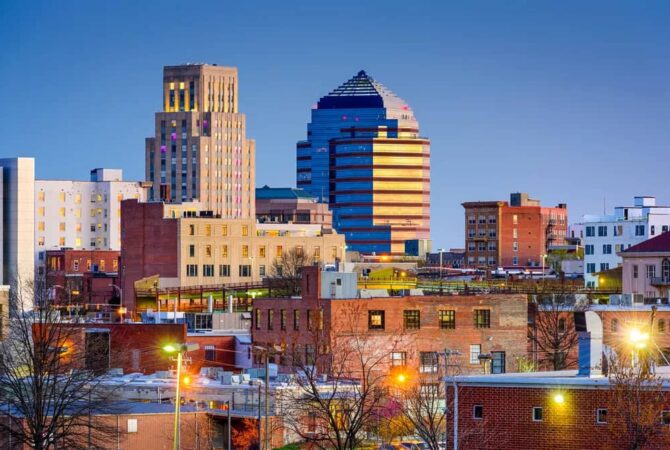
Moving to Durham? This North Carolina city blends Southern history with artistic energy and a great foodie scene—anchored by a thriving downtown, craft breweries, and a strong sense of community. Check out these 13 things to know about living in Durham!
Durham at a Glance
- Durham is the fourth-largest city in the state, with a population of 305,561 people. It’s located in the central Piedmont region of North Carolina.
- The median age in Durham is 34, contributing to the city’s youthful energy and appeal to both young professionals and families.
- Durham’s nickname of “Bull City” traces its roots back to the Civil War, when Union troops smoked the local tobacco called Bull Durham—branded with a bull logo that became core to the city’s identity.
- Durham is part of the North Carolina Research Triangle (along with Raleigh and Chapel Hill), which is a major hub for technology, healthcare, research, and innovation in the South.
- The Duke Health system makes Durham a major healthcare hub and provides residents living in Durham with top-tier medical care.
Experience Affordable Durham Living
Durham is an affordable city with a cost of living that’s 2% lower than the national average—helping make it one of the best cities in North Carolina. Utilities costs are 4% lower than the national average, and transportation costs are 2% lower. While overall housing costs are slightly above the U.S. average—Durham’s average home price is $554,139, and monthly rent is $1,734—the city’s median household income is 14% higher than average at $92,427, helping offset that extra cost.
Q: What is a livable salary in Durham, NC?
A: A living wage in Durham depends on household size. A single adult with no children should make at least $50,653 annually before taxes, while two working adults with two children need a combined $118,814 to cover basic expenses.
Explore Durham Careers
Durham—which borders Chapel Hill, Morrisville, Cary, and Raleigh—places residents close to multiple major employment locations. The city is poised for growth, and its unemployment rate is 3.4%, which is 31% lower than the U.S. average. Top Durham industries include medicine, technology, manufacturing, education, and retail. Today, the city is home to 300+ medical and health-related companies, including vaccine manufacturer Merck and Parexel International—one of the world’s largest clinical research organizations. Residents can also find jobs in technology and manufacturing at Durham-headquartered companies like Ionna, LLC, an electric vehicle charging network developer, or AISIN North Carolina, a manufacturing plant employing over 1,700 people. Other major employers in the area include Duke University, Blue Cross and Blue Shield of North Carolina, IBM, and RTI International.
Q: Why is Durham called the “City of Medicine”?
A: Durham earned the nickname “City of Medicine” because nearly one in four residents works in healthcare or a related industry. The city has one of the highest per capita concentrations of hospital beds and physicians in the world, anchored by the Duke Health System—including notable facilities like Duke Children’s Hospital and Duke Cancer Institute.
Learn at Top-Ranking Colleges in Durham
As part of the Research Triangle Park (RTP) area, students can pursue fantastic research and internship opportunities while working on their degrees at universities in Durham. For those interested in making breakthroughs in medicine and engineering, Duke University ranks among the top universities in the nation. North Carolina Central University (NCCU) is the first public liberal arts college for African American students in the country. Durham Technical Community College has a main campus near Research Triangle Park with a corporate education center training Triangle employees. High school students in the area can even get a head start on earning college credit at top high schools like North Carolina School of Science and Mathematics – Durham—a public school that draws academically gifted students from across the state for advanced STEM coursework.
Q: What universities are in the Research Triangle?
A: The Triangle Region is home to 12 colleges and universities and eight community colleges. These institutions work closely with local economic developers and businesses to ensure course offerings align with industry needs and prepare students for the workforce. The main research universities are Duke University in Durham, The University of North Carolina at Chapel Hill, and North Carolina State University in Raleigh.
Get Around with Durham Public Transportation
Residents can take advantage of efficient, cost-effective travel throughout Bull City and the surrounding region. Durham and the broader Research Triangle area offer a variety of sustainable transportation options, including public transit, roadways, biking, walking, and rail access. Explore Durham on foot or on your bike with the city’s trails and greenways. Commute throughout Durham County on the GoDurham bus system—which won the 2026 NCPTA Urban Transit Agency of the Year award in recognition of its commitment to providing “safe, reliable, fare-free, and customer-focused service.” Travel to nearby cities within the Research Triangle region via GoTriangle. Or board a Greyhound bus or Amtrak train to travel to major U.S. cities like Charlotte, DC, and New York.
Q: How does Durham support cycling and active transportation in the community?
A: Durham supports cycling and active transportation through community programs and public events like Move-a-Bull City, the city’s largest open streets celebration. This event temporarily closes roadways to cars so residents can walk, bike, and enjoy other non-motorized activities, reflecting a collaborative effort between the city, local health organizations, and community partners to promote safe, accessible travel for people of all ages and abilities.
Explore Outdoor Activities in Durham
Called “the flower of the Carolinas” by English explorer John Lawson in 1701, Durham offers a variety of beautiful outdoor spaces to explore—including an extensive network of parks and trails within the city and access to nearby North Carolina State Parks. Outdoor recreation is helped by Durham weather, which has mild temperatures in the spring, fall, and winter, with warm, humid summers. Snow is rare, and rainfall is spread throughout the year, meaning there is no dry season. Take advantage of the weather by biking or walking the American Tobacco Trail, a 22-mile rails-to-trails project. Have a picnic in Durham Central Park, a green space that often hosts community events. Canoe and explore historic buildings at West Point on the Eno Park. Swim or play tennis and pickleball at Forest Hills Park. Escape into nature at Duke Forest, an excellent spot for hiking and mountain biking. Hike and view the Cascades at nearby Eno River State Park, featuring nearly 24 miles of hiking trails. Or camp, boat, and fish at Falls Lake State Recreation Area, located less than 30 minutes away from Durham.
Q: What is Durham’s standout natural landscape feature?
A: Durham is renowned for its lush urban forest canopy and pristine river trails. The Eno River is the centerpiece of Durham’s outdoor scene—winding through over 4,000 acres of protected state park land, it’s famous for its rocky shoals, swimming holes, and the historic mill sites scattered along its banks.
Enjoy Energizing Family Activities in Durham
Durham is a family-friendly city with tons of fun educational activities and all-ages entertainment. Spark your child’s imagination by walking the Dinosaur Trail, exploring real Apollo-era space artifacts in the Aerospace exhibit, and learning about regional wildlife at the Museum of Life and Science in Durham, one of the most popular museums in North Carolina. Get acquainted with lemurs at the Duke Lemur Center, the world’s largest and most diverse sanctuary and research center for lemurs outside of Madagascar. Explore the Sarah P. Duke Gardens, a 55-acre botanical gardens that features four distinct areas to inspire learning, promote wellness, and build community. Join the kid-friendly Sprouts Club and find fresh produce, meat, flowers, handmade items, and more at the Durham Farmer’s Market. And while living in Bull City, be sure to pick up some good luck and rub the horns of Major the Bull.
Q: Why are Lemurs at Duke University?
A: The Duke Lemur Center traces back to 1963, when a Duke biology professor and Yale researcher connected over a shared commitment to civil rights. It turned out they also had a shared interest in animal conservation, and the Yale researcher needed a home for his lemur collection. The available space at Duke made it a natural fit.
Immerse Yourself in Local Culture & Black History
Filled with a vibrant culture, Durham ranks among the most diverse cities in America—bolstered by its significant Black community. Today, there are around 200 Black-owned businesses in Durham and a thriving Black Arts scene. Visit the site of historic Black Wall Street, an area honoring past and present Black-owned businesses with six historic markers. Stroll through the Black Wall Street Gardens and view public artwork honoring the legacy of past and present Black business owners at historic Black Wall Street. Learn about Black history in Durham through the faces of cultural leaders that are beautifully displayed on murals around the city. Explore the Hayti Heritage Center to learn about Durham’s Hayti community and culture, or attend events like Artist Hours and Hayti’s Soul Slam. Watch the Opening Ceremony and entertainment at the annual Juneteenth Celebration, a two-day event hosted in Durham. Or hear from leaders and settle in for a day of traditional food, music, arts, and community at the Bimbe Cultural Arts Festival.
Q: How many murals are found in Durham?
A: Durham is considered one of North Carolina’s best mural cities, with dozens of murals citywide across UHill Walls, the Face Up Project, and Downtown Durham’s Black History and Culture murals.
Discover Durham History & Architecture
Named after Bartlett L. Durham, who donated the land needed for the North Carolina Railroad, the City of Durham has significant parts of U.S. History to experience. Walk through the Duke Homestead, a national historic landmark where the Duke fortune and the nation’s tobacco industry began. Visit Historic Stagville, once among the largest plantations in North Carolina and now a preservation site committed to deepening modern understanding of the history of slavery through research, interpretation, and descendant engagement. View the location of the surrender of Confederate General Johnston to Union General Sherman at the end of the Civil War in 1865 at the Bennett Place State Historic Site. “Engage with the past” at the free-admission Museum of Durham History. See some of Durham’s stunning architecture at the Duke University campus—for concerts and quiet reflection, go to The Duke Chapel, a Gothic landmark known for its architecture. Or take a historical and architectural tour with Preservation Durham as it traces each Durham block, building by building, to share the city’s story.
Q: What is the American Tobacco Historic District?
A: The American Tobacco Historic District, a former Lucky Strike cigarette factory and headquarters of American Tobacco Company, is one of the largest historic preservation and renovation projects in North Carolina. This area is now a foodie hot spot and entertainment destination with a wide array of concerts and special events year-round.
Cheer for a Variety of Local Sports Teams
Sports fans living in Durham will find plenty to cheer for, with a strong sports community supporting college and professional teams alike. Experience the electric atmosphere of seeing the Duke Blue Devils (NCAA D-I) play at the Cameron Indoor Stadium—then dive into the program’s rich history at the Duke Basketball Museum. Head to nearby Chapel Hill to see the UNC Tar Heels (NCAA D-I) at Kenan Memorial Stadium. Enjoy America’s favorite pastime by going to a Durham Bulls (MiLB) game at Durham Bulls Athletic Park, located in the heart of the American Tobacco Historic District. Watch professional female softball team The Carolina Blaze (AUSL) score a home run at Smith Family Stadium. Or commute a short way to the Lenovo Center to attend a Carolina Hurricanes (NHL) game in Raleigh, NC.
Q: Why is Duke basketball considered one of the top programs in college basketball history?
A: The Duke men’s basketball team has consistent success, including five NCAA championships, frequent tournament appearances, and legendary players and coaches. Duke’s women’s team also maintain a high presence within the Top 25 rankings.
Experience Durham Art & Entertainment
Durham has a vibrant arts and entertainment scene. Explore the city and its artists by seeing permanent and temporary works exhibited through the Public Art Collection. Visit the Nasher Museum of Art, a free DukeArts gem on the Duke Campus, where you’ll find permanent collections of contemporary art as well as special exhibits like Art of the United States. Take workshops like glass blowing and watch artists creating pieces with molten iron at a public iron pour at the Liberty Arts Foundry. See concerts, musicals like Hamilton, comedy shows, and more at the Durham Performing Arts Center. Laugh at some of the best comedy, poetry, music, and more in the Triangle with local arts collective Mettlesome. See modern and classic films or attend the Full Frame Documentary Film Festival at The Carolina Theatre of Durham. Or wear your walking shoes to experience fantastic art, DJs in the square, artists’ opening receptions, workshops, open studios, and more at the Third Friday Art Walk.
Q: Does Durham have art workshops or classes?
A: Durham offers plenty of opportunities to take art workshops and classes. The Durham Arts Council offers many creative outlets, while the Durham Art Guild hosts events like Artful Evenings Live Painting. Duke Arts Create also offers workshops for all skill levels—from ceramics to dance to fiber arts—and while most are for the Duke community, a few free community workshops each month are open to the public, with no Duke affiliation required.
Attend Durham Festivals & Celebrations
Durham has a rich festival scene for a city its size, especially for those interested in music, arts, food, and culture. See live performances, enjoy food from local vendors, and shop art, jewelry, and more from local makers at CenterFest, Durham’s signature fall arts festival since 1974. Celebrate Black roots music and culture with performances, panels, readings, workshops, and food at Biscuits and Banjos. Feel the energy of the city during its twice-a-year LGBTQ+ Pride celebrations—one in June, and one in the fall. Try cuisine from all over the world with over 40 food trucks and beer and wine vendors at the Food Truck Rodeo in Durham Central Park! Or taste, sip, and vote for best Bull City food and beer pairing at the Bull City Food & Beer Experience.
Q: When do festivals take place in Durham?
A: Spring, summer, and fall are particularly active festival seasons in Durham. Residents can find everything from arts, music, and film events to food, cultural, and community festivals throughout the city.
Savor Incredible Durham Food
There is a variety of incredible restaurants in Durham for every palate. Enjoy the Challah Avocado Toast, Lomo Saltado, or Porkbelly Bowl at Aaktun, a cafe by day that turns into a Tulum-style tiki bar by night. Experience authentic BBQ with the Brisket Sandwich, Pulled BBQ Sandwich, or Ribs Plate at Byrds BBQ. Indulge in thoughtful Southern comfort pairings, like the Sassy Shrimp & Grits, Blackened Salmon, or the Build Your Own—where you choose your own combo of waffle, chicken, and house-made “shmear”—at Dame’s Chicken & Waffles. Explore a rotating menu of Mexican-inspired pocho cuisine at Little Bull, brought to you by Bravo’s 2026 Top Chef Carolinas winner Chef Oscar Diaz. Fill up on Southern classics like Shrimp and Grits, Broiled Oysters, Gumbo, and Fried NC Catfish at Seraphine, located in the revitalized American Tobacco Historic District. Don’t miss seasonal seafood picks prepared in meals from James Beard-nominated chef Ricky Moore, including the beloved “Hush-Honeys”—fried, honey-glazed cornmeal fritters—at the Saltbox Seafood Joint. Or for dessert in Durham, try unique flavors of ice cream like Vietnamese Coffee, Peach Vanilla Crisp, and Strawberry Basil at The Parlour.
Q: What food is Durham known for?
A: Dubbed the “Tastiest Town in the South,” the food in Durham blends its Southern heritage with modern international concepts. From pit-cooked brisket and pulled pork to Southern comforts and unique culinary styles like pocho, your tastebuds will be satisfied.
Scope Out the Durham Nightlife Scene
Durham has a vibrant nightlife scene that blends Duke University culture, live music, craft cocktails, and foodie appeal. Visit artsy venues, hidden patios, Durham gay bars, and rooftop bars for skyline views and creative drinks. Listen to Jazz on the Roof with a craft cocktail at The Roof at The Durham Hotel. Relax on the veranda and take in the beauty of the 87 acres of vineyards while enjoying wine or a cigar at ZincHouse Winery and Brewery. Choose from more than 300 whiskeys from around the world, or try local beers and tasty mocktails at Dram and Draught. Try craft beers, craft cocktails, and delicious plates, or join the Horn & Stein Society at the Flying Bull Restaurant & Brewery. Sip signature cocktails like Midnight Confessions, Purple Reign, and Electric Bloom in a chic setting at Primrose. Or spend a relaxed, low-key evening at Duke Coffeehouse—a student-run venue that hosts live music, open mics, and occasional dance parties, and is open to all students, faculty, and community members.
Q: Can you carry your alcoholic drinks around from bar to bar in Durham?
A: The Bullpen Social District allows you to take alcoholic beverages outside and walk freely between participating venues in Downtown Durham, as long as you’re using a designated cup and following the district’s guidelines.
***
Moving to Durham? Extra Space Storage has self storage facilities throughout the Bull City metro, so we can help with your transition. Find a storage unit near you!