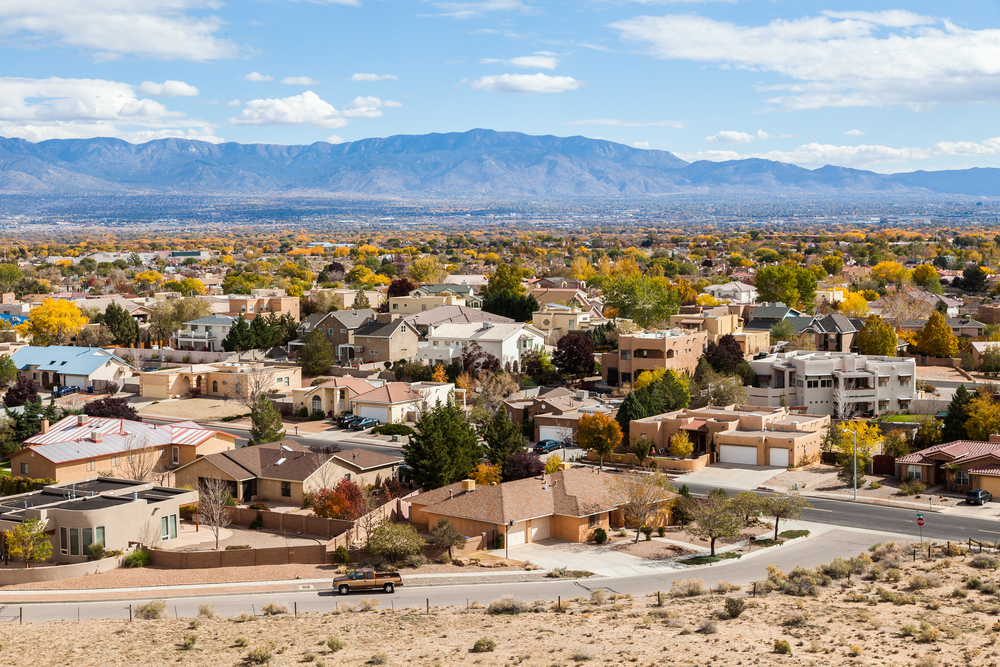
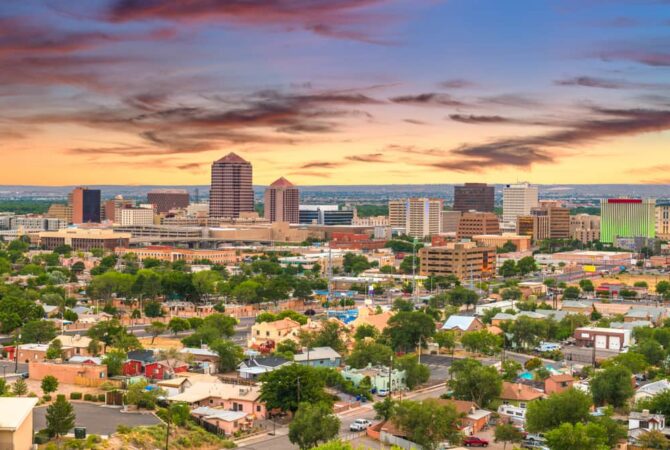
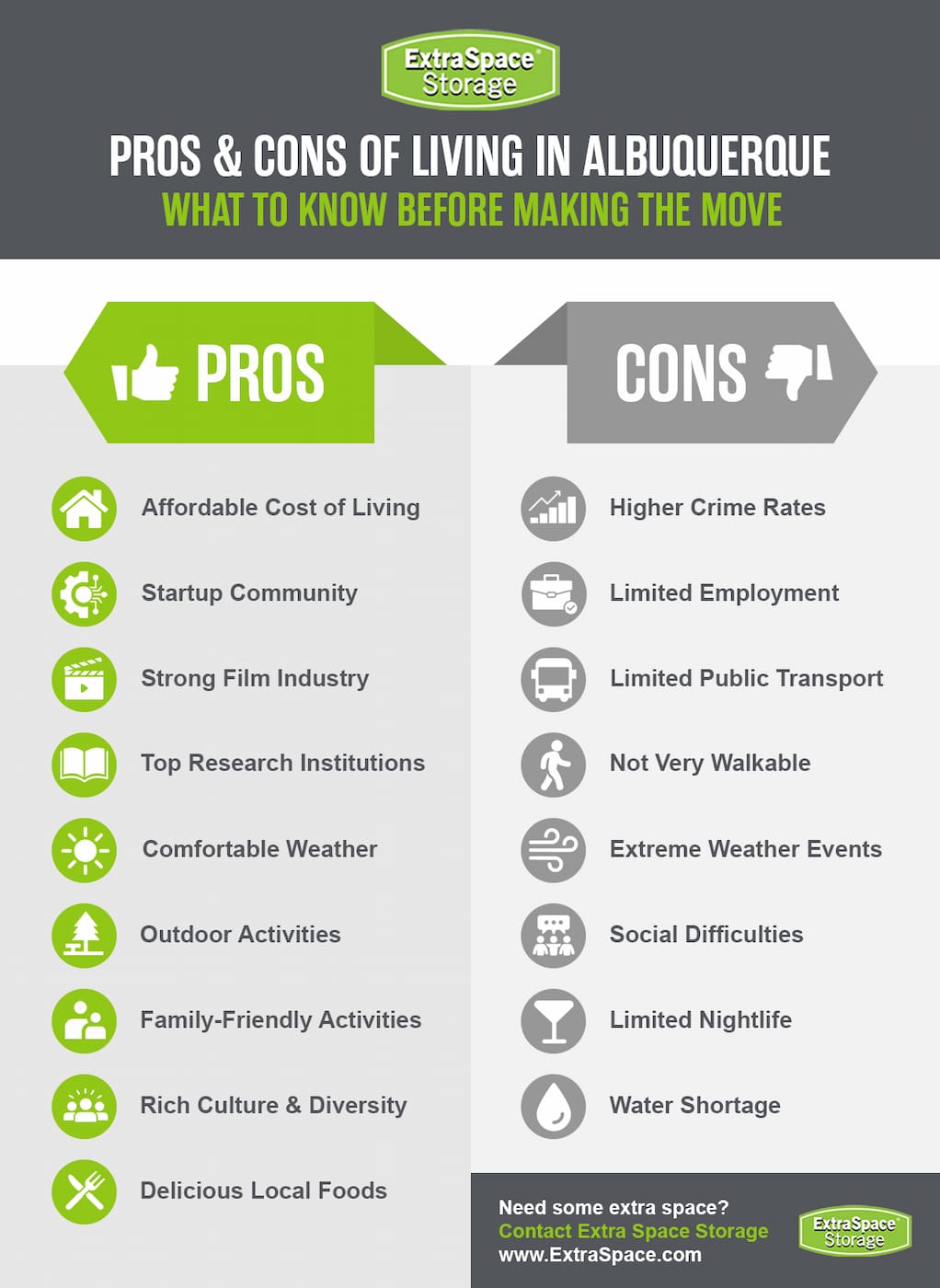
Albuquerque is a good place to live for those seeking affordability, outdoor access, and a strong sense of community. Many people like ABQ’s sunny weather, scenic desert landscapes, and lower cost of living, but some consider the limited job market and public transportation to be challenges. Considering moving to Albuquerque? Discover these 17 pros and cons of living in ABQ!
Quick Facts About Albuquerque
| Population | 560,447 |
| Average Home Price | $428,432 |
| Average Monthly Rent | $1,600 |
| Unemployment Rate | 3.6% |
| Average Commute Time | 21 minutes |
Statistics from AreaVibes, Council for Community and Economic Research (C2ER), & BestPlaces
Pros of Living in Albuquerque
There are a number of benefits to living in Albuquerque, including the city’s affordability, access to the outdoors, and family-friendly and community-centric culture. Here are more pros of Albuquerque and why people move here.
Pro: Affordable Cost of Living in ABQ
The cost of living in Albuquerque is affordable compared to Arizona cities of a similar size, such as Mesa and Tucson. If you’d like to buy a home in Albuquerque, the average home price is $428,432, and the average rent price is $1,600. Residents can often save on everyday essentials like groceries, healthcare, transportation, and utilities, making it easier to manage monthly budgets. You can access major amenities like the Albuquerque International Sunport, employment opportunities, and close proximity to nature without the big-city price tag.
Pro: Growing Startup Community
Albuquerque has been steadily emerging as a hub for entrepreneurs and startups looking for lower costs without sacrificing access to resources. In Downtown Albuquerque, Innovate ABQ serves as a central gathering place for tech companies, founders, and creative professionals—offering coworking spaces, events, skill enhancements, and collaboration opportunities.
Entrepreneurs can tap into mentorship and networking through organizations like ActivateNM, which also hosts the annual Startup Fiesta. For funding, groups such as New Mexico Angels, Verge Fund, and WESST support early-stage and growing businesses.
Pro: Strong Film Industry
ABQ is one of the top U.S. cities to work as a filmmaker, frequently ranking ahead of larger markets like Dallas, Austin, and Chicago. Thanks to New Mexico’s film incentives and diverse landscapes, the city has been a go-to filming location for major productions like The Avengers, Breaking Bad, and Better Call Saul. Albuquerque is also part of Netflix’s expanding studio footprint in the state and is home to an NBCUniversal production facility, creating steady job opportunities and contributing to the city’s growing creative economy.
Pro: Top Research Institutions
Albuquerque serves as an important education and research hub in New Mexico, making this a great reason to move to Albuquerque for those looking to pursue higher education, work in STEM fields, or build careers in research and innovation. Take advantage of undergraduate, graduate, and research programs at the University of New Mexico. Focus on advanced biomedical studies at Lovelace Biomedical Research Institute. Or apply for internships and early-career opportunities through Sandia National Laboratories and Versus Research.
Pro: Comfortable Albuquerque Weather
Albuquerque’s desert climate delivers plenty of sunshine and manageable temperatures throughout the year. Average temperatures in Albuquerque typically range from the 20s during winter months to the high 90s in summer, offering seasonal variety without extreme humidity. Warm days are balanced by cooler evenings, making outdoor plans comfortable even during peak summer months.
Pro: Plenty of Albuquerque Outdoor Activities
Living in Albuquerque means easy access to outdoor recreation year-round!
- Lace up your boots to see petroglyphs etched into the rocks on Rinconada Canyon Trail.
- Summit the Sandia Mountains via the Sandia Peak Aerial Tramway.
- Go whitewater rafting on the Rio Grande with New Mexico River Adventures.
- Bike nearly 18 miles on the Paseo del Bosque Trail, which follows the Rio Grande.
- Watch the sunrise in the Hot Air Ballooning Capital with Rainbow Ryders.
- Prepare a tasty picnic at Rio Grande Nature Center.
- Take a day trip to the volcano at Valles Caldera National Preserve.
- Buy local produce, check out food trucks, and more at the Downtown Growers’ Market.
Pro: Enjoyable Family Activities in Albuquerque
There’s no shortage of Albuquerque attractions for families:
- Explore exhibits at the National Museum of Nuclear Science & History.
- Immerse yourself in the sciences at Explora Science Center and Children’s Museum.
- Discover the history of women in ballooning at the Anderson Abruzzo Albuquerque International Balloon Museum.
- Tour art exhibits at the Albuquerque Museum.
- Enjoy unique digital motion-activated games at Electric Playhouse.
- Meet animals at the petting zoo or participate in the pie contest at the New Mexico State Fair.
- Let your kids watch or participate in youth productions at Albuquerque Little Theatre.
Pro: Rich Cultural Heritage & Diversity
Albuquerque’s identity is shaped by a rare blend of Native American, Hispanic, and Anglo cultures that influence everyday life across the city. This multicultural foundation is visible not just during festivals, but in neighborhoods, food, art, and local traditions that residents experience year-round.
- Shop, dine, or attend First Friday events at the historic Old Town Albuquerque.
- Explore exhibits and performances from New Mexico’s 19 Pueblo tribes at Indian Pueblo Cultural Center.
- Attend Gathering of Nations Pow Wow, the largest pow wow in the U.S.
- Experience Hispanic and Southwestern influences through chile roasting season.
- Sign up for flamenco workshops at the Festival Flamenco Albuquerque, the oldest and largest Flamenco Festival held outside of Spain.
- Dress up in a Halloween costume or traditional Day of the Dead attire while you ride your bike for Day of the Tread.
- Enjoy the rhythm of taiko drumming at the Aki Matsuri Japanese Fall Festival.
- Watch the fleet of hot air balloons in the sky at the Rio Grande Arts & Crafts Festival.
Pro: Delicious Local Albuquerque Food
ABQ’s food scene prominently features bold flavors rooted in local tradition. Here are restaurants with some of the best food in Albuquerque, loved by locals and visitors alike:
- Vic’s Daily Cafe for a great Albuquerque breakfast
- Itality to try plant-based, Pueblo-inspired cuisine for lunch in ABQ
- ChopstiX for some of the best Chinese food in Albuquerque
- Farm & Table for a refreshing lunch made with locally-grown produce
- High Noon Restaurant & Saloon for a hearty dinner in Old Town
- I Scream Ice Cream to satisfy your sweet tooth
Get Everything You Need For An Easier Move to Albuquerque
Cons of Living in Albuquerque
A few drawbacks of moving to Albuquerque include higher crime and transit challenges. Think about these cons of Albuquerque before deciding to relocate to the area.
Con: Higher Crime Rates
Crime rates in Albuquerque are higher than the national average, which can be a determining factor when deciding whether or not relocating to Albuquerque is right for you. That said, the city has taken a proactive approach to public safety.
Programs like the Metro Crime Initiative and Albuquerque Community Safety focus on targeted enforcement and civilian-led crisis response. The Violence Intervention Program (VIP) works to prevent repeat offenses through early intervention, while the Rapid Accountability Diversion program addresses low-level offenses with alternatives to incarceration.
These efforts have contributed to a broader trend of declining crime in the city, and many neighborhoods throughout ABQ—like Nob Hill, Bear Canyon, and Ventana Ranch—continue to feel safe and community-focused.
Con: Lack of Employment Diversity
One downside of living in Albuquerque is that the job market can feel a bit limited. Many local jobs are concentrated in just a few industries—like healthcare, aerospace, government, and film—while fields such as tech, finance, and other specialized professional services are much smaller than you’d see in other metro areas. The good news is Albuquerque maintains a stable job market and an unemployment rate of just 3.6%, which is lower than the national average.
Con: Limited Albuquerque Public Transportation
Albuquerque is largely a car-dependent city, which can be a drawback for those accustomed to extensive rail or subway systems. However, public transportation options do exist with no cost to you with the city’s recent implementation of fare-free public transit.
- New Mexico Rail Runner Express connects ABQ with nearby cities like Santa Fe for regional commuting.
- ABQ RIDE and the Albuquerque Rapid Transit (ART) systems operate bus routes.
- Pace Bike Share allow you to bike to any destination around the city.
Con: Not Very Walkable
Albuquerque is a sprawling city, with neighborhoods spread out and separated by open land. This makes most areas car-dependent and limits options for walking, even for short trips. Commuting across town can take longer than expected, and public transit is reduced outside of central corridors. For those who prefer dense, walkable neighborhoods or easy access to transit, Albuquerque’s layout can feel disconnected and inconvenient.
Luckily, there are still some walkable neighborhoods to choose from:
Con: Extreme Weather Events
While Albuquerque enjoys plenty of sunshine, residents should be prepared for occasional extreme weather events. Summer monsoon season can bring intense thunderstorms—with heavy rain, flash flooding, lightning, and dust storms that reduce visibility and disrupt travel. Because these storms can be dangerous, Albuquerque takes precautions, including a warning system to residents, extensive underground storm pipes, sustainable infrastructure design projects to capture extra water and utilize for irrigation, and more.
High winds are also common throughout the year and can be particularly noticeable in open areas of the city. As a result, air quality can also be an issue in Albuquerque during wildfire season or periods of temperature inversion, especially for residents with respiratory sensitivities—fortunately, the city runs a Daily Air Quality Update site with information about the pollen count so they can stay indoors when necessary.
Con: More Difficult to Form Community Ties
For those interested in what it’s like to live in Albuquerque, the city’s short-term resident population—driven in part by military assignments and laboratory employees—means that your neighbors and coworkers often come and go. While Albuquerque has vibrant cultural networks, newcomers who aren’t connected to these communities may need to put in extra effort to build friendships and feel fully integrated into city life.
Here’s how you can try to meet new people in Albuquerque:
- Attend the Albuquerque Hiking and Outdoor Meetup.
- Meet singles at the Solo Club.
- Join a co-ed league with CLUBWAKA.
Con: Little Nightlife in Albuquerque
Unlike other major cities, ABQ doesn’t offer the same number of entertainment options, leaving residents with a somewhat lackluster nightlife. Still, you can find things to do in Albuquerque with a bit of effort.
- Vernon’s Speakeasy, The Copper Lounge, & Teddy Roe’s for cocktail lounges
- Hyena’s Comedy Club or The Box Performance Space for comedy & improv
Con: Water Shortage
Water scarcity is a long-term concern throughout the Southwest, and Albuquerque is no exception. If you’re wondering how living in Albuquerque is affected by environmental factors, water management is an important consideration. The city relies on the Rio Grande and groundwater sources, making conservation a priority.
As a proactive measure, Albuquerque has invested heavily in sustainable water management practices, and residents are encouraged to use water-efficient landscaping and appliances. Due to this approach, the water supply and aquifer levels in the ABQ metro are on the rise.
Should You Move to Albuquerque?
You should move to Albuquerque if you value an affordable cost of living, easy access to outdoor recreation, or are looking for jobs in entertainment. You may want to move out of Albuquerque or consider relocating to a different city if you’re seeking a fast-paced job market, extensive public transit, or a large late-night entertainment scene. For these reasons, ABQ is often best for outdoor enthusiasts, young professionals breaking into the film industry, families, and retirees. Before making a decision, consider your lifestyle preferences, climate tolerance, and career needs.
Albuquerque may be the right fit for you if…
- You want a lower cost of living compared to other major U.S. cities.
- You enjoy outdoor activities like hiking, biking, or exploring nearby mountains and rivers.
- You appreciate sunny weather most of the year and a dry, mild climate.
- You are looking for a city with a rich history, strong cultural traditions, festivals, and community events.
- You want access to family-friendly attractions such as museums, science centers, and parks.
- You’re looking for a job in the research or film industry.
You may want to consider moving to another city if…
- You rely heavily on public transportation or prefer a city with extensive rail and bus options.
- You work in sectors like finance, tech, or large corporate industries with limited local options.
- You prefer a more bustling nightlife or entertainment scene.
- You’re concerned about higher-than-average crime rates and want a city with lower overall crime.
- You value tight-knit community connections and prefer a city where social networks are easier to form.
Albuquerque Compared to Nearby Cities
Trying to decide if Albuquerque is better than Santa Fe or what it’s like living in ABQ vs. Phoenix or Denver? Comparing The Duke City to similar metros can help you decide which is better for your lifestyle.
| Factor | Albuquerque, NM | Santa Fe, NM | Denver, CO | Phoenix, AZ |
| Average Monthly Rent | $1,600 | $1,125 | $1,883 | $1,100 |
| Average Home Price | $428,432 | $290,800 | $659,481 | $250,800 |
| Average Commute Time | 21 minutes | 19 minutes | 25 minutes | 25 minutes |
| Walk Score | 43/100 | 39/100 | 61/100 | 41/100 |
| Unemployment Rate | 3.6% | 2.9% | 3.1% | 3.6% |
| Major Industries | Aerospace, film, healthcare | Government, tourism, construction | Bioscience, aviation, digital communications | Education, hospitality, utilities |
Statistics from AreaVibes, Council for Community and Economic Research (C2ER), & BestPlaces
Frequently Asked Questions About Moving to Albuquerque
Does Albuquerque have state income tax?
Albuquerque residents pay New Mexico state income tax, which uses a graduated tax system based on income. On the plus side, property taxes are low at 0.947%, with New Mexico ranking among the states with the lowest effective property tax rates, helping make homeownership a bit more affordable.
Is Albuquerque a good place to retire?
Albuquerque is a good place to retire because of its affordable cost of living, access to great healthcare, a growing number of senior housing communities, warm and sunny climate, and its many cultural events and local community programs. Retirees can enjoy Friday Morning Yoga Class on Fridays at the Santa Barbara Martineztown Multigenerational Center or Senior Scrabble at Lomas Tramway Library.
That said, retirees should consider drawbacks to living in Albuquerque in their golden years, particularly how there are retirement income taxes, challenging independent housing availability, how the high altitude, dry air, and hot sun can impact your health, and how limited public transit is, making it necessary to purchase a car or utilize ride shares.
Does Albuquerque get snow?
Albuquerque gets snow despite its desert climate, averaging about 11 inches annually. Most snowfall occurs between December and February, with individual snow events bringing only a few inches that usually melt within a couple days. ABQ’s eastern foothills and Sandia Mountains receive significantly more accumulation due to higher elevations. And in the valley, winter temperatures are generally mild, with snow being light and short-lived in most residential areas.
What state is Albuquerque in?
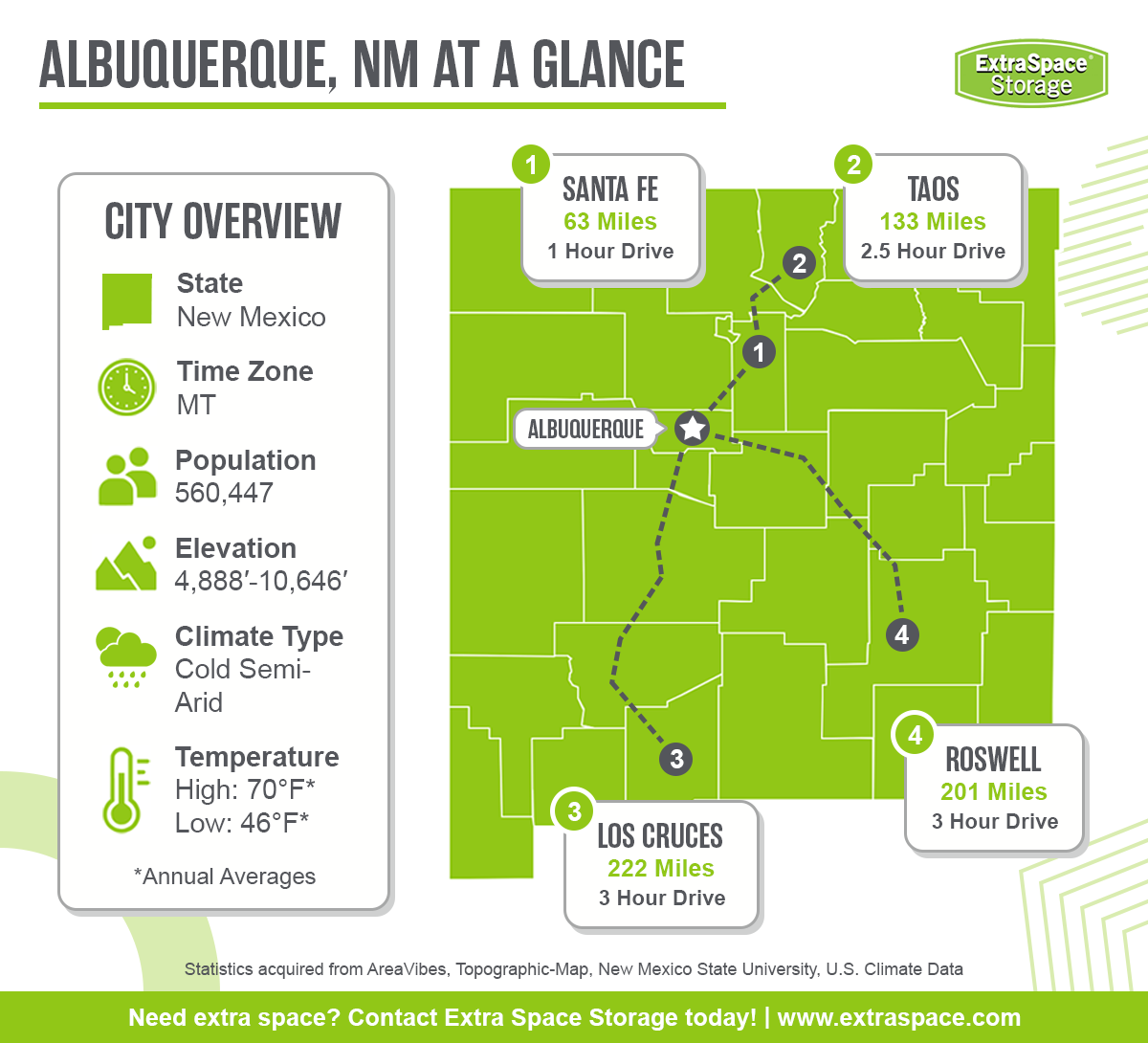
Albuquerque is located in the state of New Mexico and sits along the Rio Grande at the base of the Sandia Mountains. As the state’s largest city, ABQ serves as New Mexico’s main cultural and economic hub, and is about 60 miles southwest of Santa Fe, the state capital.
Is Albuquerque a good place to live?
While it has its pros and cons, Albuquerque is a great place to live, offering affordable living in a thriving metro with a gorgeous backdrop of the Sandia Mountains. This New Mexico city is particularly nice for families, retirees, young creatives, and outdoor recreation enthusiasts, as the year-round nice weather provides plenty of opportunities for something to do. And in the summer months, when it’s best to stay cool, ABQ offers plenty of indoor activities and events to keep you busy.
***
Moving to Albuquerque? Extra Space Storage has facilities located across the nation that can accommodate your important belongings while you make the transition. Rent Albuquerque self storage today!