Storage Tips
Self Storage vs. Warehouse Storage: Which Does Your Business Need?
Most businesses weighing self storage against a warehouse actually have three options for commercial storage—a traditional storage unit, a warehouse-style unit, and a traditional warehouse. In our guide below, Extra Space Storage discusses the average cost of traditional warehouse storage rent, factors that can impact pricing, and more!

Read Time: 7 min read
Summary: To choose the right commercial storage for your business, start by comparing three options: a traditional storage unit, a warehouse-style unit, and a traditional warehouse. Self storage units range from 5x5 to 10x30 and suit smaller inventory or equipment on flexible month-to-month terms. If you’ve outgrown a standard unit, consider warehouse-style units at select locations, which offer more space plus drive-up access and roll-up doors for pallets. A traditional warehouse fits high-volume operations that need forklifts and racking, but often requires a multi-year lease with NNN costs. Remember to weigh your space, commitment, and equipment needs before deciding.
Three Ways to Store Business Inventory
The best commercial storage option for your business will depend on factors like the amount of space you need, how long you need it, and what you plan to do with the space. See the table below to compare the three options.
Rent from Extra Space Storage | Traditional warehouse | |
Storage option | Traditional storage unit or warehouse-style unit | Traditional warehouse |
Typical size | Storage unit: Typically 5x5 to 10x30 or larger Warehouse-style: Larger units designed for business inventory and equipment | Often several thousand square feet or more |
Availability | Storage unit: Many Extra Space Storage locations Warehouse-style: Select Extra Space Storage locations | Commercial real estate listings and warehouse brokers. Not offered by Extra Space Storage |
How you get it | Reserve online or rent through the facility | Typically rented or leased through a broker or directly from the property owner |
Commitment | Flexible, month-to-month rental | Often requires a longer-term lease |
Pricing model | Monthly rent based on unit size, location, and features | Typically monthly rent based on square footage, location, lease terms, and property features |
Up-front costs | Usually first month’s rent and applicable fees | May include security deposit, first month’s rent, and other lease-related costs |
Common features | Climate control, drive-up access, first-floor access, indoor access, and elevator access | Loading docks or bays are common facility features at many traditional warehouse locations |
What Is Self Storage?
Self storage is a flexible storage option consisting of enclosed units from 5x5 up to 10x30, with varying features like drive-up storage and climate control at select locations.
What Is Warehouse-Style Storage?
Warehouse-style storage is a commercial space for businesses that need more room than what a standard storage unit can provide. Size, layout, lease terms, and availability vary by facility.
What Is Traditional Warehouse Storage?
Traditional warehouse storage is a commercial storage option that typically offers thousands of square feet of space, multi-year leases with NNN costs, facilities designed for forklifts, and on-site staff.
Which Storage Option Fits Your Business?
Most growing businesses need 200 to 1,000 square feet, drive-up access, and the flexibility to scale month to month—needs that self storage and warehouse-style units are built to handle. A traditional warehouse, on the other hand, is ideal for high-volume operations with racking, forklifts, and staff on-site—but it comes with trade-offs like a multi-year lease, NNN costs (property taxes, insurance, maintenance), and build-out expenses. Read our guide to compare the real costs, commitments, and capabilities of all three options, so you can pick the right fit for where your business is right now.
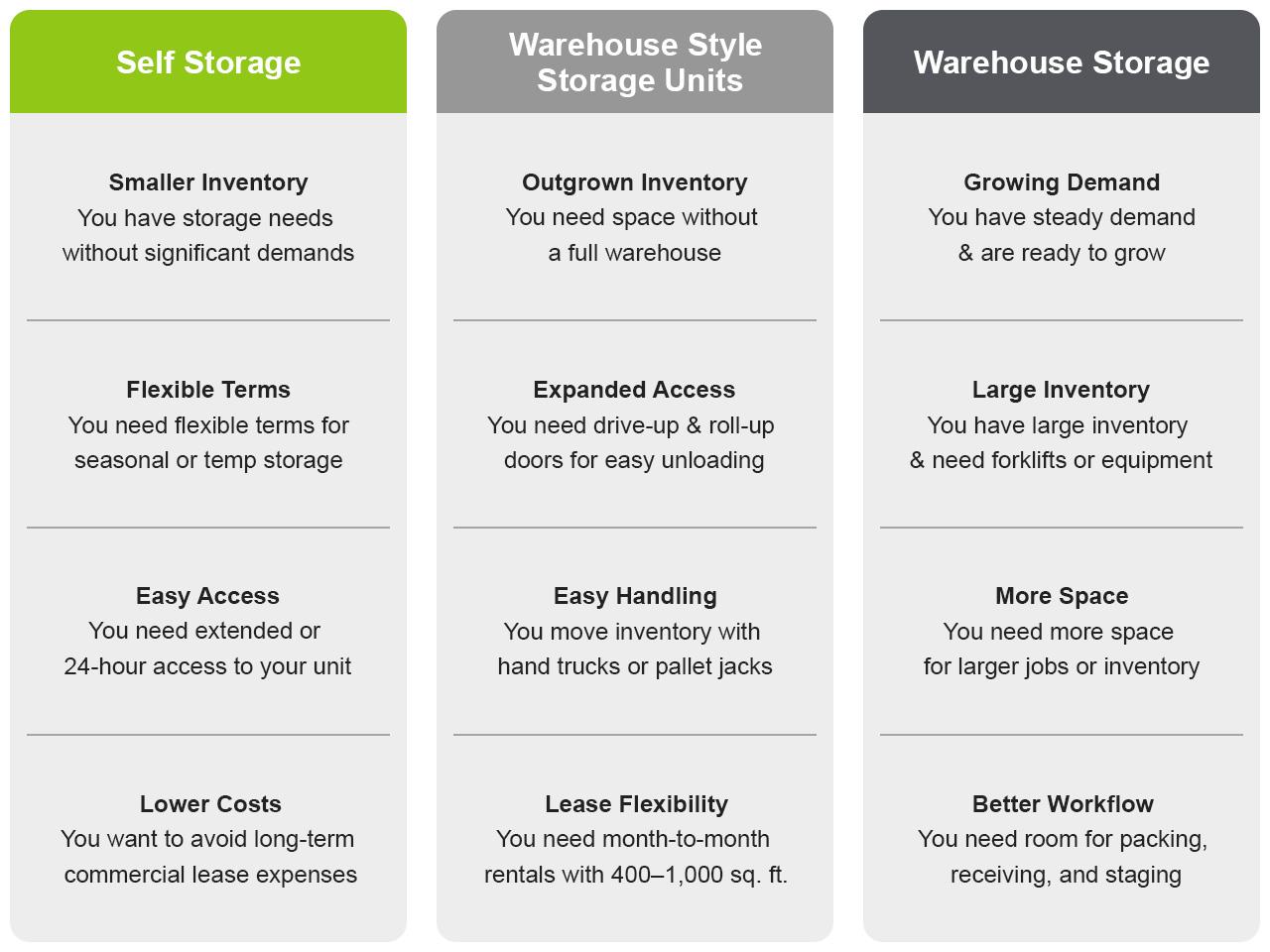
Self storage makes sense when:
You need a smaller storage space for inventory, equipment, or supplies.
Your storage needs don't require specialized loading equipment or warehouse infrastructure
You need flexible month-to-month terms that can scale with your buisness and want to avoid long-term commercial lease expenses
Warehouse-style storage units make sense when:
Your inventory has outgrown a standard unit, but you're not ready for the full-scale logistics of warehouse storage
You need drive-up access and roll-up doors to load and unload pallets or bulky equipment
You're moving inventory by hand truck or pallet jack rather than forklift
You still want month-to-month flexibility, just with more square footage (typically 400–1,000 sq ft)
Warehouse makes sense when:
You need significantly more space for high-volume inventory and operations that are too large for a storage facility to accommodate
You need warehouse infrastructure and equipment such as forklifts, racking, or dedicated loading areas to handle your large inventory
You don't have enough space to take on larger jobs or stock best-selling items
Your workflows are inefficient, and packing, receiving, or staging tools happens in a cramped, overlapping area
Your buisness has enough consistent volume to justify the higher costs and longer-term commitment of warehouse leases
Self Storage Costs vs. Warehouse Costs
Warehouse storage costs are affected by several factors like facility size, building age, clear height, operating expenses, and maintenance costs. The up-front number isn't always the final amount you'll end up paying for warehouse storage—a lease for warehouse space rarely fully details extra costs such as annual lease escalations, build-out costs, utilities, and commercial liability insurance. Combine these additional costs with the sticker price, and you'll see that over a 5-year contract term, your actual costs and what you expected to pay can vary greatly. Self storage—including warehouse-style self storage—works differently. A monthly rental model gives businesses a predictable figure to plan around, no matter the unit size. See the table below to compare warehouse leasing against monthly self storage rates.
Cost factor | Extra Space Storage (traditional or warehouse-style) | Warehouse lease |
Typical commitment | Month-to-month | 3–5 year lease |
Common up-front costs | First month, admin fee, insurance | Build-out, deposit, personal guarantee, insurance |
Pricing structure | Monthly storage unit rate | Annual rate per sq ft + NNN (taxes, insurance, maintenance) |
500 sq ft (illustrative example only) | Traditional unit: about $200–$500/month Warehouse-style unit: quoted by the facility | About $565/month total at $9.54/sq ft/yr base rate + $4/sq ft/yr in NNN expenses |
Five-year considerations | Predictable monthly costs | Rent escalations, build-out, utilities, insurance, NNN |
Rates shown are based on national averages and are provided for illustrative purposes only. Actual pricing varies by location, property, and other factors. Standard self storage and warehouse-style self storage follow the same monthly pricing model. Customers can generally expect warehouse-style rates to be higher given the larger square footage and features like drive-up storage.
Extra Space Storage has several commercial storage options that can accommodate your business needs, from small storage units to warehouse-style storage spaces.
View Standard Storage Unit Prices for Business Storage
From small units like 5x5 or 5x10 for simple inventory storage to larger 10x20 units for equipment or vehicle storage, view average and lowest prices for different business storage sizes near you. Prices for warehouse-style storage come directly from the facility.
Warehouse-Style Storage Units at Extra Space Storage
Extra Space Storage offers warehouse-style self storage units featuring roll-up doors and drive-up access. These features make it easy for businesses to load and unload pallets, inventory, and equipment by minimizing the distance items need to be carried. You can find warehouse-style self storage in select markets with high business storage demand, such as Texas, Florida, California, and Nevada. To find warehouse-style self storage near you, contact your nearest Extra Space Storage facility or call us directly—our team can check availability in your area. Because warehouse-style self storage requires more space than a standard facility, not all Extra Space Storage locations offer this unit type.
When to Upgrade Your Business Storage
Your business might begin by storing inventory in a room at home, like a garage, office, or spare bedroom. Many business owners seek off-site storage, when their inventory or equipment start overwhelming their space at home. With a variety of available sizes, a traditional self storage unit is a good next step. If your inventory keeps growing, a warehouse-style self storage unit offers more room to work with and offers features like drive-up access and roll-up doors that make it easier to load and unload pallets or bulky equipment with a hand truck.
When You Need a Traditional Warehouse
Since Extra Space Storage doesn't directly offer true full-scale warehouses, there could come a point when you'll outgrow our facilities—until that time, we're happy to continue accommodating your business storage needs. When you're ready to find a true, full-service warehouse space, work with a commercial real estate broker to find a solution that suits your inventory volume, pallet count, and staffing needs. Warehouses also often offer added benefits like the ability to store items typically not allowed in storage units—like shelf-stable food, plants, and aerosols.
Frequently Asked Questions About Self Storage Vs. Warehouses
Warehouse storage vs self storage—what's the difference?
Warehouse storage spaces usually involve multi-year contracts and are ideal for large-scale operations dealing with bulk inventory and commercial shipping, whereas self storage units are a more flexible month-to-month storage option meant for small business overflow and personal use. Warehouse-style units is a commercial space for businesses that is typically larger than a standard unit, but keep in mind that size, layout, lease terms, and availability vary by facility.
Is warehouse-style storage the same as warehouse storage?
No, warehouse-style storage is not the same as a traditional warehouse. Although both provide space for business inventory and large items that may not fit in a standard self-storage unit, there are several key differences. Warehouse-style storage units typically offer more flexible rental agreements, while traditional warehouses often require long-term leases. The level of service and amenities can also vary depending on the storage facility or warehouse.
How much warehouse space do I need?
The amount of space your business needs will depend on your inventory, equipment, and how you use the space. Smaller businesses may only need a standard self-storage unit, while businesses with larger inventories or equipment may benefit from warehouse-style storage. A traditional warehouse may be a better fit for businesses that need extensive operational space, loading areas, or room for employees and equipment. Read our small warehouse size guide for more details on how much space different businesses might require.
How much does warehouse-style storage cost?
Warehouse storage typically costs as low as $200 for 500 sq ft and up to $800 for more sq ft or more in expensive markets.
Tips & Resources for Business Storage
Business Storage
See the full range of business storage solutions, from documents and inventory to equipment and vehicles.
Business Document Storage
Find helpful tips for organizing and storing your business documents safely in self storage.
Business Inventory Storage
Free up space at your office or retail location by storing overflow inventory, supplies, and stock.
Storage for Contractors
Storage tips and unit recommendations for contractors, builders, and tradespeople.
Business Vehicle Storage
Explore indoor, covered, and outdoor options for parking work trucks and company vehicles.
Equipment Storage
See what business equipment you can store, the unit sizes to consider, and storage solutions that fit your needs.
How to Insure Your Belongings
Sign up for storage insurance to protect the value of your belongings from the unexpected.
Find Cheap Storage Units Near You
Compare rates near you and find an affordable option that fits your business budget.
Find Business Storage Near You
Extra Space Storage has several commercial storage options that can accommodate your business needs, from small storage units to warehouse-style storage spaces.