

Durham is one of the best places to live in North Carolina and a great U.S. city for veterans and retired military. Residents of all kinds flock to Durham for its friendly community, great jobs, and ample outdoor recreation—though some aren’t as fond of Bull City’s humid weather and rising housing costs. Before officially deciding to move, learn more about the pros and cons of living in Durham, NC below!
Quick Facts About Durham
| Population | 285,434 |
| Average Home Price | $554,139 |
| Average Monthly Rent | $1,734 |
| Unemployment Rate | 3.4% |
| Median Household Income | $92,427 |
Statistics from AreaVibes & Council for Community and Economic Research (C2ER)
Pros of Living in Durham
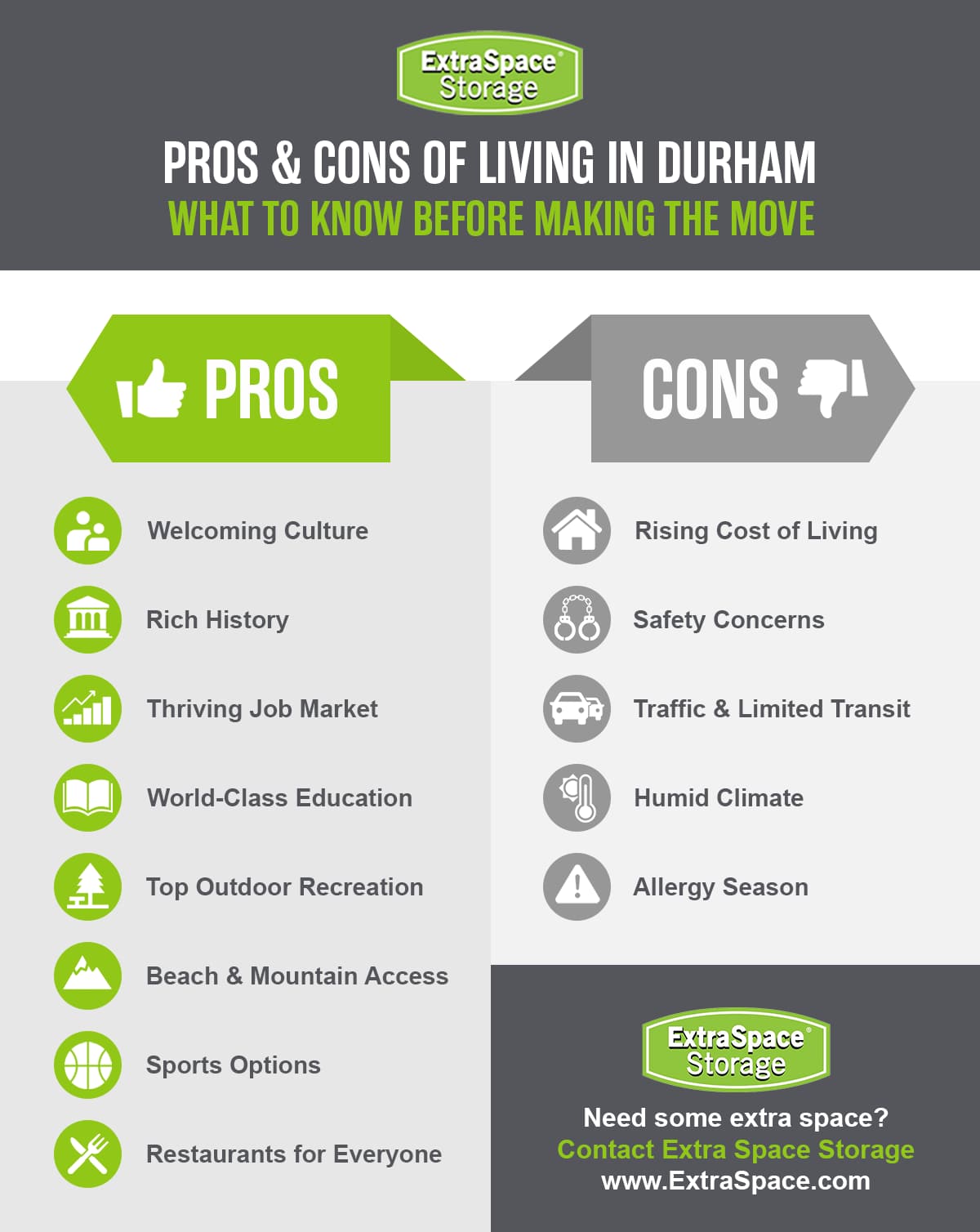
Some of the benefits of living in Durham include a great job market, proximity to outdoor recreation, and a diverse food scene. Check out these other top reasons to move to Durham!
Pro: Welcoming Bull City Culture
With a near-perfect score on the Municipal Equality Index, Durham is widely recognized as a progressive and welcoming place to call home. Residents describe a community that is kind, resilient, and creative, where neighbors value connection and readily extend warmth and support to newcomers and longtime residents alike. The city is also home to thriving LGBTQ and arts communities, along with a diverse food and beverage scene shaped by cultures from around the world. Together, these qualities contribute to a vibrant, inclusive atmosphere that makes Durham an inviting place to live.
Pro: Rich Durham History
Durham has a rich history that appeals to history enthusiasts and curious newcomers alike. Thought to be the site of Adshusheer, an ancient Native American village, the area was shaped by Eno and Occaneechi peoples along the The Great Indian Trading Path. Later, the rise of bright leaf tobacco transformed Durham into a major industrial center, giving rise to influential companies and the iconic “Bull Durham” tobacco brand that inspired the city’s nickname, “Bull City.” Durham also holds an important place in African American history, as Parrish Street emerged in the late 1800s and early 1900s as a thriving hub of Black entrepreneurship—earning the nickname “Black Wall Street.”
Pro: Strong Job Market in Durham
Job seekers are in luck in Durham. The city’s career landscape is anchored by Research Triangle Park (RTP), the largest research park in the country—home to more than 300 companies across industries like technology, science, agriculture, and more. Major employers like Cisco, IBM, and Pfizer maintain a significant presence in RTP, creating a wealth of opportunities for young professionals. Job seekers can also pursue employment with leading healthcare companies like Viiv Healthcare and G1 Therapeutics, as well as prominent government agencies and research institutes such as the National Institute of Environmental Health Sciences (NIEHS) and the U.S. Environmental Protection Agency (EPA).
Pro: World-Class Education
Bull City offers top-notch higher education opportunities. One of Durham’s biggest draws is Duke University, a prestigious institution consistently ranked among the nation’s top universities. Duke offers world-class undergraduate, graduate, professional, and research programs, including highly regarded medical and law schools.
While Duke is a major educational hub for the city, it’s far from the only option for higher learning. Other great colleges and universities in Durham include North Carolina Central University, a public historically Black university, as well as Durham Technical Community College, which provides accessible pathways to career training, professional certifications, and degree programs.
Pro: Top Opportunities for Outdoor Recreation in Durham
With a relatively mild climate, it’s easy for Durham residents to enjoy the outdoors all year round. Summer temperatures typically peak around 89 degrees, while winter lows average around 30 degrees. Though Bull City does see occasional snowfall, accumulations are generally light, allowing residents to take advantage of outdoor recreation every season. Popular outdoor destinations include:
- Eno River State Park for hiking, camping, & exploring the scenic Eno River
- Sarah P. Duke Gardens to wander thorugh a 55-acre botanical garden on Duke University’s campus
- Lake Michie Park for boating & largemouth bass fishing just 30 minutes north of downtown
- Little River Park for fishing, boating, or simply enjoying a peaceful getaway just outside the city
- North/South Greenway to explore a paved trail system—including routes like Warren Creek Trail & Stadium Drive Trail—spanning roughly five miles across Durham
Pro: Easy Access to Nearby Beaches & Mountains
Durham’s unique location places residents within easy reach of both the Atlantic Coast and some of North Carolina’s most scenic mountain destinations. Whether you enjoy hiking, camping, fishing, surfing, or simply spending time in nature, the city’s proximity to major highways—including I-85, I-885, and I-40—make it easy to plan a day trip or weekend getaway. Great spots nearby include:
- 20-minute drive: Occoneechee Mountain State Natural Area to hike a steep three-mile trail for beautiful river views
- 1.5-hour drive: Hanging Rock State Park for camping & hiking among mountains & waterfalls
- 1.5-hour drive: Pilot Mountain State Park for rock climbing, horseback riding, & hikes to the iconic mountain peak
- 2.5-hour drive: Wrightsville Beach for swimming, surfing, & coastal fun near Durham
- 3-hour drive: Carolina Beach for a family-friendly beach with a classic boardwalk & fun amusement rides
- 3-hour drive: Kure Beach for a quieter beach escape with a relaxed atmosphere & fishing piers
- 3-hour drive: Topsail Island for leisurely walks on the beach & a laid-back vibe
Pro: Great Sports Scene
Sports fans living in Durham have no shortage of teams to root for. The city is perhaps best known for Duke University athletics—particularly the basketball program, which has become one of the most widely recognized in college sports. The excitement surrounding Duke athletics helps create a strong sports culture throughout Durham. Some of the best teams to rally behind in this sports city include:
- Durham Bulls (MiLB) at Durham Bulls Athletic Park
- Carolina Blaze (AUSL) at Smith Family Stadium
- Duke Blue Devils (NCAA D-I) basketball at Cameron Indoor Stadium
- NCCU Eagles (NCAA D-I) football at O’Kelly-Riddick Stadium
Pro: There’s a Durham Restaurant for Everyone
Durham is a standout destination for food lovers, offering a diverse and multicultural dining scene with options ranging from casual neighborhood spots to upscale restaurants. Here are some of the best restaurants in Durham to check out:
- Guglhupf Bakery & Restaurant, a German cafe known for its baked goods, hearty brunch offerings, & delicious drinks
- It’s a Southern Thing, a local favorite serving scratch-made Southern comfort foods
- Little Bull, a cozy, tapas-style restaurant offering creative small plates influenced by Mexican & American culinary traditions
- Lakewood Social, a laid-back spot featuring elevated bar fare, beers on tap, & outdoor seating areas
- Queeny’s, a retro-inspired diner & lively late-night spot serving beer, wine, & cocktails
Get Everything You Need For An Easier Move to Durham
Cons of Living in Durham
Downsides of living in Durham include the rising cost of living, summer humidity, and high pollen counts. Learn more about potential disadvantages of living in Durham below.
Con: Rising Cost of Living in Durham
Durham’s steady population growth—about 1.56% per year—has contributed to a rising cost of living in the area. Housing costs, in particular, tend to be higher than in nearby cities like Charlotte and Raleigh, running roughly 5% above the North Carolina average and slightly above the national average. Healthcare expenses are also about 7% higher than the state average. That said, residents can find some relief in other areas of daily spending—utility costs, for example, are generally lower than both state and national averages.
Con: High Durham Crime Rates
Crime rates in Durham are relatively high, with the city ranking safer than only about 16% of North Carolina cities and a smaller share of communities nationwide. It’s worth noting, however, that Durham’s crime levels are generally on par with those in nearby metros like Greensboro and Charlotte. The City of Durham has also implemented a range of public safety initiatives, including Partners Against Crime and the Summit on Saving Lives, aimed at reducing violence and strengthening community safety. Crime levels also vary significantly by neighborhood, meaning there are still plenty of safe areas to live in Durham—including Fairfield, Hope Valley Green, Spring Valley, and more.
Con: Heavy Traffic & Limited Public Transit
As Durham’s population has increased, so has traffic congestion. During peak rush hours, major corridors like I-40, I-85, and downtown routes often experience frequent backups and delays. Public transportation options are also relatively limited, primarily served by the GoDurham bus system. However, the City of Durham does provide shared micromobility programs, giving residents access to e-bikes and scooters. Additionally, several neighborhoods—like Duke University-East Campus, Walltown, and Burch Avenue—are particularly walkable, offering residents other convenient ways to get around.
Con: Durham Humidity
In contrast to Bull City’s generally mild winters, summers in Durham can bring hot, humid weather, with humidity levels peaking in mid-July. When combined with temperatures in the upper 80s and low 90s, the heat index can make it feel significantly hotter—sometimes into the triple digits—and lead to uncomfortable conditions for extended outdoor activities during the hottest parts of the day.
That said, many residents find that the climate becomes easier to adapt to over time. Early mornings and evenings often remain pleasant for outdoor activities, and the city’s abundance of shaded parks and nearby waterways offer natural relief during the warmer months. Air-conditioned public spaces and pools also help balance out the summer heat.
Con: Allergy Season in Durham
Durham’s humid climate and dense tree canopy contribute to elevated pollen levels, especially during the spring and summer months. As a result, pollen allergies in the Triangle area have worsened over time, and Durham has become one of the worst cities in the U.S. for pollen allergies.
However, it’s possible to manage these conditions with simple precautions. Monitoring daily pollen forecasts, limiting time outdoors during high-count periods, and immediately changing clothes after being outside can significantly reduce exposure and make allergy season more manageable.
Should You Move to Durham?
You should move to Durham if you’re looking for a friendly city with ample job opportunities, diverse cuisine, and a variety of outdoor recreation close to home. However, it’s important to consider your transportation needs, health, climate preferences, and general lifestyle before deciding to relocate, as Durham residents face limited transit options, seasonal allergies, and hot, humid summers.
Durham may be the right fit for you if…
- You’re looking for jobs in tech, science, or healthcare in a nationally recognized employment hub.
- You’re an outdoor enthusiast who wants easy access to a wide range of landscapes, including mountains and beaches.
- You want to live in a foodie city with restaurant options spanning a variety of cultures and price points.
- You value living in a city with rich historical significance.
- You enjoy getting to know your neighbors and want to live in an inclusive, welcoming community.
You may want to consider moving to another city if…
- You suffer from severe pollen allergies.
- You prefer commuting by train or other public transit.
- You’re seeking affordable housing with large floor plans.
- You’re uncomfortable with hot, humid summers.
- You’d like to live in a city known for its safety.
Durham Compared to Nearby Cities
Wondering if Durham is better than Raleigh, Charlotte, or Asheville? Consider the following fast facts for help figuring out which North Carolina city is right for you.
| Factor | Durham, NC | Raleigh, NC | Charlotte, NC | Asheville, NC |
| Average Monthly Rent Price | $1,704 | $1,449 | $1,573 |
$1,633
|
| Average Home Price | $554,139 | $451,230 | $401,923 |
$642,883
|
| Average Commute Time | 23 minutes | 24 minutes | 25 minutes | 17 minutes |
| Walk Score | 30/100 | 31/100 | 26/100 | 37/100 |
| Unemployment Rate | 3.4% | 4.2% | 4.7% |
2.5%
|
| Major Industries | Technology, science, healthcare | Technology, science, education | Finance, energy, manufacturing | Healthcare, hospitality, education |
Statistics from Council for Community and Economic Research (C2ER), Best Places, Walk Score, & AreaVibes
Frequently Asked Questions About Moving to Durham
What is a livable salary in Durham, NC?
A single adult with no children needs to make just over $50,000 a year to live comfortably in Durham. For a household with two working adults and one child, a livable income rises to about $98,681 annually.
Is Durham safe?
While crime rates in Durham are slightly higher than the state and national averages, the city remains a relatively safe place to live. Crime rates also vary significantly by neighborhood—particularly safe areas to live in Durham include Fairfield, Hope Valley Green, and more.
Does it snow in Durham, NC?
Durham has a relatively mild climate, receiving only about four inches of snow per year on average. Winter temperatures rarely dip below 30 degrees, so when snowfall does occur, it generally doesn’t accumulate for long. The snowiest month in Durham is usually January.
How far is Durham from Raleigh?
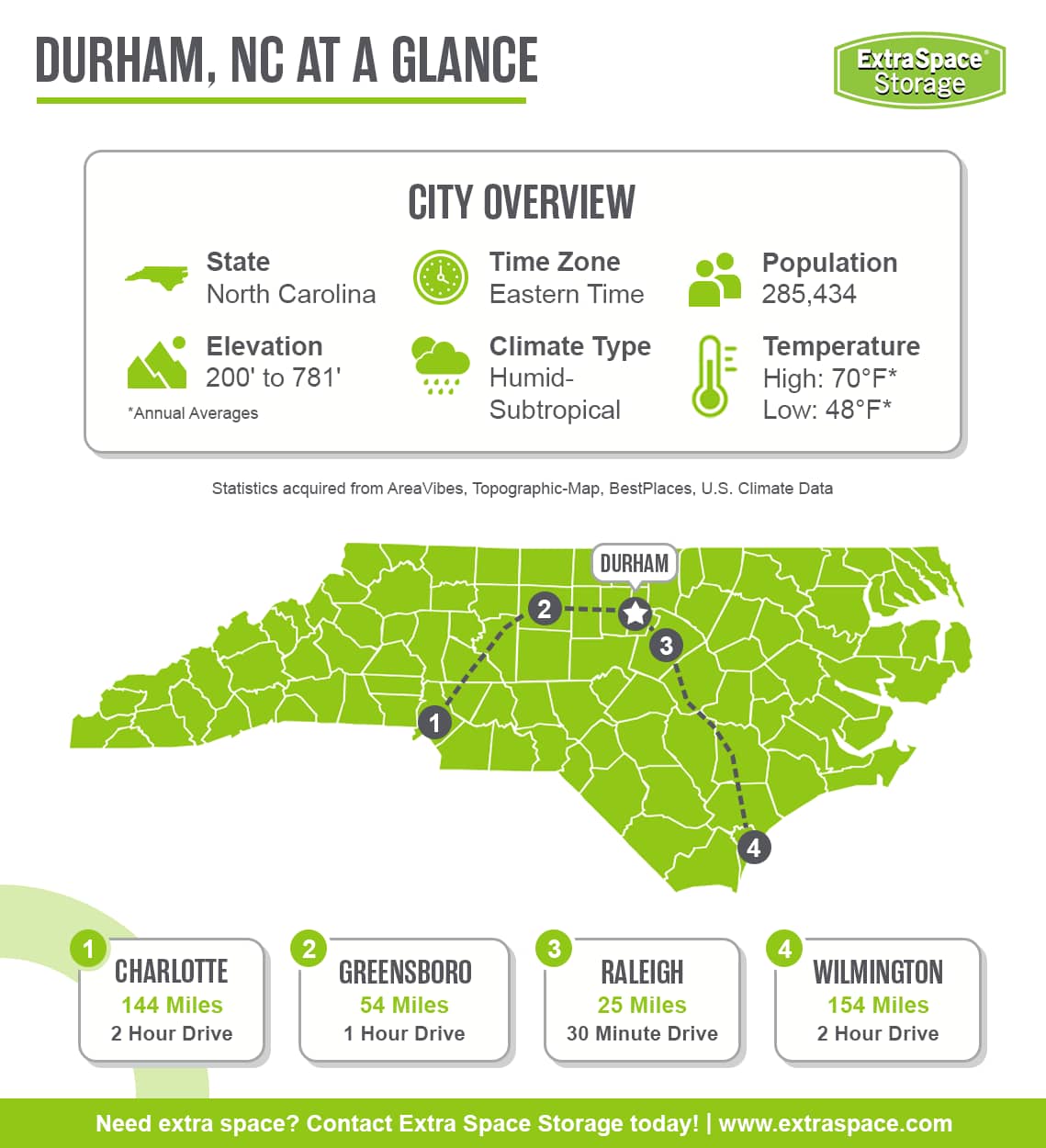
The distance from Durham to Raleigh is about 25 miles by car, with a typical drive time of 30 to 45 minutes. The two cities are also connected by regional transit options, including bus and rail, with travel times generally ranging from 45 to 60 minutes depending on time of day.
Is Durham a good place to live?
Durham is a great place to live for outdoor enthusiasts, young professionals, and those seeking a vibrant city with a welcoming, community-oriented feel. It offers strong job opportunities, cultural diversity, and easy access to both urban amenities and nearby natural landscapes. While the city does experience humid summers and high pollen counts, many residents find the overall quality of life makes living in Durham worthwhile.
***
Moving to Durham? Extra Space Storage has conveniently located storage facilities across Bull City to help with your transition. Rent Durham self storage today!