

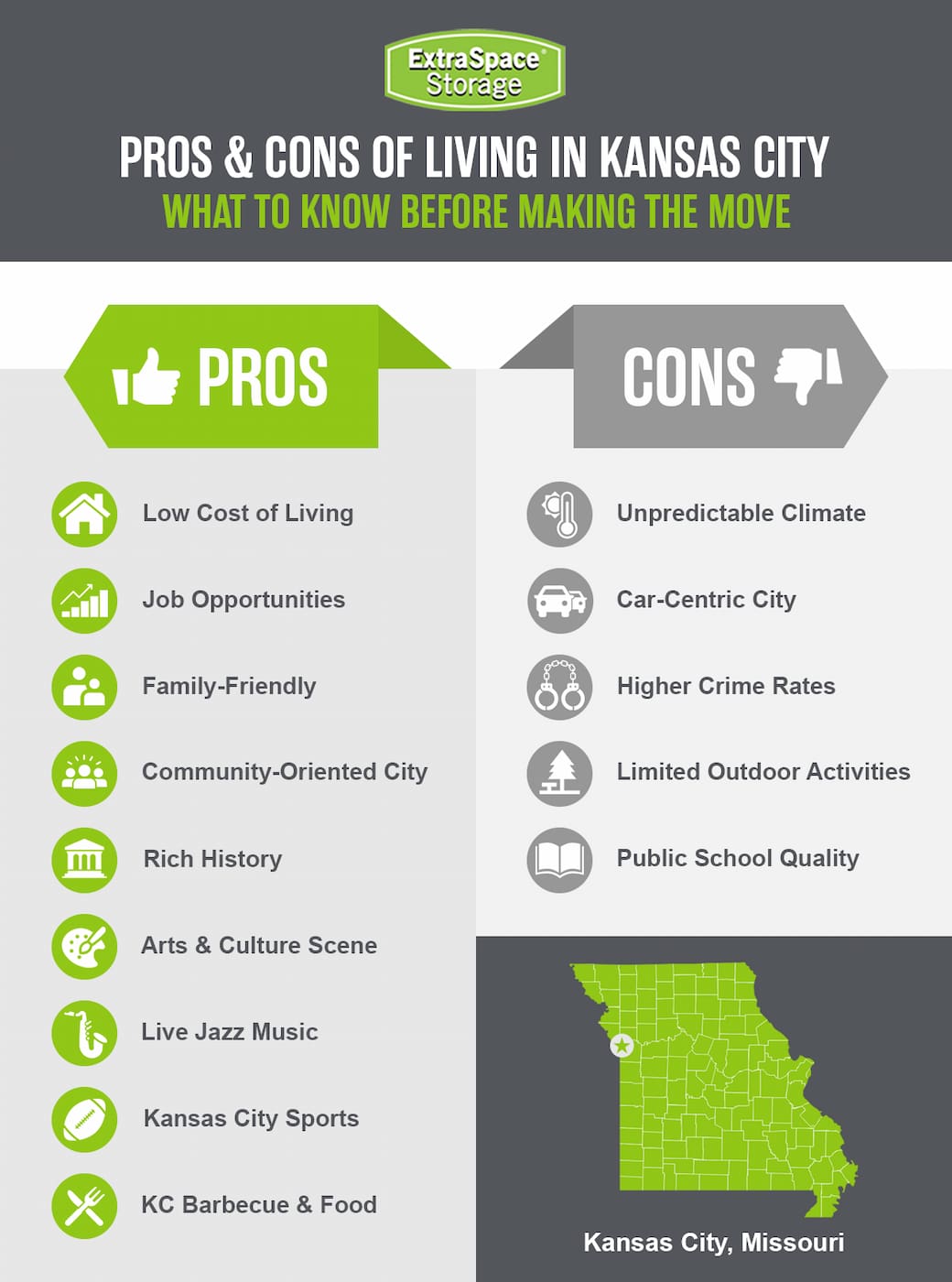
Kansas City, MO is a top Midwestern City to live in! Residents like that living in KCMO gives them access to great local food and museums—but there are some downsides, like limited public transit and outdoor recreation. Here are 14 things people like or dislike about living in Kansas City!
Quick Facts About Kansas City
| Population | 491,158 |
| Average Home Price | $434,284 |
| Average Monthly Rent | $1,512 |
| Average Days of Sunshine | 205 days |
| Unemployment Rate | 3.4% |
Statistics from AreaVibes, Council for Community and Economic Research (C2ER), & BestPlaces
Pros of Living in Kansas City
Kansas City is a great place to live due to its abundant job opportunities and access to amazing BBQ places. Continue reading for more benefits of living in Kansas City!
Pro: Low Cost of Living
The State of Missouri has the sixth-lowest cost of living in the U.S., giving KC residents an advantage! The cost of living in Kansas City is 11% lower than the national average due to factors like lower-cost healthcare, housing, and groceries. The city also has plenty of affordable Kansas City neighborhoods that don’t make you compromise on safety. Especially compared to other metro areas like Chicago, Minneapolis, and Denver, Kansas City offers big-city living with a smaller price tag, allowing residents to spend more on the fun parts of living in KCMO—like its entertainment, shopping areas, and vibrant nightlife.
Pro: Job Opportunities Galore
Kansas City is a great place for singles and young professionals looking to jumpstart or further their careers—especially because you have access to jobs on both the Missouri and Kansas side! The top job industries in Kansas City are in financial services, healthcare, manufacturing, and more. If you want to go into corporate life, look into jobs with Netrality Data Centers, Mid-America Regional Council, or the Finance Shared Service Center. Find a job in the healthcare sector with top area hospitals like Saint Luke’s Health System, HCA Midwest, and Children’s Mercy. Check out KC manufacturing positions with companies like Nautical Manufacturing & Fulfillment, Lenexa Manufacturing Company, or Harlan Global. If those industries aren’t for you, Kansas City is also home to big names like Garmin International, American Century Investments, Hallmark, and more!
Pro: KCMO Is Family-Friendly
KC is already home to many young families, partially due to the presence of great neighborhoods. When you want to get out of the house, there are so many family-friendly things to do in Kansas City:
- Spark creativity with hands-on art experiences at Hallmark Kaleidoscope.
- Explore the world of play and imagination through indoor or outdoor interactive exhibits and learning spaces at the Wonderscope Children’s Museum of Kansas City.
- See the world at a smaller scale at The National Museum of Toys and Miniatures.
- Explore science experiments, seasonal attractions, and exhibits like Titanic: An Immersive Voyage at Union Station.
- Pet farm animals, explore nature trails, fish, and learn about living on a farm at Overland Park’s Deanna Rose Children’s Farmstead.
- Let your imagination wander at LEGOLAND Kansas City, where you can build your own fun or experience entertainment surrounding your favorite building block toys!
- See what life can be like under the sea and get up close with marine creatures at the touch pool at SEA LIFE Kansas City Aquarium.
- Test your courage on rollercoasters and fun rides at Worlds of Fun—or take time to cool off from the heat on water slides, in the wave pool, or in the lazy river at Oceans of Fun.
Pro: Community-Oriented City
Many large nonprofits give back to the community, and there are plenty of events and festivals focused on bringing residents together. Here are some ways Kansas City joins together for good:
- Greater Kansas City Community Foundation helps people start charitable giving through donor-advised funds, and has given more than $9 billion in grants since its opening in 1978.
- St. Luke’s Hospital of Kansas City collaborates with community organizations, allows employees a paid day to volunteer somewhere in the community, and partners with the Boys and Girls Clubs of Greater Kansas City.
- KC Pride Festival celebrates inclusion and belonging, bringing people across the city together to support the LGBTQ community.
- Parade of Hearts turns the city into a shared outdoor art gallery for people to take pride in their neighborhood and city.
- Big Slick raises funds for Children’s Mercy Hospital by rallying celebrities and locals through fun and comedy.
- Kansas City St. Patrick’s Day Parade brings thousands of people together to celebrate the city’s strong Irish heritage.
Pro: Home to Rich History
History buffs will love Kansas City, as it’s packed with tons of opportunities to learn about the past. Become the ultimate historian by visiting these Kansas City museums and landmarks:
- National WWI Museum and Memorial to see artifacts & learn stories from every nation’s perspective
- Negro Leagues Baseball Museum celebrates & teaches about African-American baseball
- Shoal Creek Living History Museum takes you back in time to 19th-century life through buildings, characters, & demonstrations
- 1855 Harris-Kearney Historical House Museum offers museums of a preserved historical home in KC
- National Archives at Kansas City features historical records for Brown v. Board of Education, the first Walt Disney company bankruptcy file, the Treaty at the Ponca Agency, & more
Pro: Kansas City Is Artsy
The Kansas City arts scene offers up plenty of museums, performing arts venues, and a creative district. Some highlights of KCMO’s artistic side include:
- World-class collections—ranging from ancient artifacts to sculptures out on the lawn—at the Nelson-Atkins Museum
- Masterpieces from a range of mediums like photography, pottery, film, & more at the Kemper Museum of Contemporary Art
- Breathtaking performances from the Kansas City Symphony, the Kansas City Ballet, the Lyric Opera of Kansas City, & various Broadway tours at the Kauffman Center for the Performing Arts
- Galleries, visits with local artists, & live music during First Friday in the Crossroads Arts District each month
- Plenty of Kansas City murals and sculptures throughout the city’s streets and on buildings
Pro: Live Jazz Is Easy to Find
Kansas City has a strong jazz tradition. From exploring jazz’s rich history to enjoying live concerts, you can enjoy this music in a variety of different ways throughout the city:
- The live Jazz calendar is updated by locals & provides information on daily jazz performances
- The American Jazz Museum offers exhibits about jazz legends & hosts live shows through their music venue, the Blue Room
- Support & snap to original compositions from jazz musicians at the Green Lady Lounge
- Lonnie’s Reno Club offers fine-dining set to jazz
- Black Dolphin features a cocktail menu & snacks at their live jazz shows
Pro: Easy Access to Kansas City Sports
If you’re a big sports fan, then KC is the place for you. Kansas City sports teams are plentiful, so you can likely find a game at any time of year. Check out these Kansas City teams:
- Kansas City Chiefs (NFL) at GEHA Field at Arrowhead Stadium
- Kansas City Royals (MLB) at Kauffman Stadium
- Sporting Kansas City (MLS) at Sporting Park
- Kansas City Current (NWSL) at CPKC Stadium
- Kansas City Mavericks (ECHL) at Cable Dahmer Arena
- Kansas City Comets (MASL) at Cable Dahmer Arena
- Kansas City Monarchs (American Association of Professional Baseball) at Legends Field
Pro: Kansas City Has a Hot Barbecue Scene
Kansas City is one of the best places for barbecue in the U.S.! With a near-infinite amount of options, it can be hard to choose where to get your barbecue fix—but you can’t go wrong with these, which are some of the best BBQ restaurants in Kansas City:
- Joe’s Kansas City Bar-B-Que for award-winning barbecue
- Q39 for a fresh perspective on KC barbecue
- Char Bar for enjoying delicious eats with friends in an outdoor beer garden
- Slap’s BBQ for classic barbecue items like sandwiches, ribs, plates, & so much more
- Jack Stack Barbecue for classic hickory wood-smoked barbecue
Get Everything You Need For An Easier Move to Kansas City

Cons of Living in Kansas City
While there’s a lot to love, there are disadvantages to living in Kansas City, like cold weather and a lack of options for public transit. Here are five cons of living in Kansas City.
Con: The Kansas City Climate Can Be Extreme
The weather in KC is a humid continental climate, causing seasonal temperature fluctuations—which isn’t ideal for folks wanting warmth all year long. Residents experience freezing temperatures and dryness in the winter, with low temperatures averaging in the 20s and producing about 15 inches of snow. Summers in KC mean high humidity, high temperatures in the 80s and 90s, and the potential for severe thunderstorms and occasional tornadoes. Luckily, there are plenty of indoor activities available throughout the year to help ride out seasonal weather extremes.
Con: You’ll Need a Car
A common complaint from residents is that Kansas City’s public transportation system is lacking—which exacerbates the city’s urban sprawl problem. Part of urban sprawl means the city is also not as walkable since the city metro grows outward, rather than up—making some people increasingly located farther from important amenities. Though the city has the RideKC bus system, getting somewhere with public transit can take a long time. While this may be discouraging, those with a car can get around with ease, with the average commute in Kansas City being about 22 minutes, nearly five minutes less than the national average. Kansas City has also worked on improving public transit with the addition of the RideKC Streetcar—which runs from River Market to UMKC with stops in-between.
Con: The Crime Rate in Kansas City Is High
The crime rate of Kansas City is 194% higher than the national average. This concerns most folks when they consider moving to Kansas City, but not every neighborhood has high crime. Some Kansas City neighborhoods are safer than others, like Lea Manor, Volker, and Waldo, plus you won’t need to go over budget to be safe in your neighborhood. Additionally, government and community officials are combating the high crime rate with their KC United for Public Safety plan, based on a neighboring city in which violent crime went down by 70%.
Con: Limited Kansas City Outdoor Activities
As part of the Great Plains, KC doesn’t offer ocean or Great Lakes access, or even buttes and mountains. While the metro lacks many outdoor spectacles, it still has plenty to offer in the way of outdoor recreation:
- Head to Cave Spring Park, where you can explore winding trails, have a picnic, and explore the ruins of people who once lived there.
- Smithville Lake is less than an hour’s drive away to camping, fishing, hiking, horseback-riding, and more.
- The Overland Park Arboretum & Botanical Gardens offers visitors 1,700 species of plants to admire.
- Make your way over to Swope Park—where you can go on a walk and find different artworks, work with your green thumb at the Kansas City Community Gardens, and even play golf at Heart of America Golf Course or Swope Memorial Golf Course.
Con: KCMO’s Public Schools Have Room for Improvement
The quality of Kansas City public schools varies a lot, as the schools tend not to be well-funded. However, that doesn’t mean your kids can’t get a good education. There are plenty of great Kansas City private schools or top public school districts in the suburbs, including Lee’s Summit R-VII School District, Blue Springs R-IV School District, Liberty School District, and more. Additionally, KCMO offers access to great higher education options within city limits, including the University of Missouri – Kansas City, Rockhurst University, and Metropolitan Community College – Kansas City.
Should You Move to Kansas City?
Yes, you should move to Kansas City if you’re looking for a city with family-friendly fun, a low cost of living, and first-rate barbecue. But Kansas City may not be the right choice for everyone, especially if you’re hoping for a highly walkable city with a predictable climate. To help you decide whether Kansas City is for you or not, consider these scenarios.
Kansas City may be the right fit for you if…
- You want to raise a family.
- You’re looking for an artsy Midwest city to call home.
- You want to live somewhere with strong community ties.
- You love barbecue.
- You want a variety of sports teams to root for.
You may want to consider moving to another city if…
- You want to live somewhere without weather extremes.
- You want access to lots of public transit.
- You’re worried about crime rates.
- You want great public school options.
- You hope for plenty of job opportunities.
Kansas City Compared to Other Nearby Cities
If you’re wondering if Kansas City is better than St. Louis or other regional metros like Omaha and Denver, comparing key data points can help you decide! Check out the average rent, home price, commute time, and more.
| Factor | Kansas City, MO | St. Louis, MO | Omaha, NE | Denver, CO |
| Average Monthly Rent | $1,512 | $1,216 | $1,578 | $1,883 |
| Average Home Price | $434,284 | $424,572 | $383,664 | $659,481 |
| Average Commute Time | 22 minutes | 24 minutes | 19 minutes | 25 minutes |
| Walk Score | 35/100 | 66/100 | 48/100 | 61/100 |
| Unemployment Rate | 3.4% | 3.9% | 3.1% | 3.1% |
| Major Industries | Distribution & logistics, advanced manufacturing, technology | Advanced manufacturing, bioscience, financial services | Finance, insurance, healthcare | Aerospace & aviation, bioscience, healthcare & wellness |
Statistics from Council for Community and Economic Research (C2ER), BestPlaces, Walk Score, & AreaVibes
Frequently Asked Questions About Moving to Kansas City
What salary lets you live comfortably in Kansas City?
For one adult with no dependents, a comfortable salary in Kansas City before taxes is $47,317. For two working adults with one dependent, a comfortable household income is $92,411. Ultimately, what’s considered a comfortable living wage in Kansas City depends on lifestyle factors, family size, and more.
Does Kansas City have a high crime rate?
Like any densely populated area, Kansas City has a higher crime rate due to a larger number of people in a confined space. To combat the crime rate in the areas most affected, the city has committed $2 million to a violence prevention initiative.
How cold does Kansas City get?
The temperature in Kansas City gets down to a low of 20 degrees—not accounting for windchill—with November through February being the coldest months. December brings in the most snow, with an average of 15 inches per year.
What’s the distance from Kansas City to St. Louis?
As Missouri cities, the distance from Kansas City to St. Louis is around 250 miles. This is a:
- 4 to 5-hour drive by car
- 4 to 5-hour & 20-minute bus ride via a one-way Greyhound ride
- 5-hour & 40-minute train ride via the Missouri River Runner Train (including stops along the route)
Is Kansas City a good place to live?
Yes, Kansas City is a good place to live, especially for families and students! The city offers numerous amenities and attractive neighborhoods, along with a low cost of living.
***
Committed to moving to Kansas City? Get a storage unit from Extra Space Storage to help manage your household belongings while you move. Find a storage facility near you!