
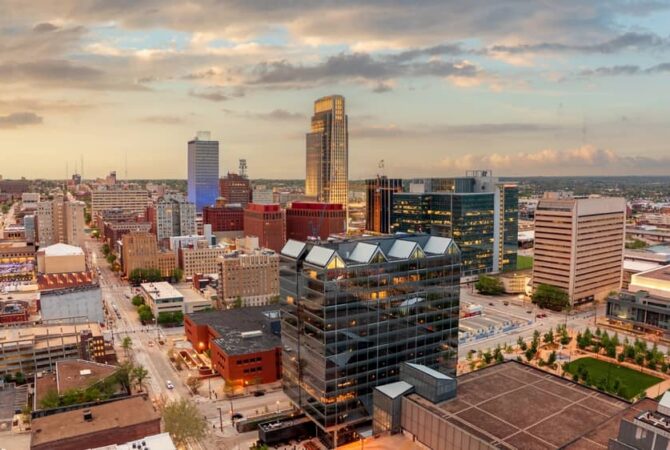
Omaha is a great place to live! This Nebraskan city is among the best places to live in the Midwest and the best mid-size cities to live in—but many residents dislike its traffic and weather extremes. Here are 18 pros and cons to tell you what people like and don’t like about living in Omaha!
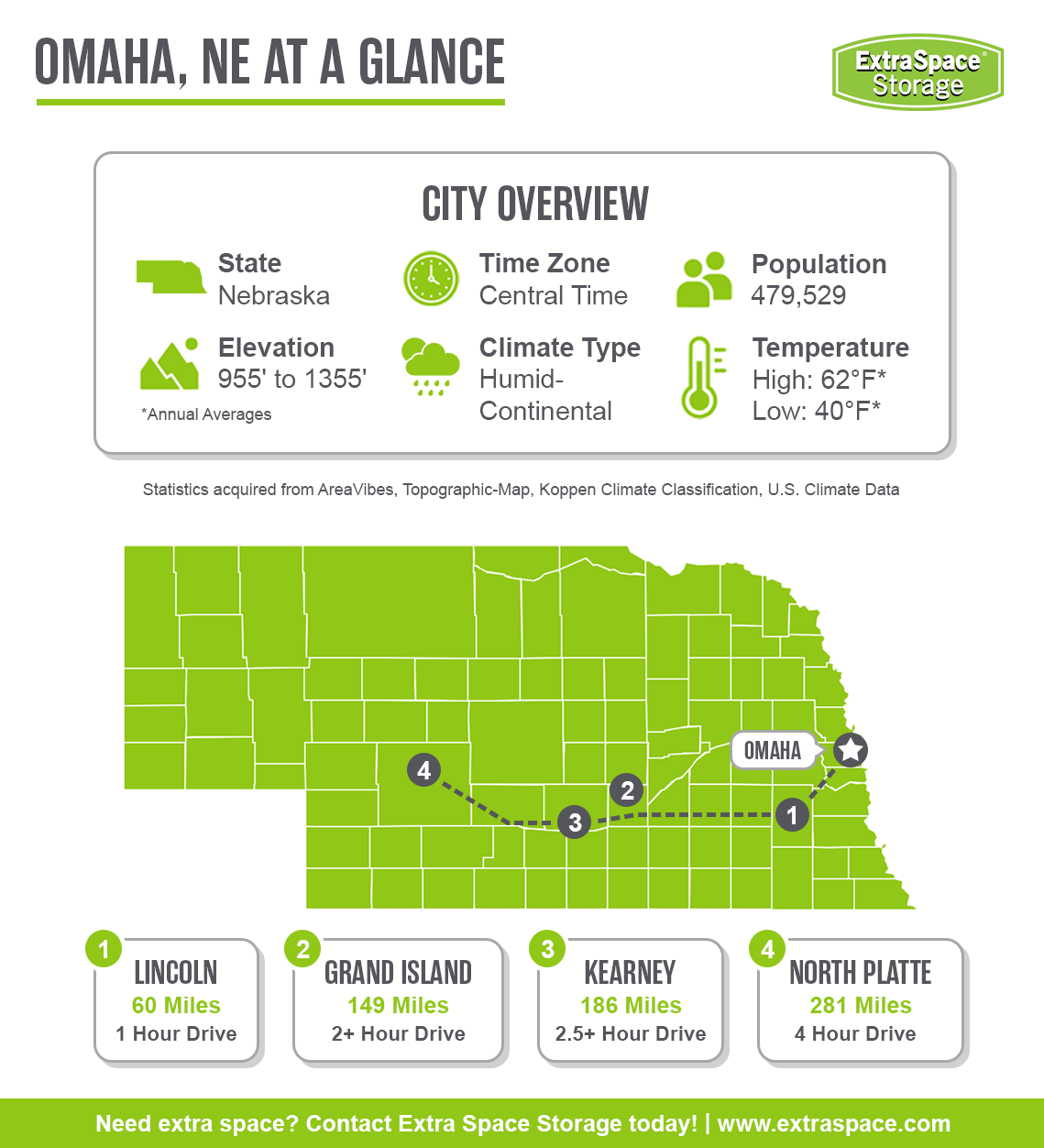
Quick Facts About Omaha
| Population | 479,529 |
| Average Home Price | $383,664 |
| Average Monthly Rent | $1,578 |
| Average Temperature | Average summer high of 90°, average winter low of 19° |
| Unemployment Rate | 3.1% |
Statistics from AreaVibes, Council for Community and Economic Research (C2ER), & BestPlaces
Pros of Living in Omaha
Omaha is a family-friendly city with lots of entertainment, a low cost of living, and more. Read on to learn about more benefits of living in Omaha!
Pro: Omaha Is Affordable
One of the most affordable U.S. cities, Omaha offers plenty of big-city amenities at a low cost—including access to entertainment venues, restaurants, an airport, universities, public transportation, and more for a reasonable price! Omaha’s cost of living is 10% lower than the national average due to lower housing, utilities, transportation, and healthcare costs. For a single adult without dependents, a livable salary in Omaha is around $38,918 after taxes—and with a median household income of $62,213, that’s well within reach. Even better? You don’t have to compromise safety for affordability, as Omaha is home to many safe, affordable neighborhoods like Aksarben, Dundee, West Omaha, and more.
Pro: Great Place to Build a Career
Omaha is one of the best cities for jobs in the country, as Omaha’s unemployment rate is 34% lower than the national average at 3.1%. The top industries in Omaha include agriculture and food processing, financial services, transportation and logistics, healthcare and medicine, and information technology and telecommunications. Omaha is also a great place for military families and retirees, as the city is only 18 miles from the Offutt Air Force Base. Plus, there are multiple Fortune 500 companies in Omaha, including:
Pro: Top Healthcare Facilities
Whether you’re looking for top medical care for you and your family or for job opportunities, many Omaha hospitals and healthcare systems are nationally and regionally ranked:
- University of Nebraska Medical Center (UNMC) is known for its high-quality treatments for leukemia, colon cancer, and diabetes—and is rated the top hospital in the metro and in the state.
- CHI Health has four hospitals in Omaha, so reliable healthcare is always accessible.
- Children’s Nebraska has ranked nationally for three pediatric specialties.
- The Boys Town National Research Hospital works to improve healthcare with its research in hearing and balance, speech and language, behavioral care, and more.
- Methodist Health System is best known for having the region’s only medical campus dedicated to women’s health—Methodist is also rated high performing in ten procedures and second in Nebraska for regional hospitals.
Pro: You Can Get Your Degree
If you’re looking for a relaxed place to earn an education with a great school-to-job pipeline, Omaha has multiple options to choose from. Whether you seek in-person opportunities or online classes at a community college, here are some Omaha universities and their top studied programs:
- University of Nebraska Omaha, known for its education program, as well as its nationally-ranked criminology program.
- Creighton University offers a strong Jesuit and sports atmosphere in addition to, where you can study in top-ranked nursing, business, and dental programs.
- Clarkson College is a private health sciences school that offers great access to Nebraska Medicine facilities, the top-ranked hospital system in the state.
- College of Saint Mary, a Catholic and all-women school, offers amazing value, excellent education, and provides supportive single-parent resources—including a residence hall for single moms.
- Metropolitan Community College offers multiple campuses across the Omaha metro that are staffed with dedicated instructors for programs ranging from the humanities, automotive technology, information systems and technology, and more.
Pro: Watch the College World Series in Omaha
Every year since 1950, the NCAA Men’s College World Series has been held in Omaha, drawing in thousands of fans from all across the country. During this time, visitors can experience all that Omaha has to offer, including various College World Series-themed activities and food all across the city! Start with touring and finding family fun in Baseball Village. After the game ends, there are plenty of events like the DJ party and dancing at The Matt, or getting in on the famous Jell-O shot leaderboard at Rocco’s.
Pro: Home to One of the Nation’s Best Zoos
The Omaha Henry Doorly Zoo and Aquarium was voted the #1 zoo in the United States by USA Today several times—and for good reason! With 160 acres of various indoor and outdoor habitats, there’s no shortage of activities to do and wildlife to see. Here are some of the most popular things to see:
- The Lied Jungle is the country’s largest indoor rainforest, with animals like monkeys, hippos, and colorful birds.
- The Desert Dome, the world’s largest indoor desert, features plants and animals from the Southern African Namib Desert, Australia’s Red Center desert, and the Southwestern U.S. Sonoran Desert.
- Underneath the Desert Dome, you’ll find the world’s largest nocturnal exhibit, the Eugene T. Mahoney Kingdoms of the Night, which features animals like crocodiles, fruit bats, and wallabies.
- Walk through a tunnel with sharks and sea turtles swimming around you, then visit the penguins and jellyfish at the Suzanne and Walter Scott Aquarium.
- Be surrounded by free-flying butterflies before visiting the insectariums and terrariums holding stick insects, arachnids, beetles, and more in the Berniece Grewcock Butterfly and Insect Pavilion.
- Watch as hundreds of colorful koi fish flock to the Lagoon Islands bridge when you feed them.
Pro: Great Place for Families
One of the best cities for families, Omaha offers residents good school districts, parks and playgrounds, and plenty of family-friendly things to do in Omaha, including:
- The Omaha Children’s Museum, a two-floor facility with permanent & traveling exhibits
- Exploring real train cars from the 1940s & ’50s at the historic Durham Museum
- Basic physics, environmental science, biology activities, events, & more at the Kiewit Luminarium
- Entertaining musicals, plays, & comedies for the whole family at The Rose Theatre
- A playground, outdoor amphitheater, slides, & more along the Gene Leahy Mall at the Riverfront
- Water slides, rides, lazy rivers, & more at Fun-Plex
- Events, exhibits, & hundreds of well-tended local & greenhouse plants at Lauritzen Gardens
Pro: Robust Arts & Culture Scene
Residents enjoy easy access to expansive arts and culture networks throughout the city. Explore some of the popular Omaha arts and culture options below!
- See masterpieces at local Omaha art museums like The Joslyn, the Bemis Center for Contemporary Arts, or Kaneko
- Watch a variety of performing arts from the American Midwest Ballet, Omaha Symphony, or Opera Omaha at venues like the Orpheum Theatre, Holland Performing Arts Center, & the Omaha Community Playhouse
- See new and classic movies, participate in post-film discussions, attend filmmaker panels, & more at the local nonprofit Omaha movie theater, Film Streams
- Support Omaha’s creativity through businesses like Hot Shops Art Center or Petshop Gallery, or attend Benson First Friday in the Benson Creative District
- Listen to musicians like Pixies, Silversun Pickups, or Little Brazil at MAHA Festival, or see touring acts at Steelhouse Omaha or the CHI Health Center Omaha
Pro: A Foodie’s Paradise
It is no surprise that Omaha is a must-see for all foodies. Home of the world-famous Reuben sandwich and Omaha Steaks, Omaha has a bustling food scene. For an iconic regional bite, head to Runza for the Midwestern classic Runza sandwich—a mixture of ground beef, cabbage, and onions all stuffed into fresh-baked bread—which was created in Lincoln, NE. When you’re ready to expand, try some of the best Omaha restaurants:
-
- Clio for fresh Mediterranean food & happy hour
- Bouillon for French dishes & French takes on American food
- J.Gilbert’s for wood-fired steaks & seafood with elegant dining
- Yoshitomo for the best sushi in Omaha
- Coneflower Creamery for some of the best ice cream in America
Pro: Fun Brewery Scene
Alongside an amazing food scene, Omaha’s breweries each have their own unique style.
- Infusion Brewing takes on the classic feel of craft beer while honoring the roots of its founders.
- Kros Strain allows you to get the taste of exciting beer flavors such as the Gas Station Cheeseburger and Self-Propelled Mower, showing that there’s no shortage of creativity when it comes to drinks in Omaha.
- Drink Brickway in the Old Market does a tour and tasting, allowing you to get a closer look at what makes the Omaha brewing scene so special.
- Kinkaider Brewing Co is a local staple, taking pride in offering farm-crafted beer in the Midwest.
- Monolithic offers a full menu of freshly made-in-house beers and a menu of rotating sandwiches and appetizers.
Get Everything You Need For An Easier Move to Omaha
Cons of Living in Omaha
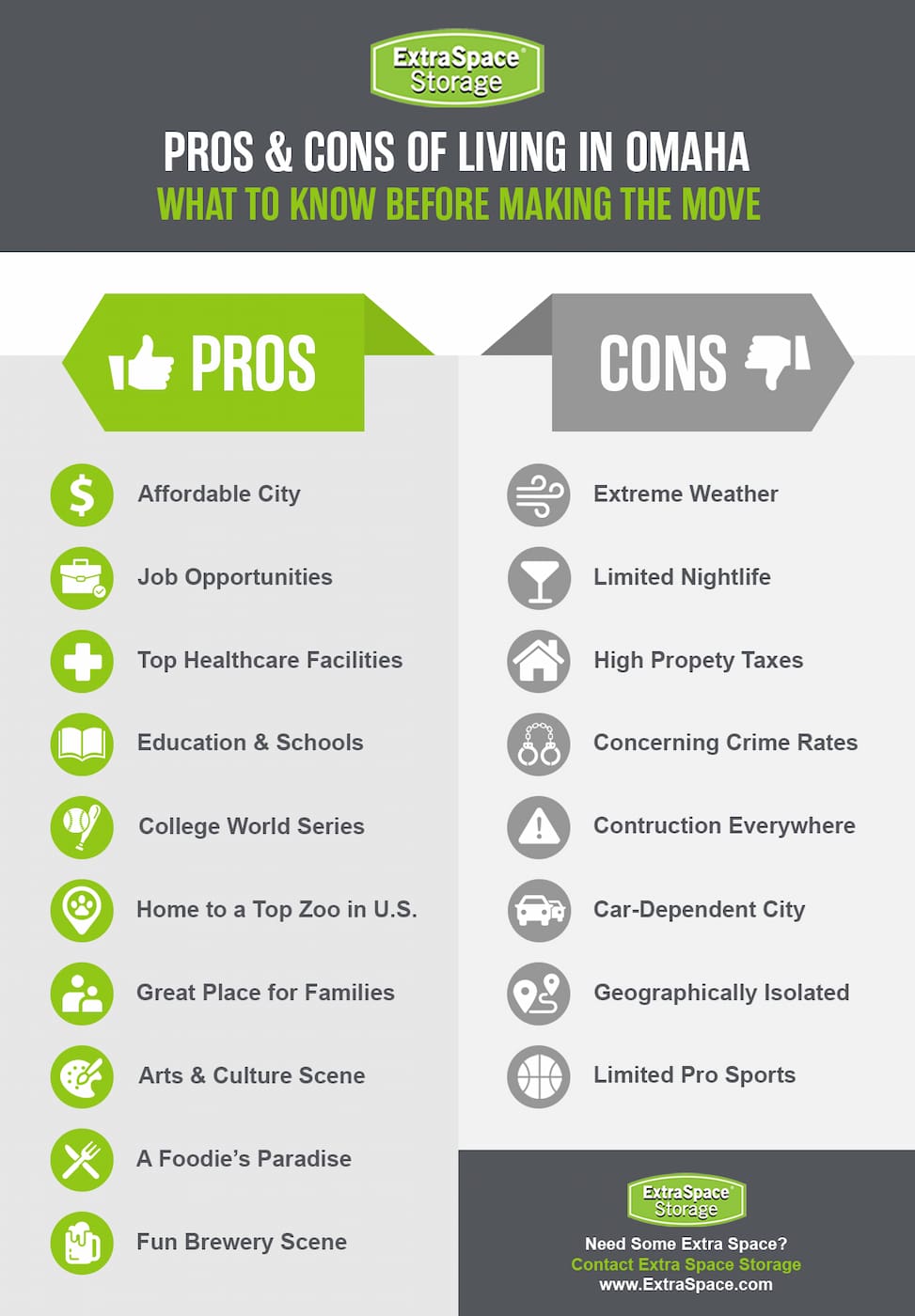
Life in Omaha also comes with some downsides, like city-wide construction and high property taxes. Here are the disadvantages of living in Omaha.
Con: Omaha Weather Is Extreme
With Omaha’s climate, you can to see harsh temperatures in all four seasons—expect an average January low to be around 13 degrees and a July high to be around 86 degrees—with intense humidity levels compounding the heat. It’s also important to know that Omaha is in Tornado Alley, so there’s a risk of tornadoes and thunderstorms starting in the spring and going into the summer.
The weather in Omaha can also be unpredictable, so it’s important to be prepared for anything that could happen. In the winter, residents can experience sub-zero temperatures, heavy snow, and blizzards. However, those wanting seasonal variety are sure to get it in Omaha, with beautiful fall foliage, snow, cool springs, and warm summers.
Con: Limited Nightlife
Omaha nightlife isn’t always exhilarating. Even so, when an Omaha nightclub or district does have something going on, the area is packed on the weekends! You can visit the more popular areas, like the Blackstone District, Benson, Capitol District, and the Old Market, and find fun at clubs and lounges like Bar 39, The Exchange, The Sydney, and more.
Con: High Property Taxes
Property taxes in Nebraska are the fourth-highest in the country based on the 2023 effective tax rate of 1.43%. Residents and businesses sometimes struggle to pay for property based on these tax rates and look for ways around them. Though property taxes are high and there have been some efforts to reduce property taxes, about 60% of the money helps K-12 schools—so you can take comfort in knowing your tax money is being used to strengthen the community’s youth. Furthermore, Omaha’s home prices are 20% lower than the national average, which helps offset the cost of higher property taxes.
Con: Crime Rates Are a Concern
Like many other large cities, Omaha experiences higher crime rates. The city as a whole has come together through a crime reduction strategy that has been recognized nationally. The Violence Prevention Omaha 360 program unites law enforcement, faith leaders, schools, nonprofits, residents, and businesses to address the cause of violence, with a focus on early intervention through younger kids. After the program started, crime in Omaha went down by 14% in 2024, and an additional 10% in 2025.
Con: Construction Is Everywhere
Getting around Omaha can be challenging because of frequent construction going on—the roads and infrastructure are older, and the fluctuating climate means there are more potholes that lead to frequent and necessary road construction. A trip around the city can be different each day, and it can be important to plan out your drive according to road closures and restrictions. On the upside, a large chunk of Omaha’s construction is due to an increased investment in urban revitalization.
Con: A Car-Dependent City
In order to get around in Omaha with ease, you’ll likely want a car. For the size of the city, Omaha’s transit score is low at 24, with a walk score of 48 and a bike score of 42—meaning most areas aren’t accessible by foot or bike for common errands. While the public transit system is not very robust, there are a few options, including Omaha Metro buses, the Heartland Bike Share, and the city’s Lime scooters. Additionally, Omaha is in the middle of adding transportation options through the Omaha Streetcar! Though you may need a car to get around conveniently, Omaha has a good commute time of about 8 minutes less than the national average. If you prefer to live somewhere with a higher walkability, you have options like Benson, Downtown/Old Market, and Midtown.
Con: Geographically Isolated
One big drawback of Omaha is its isolation from other major metropolitan hubs. The nearest major metro—Kansas City, MO—is a three-hour drive away. While Omaha is well-connected locally to Lincoln and Council Bluffs, it requires significant travel to leave the Great Plains, see mountains, or catch a new view. Omaha is “triple landlocked,” meaning you have to cross three state lines in any direction to hit an ocean. However, residents do have easy access to air travel—the Eppley Airfield is currently undergoing a major expansion to offer more direct flights for those looking to travel out of the Midwest.
Con: Limited Pro Sports
Despite being a big Midwestern city, Omaha lacks a deeply rooted sports culture often found in large markets. While it doesn’t have major-league professional teams, Omaha sports fans show up in full force to support their hometown favorites, especially with college sports—namely the University of Nebraska Lincoln’s Husker football team—being a huge part of the city’s identity.
- Cheer on the Omaha Storm Chasers (MiLB) at Werner Park.
- Catch exciting soccer action with Union Omaha (USL).
- Experience the fast-growing energy of pro volleyball with the Omaha Supernovas (MLV), or watch the Creighton Bluejays (NCAA Division I) play basketball at the CHI Health Center Omaha.
- Support the Omaha Mavericks (NCAA Division I) men’s ice hockey at the Baxter Arena.
Should You Move to Omaha?
You should move to Omaha if you’re looking for somewhere to raise a family while having access to top jobs and good education—though you should consider your housing budget, lifestyle preferences, and tolerance for extreme weather. Look at these considerations to help you decide whether Omaha is for you.
Omaha may be the right fit for you if…
- You’re looking for an affordable city with lots of job opportunities.
- You’re looking for somewhere to get a higher education.
- You want some of the best healthcare options in the country.
- You’re raising a family and want family-friendly activities to explore.
- You’re a fan of baseball and want to be close to a big part of baseball history.
- You like supporting local arts.
You may want to consider moving to another city if…
- You don’t like weather extremes.
- You want to have a thriving nightlife.
- You’re hoping for low property taxes.
- You don’t like dealing with construction or limited public transit.
- You want to be near the beach or the mountains.
- You want a local major league sports team to cheer on.
Omaha Compared to Other Nearby Cities
Wondering how Omaha compares to similar Midwest cities like Kansas City, or what Omaha vs. Des Moines or Lincoln is like? Consider items like average rent, average home price, unemployment rates, and more to compare your options and to decide which is for you.
| Factor | Omaha, NE | Kansas City, MO | Des Moines, IA | Lincoln, NE |
| Average Monthly Rent | $1,578 | $1,512 | $876 | $1,309 |
| Average Home Price | $383,664 | $434,284 | $351,603 | $398,052 |
| Average Commute Time | 19 minutes | 22 minutes | 19 minutes | 18 minutes |
| Walk Score | 48/100 | 35/100 | 45/100 | 44/100 |
| Unemployment Rate | 3.1% | 3.4% | 4.2% | 2.5% |
| Major Industries | Financial Services, Insurance, Technology | Manufacturing, Agricultural Bioscience, Logistics | Manufacturing, Healthcare, Technology | Government, Education, Agribusiness |
Statistics from Council for Community and Economic Research (C2ER), BestPlaces, Walk Score, & AreaVibes
Frequently Asked Questions About Moving to Omaha
Is Omaha an expensive place to live?
Omaha is not considered to be expensive, as the cost of living in Omaha is 10% lower than the national average. All index categories comprising the cost of living are lower than the national averages.
Is Omaha safe?
Omaha is considered safe. There are some neighborhoods in Omaha that have higher crime rates than others, but you can still find safe and affordable neighborhoods throughout the city.
Does it snow in Omaha, Nebraska?
On average, Omaha receives 31 inches of snow every year—more than Kansas City’s 15 inches, but less than Minneapolis’ 52 inches.
What state is Omaha in?
Omaha is located in eastern Nebraska, with the Missouri River marking the border between Nebraska’s largest city and Council Bluffs, IA. It’s located 56 minutes away by car from the state’s capital, Lincoln, NE, about two hours away from Des Moines, IA, and three hours away from Kansas City, MO.
Is Omaha a nice place to live?
Omaha is a nice place to live. If you’re looking for somewhere to grow in your career, get an education, or raise a family, Omaha is built for you. On the other hand, Omaha isn’t for everyone, so it’s important to take time to think over whether the pros of living there outweigh the cons.
***
Decided Omaha life is for you? Extra Space Storage can help you store your items while you move. Find a storage facility near you today!