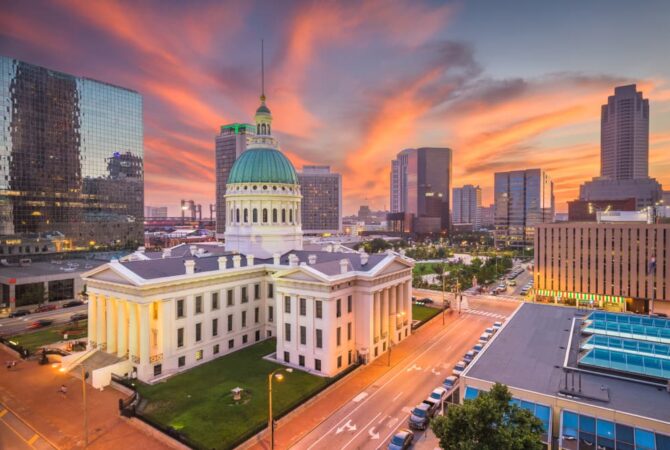
St. Louis is a great place to live in the Midwest, supported by its rich culture, strong job market, and iconic attractions. However, some residents dislike its limited nightlife and urban sprawl. Explore these pros and cons of living in St. Louis to see if it’s right for you!
Quick Facts About St. Louis
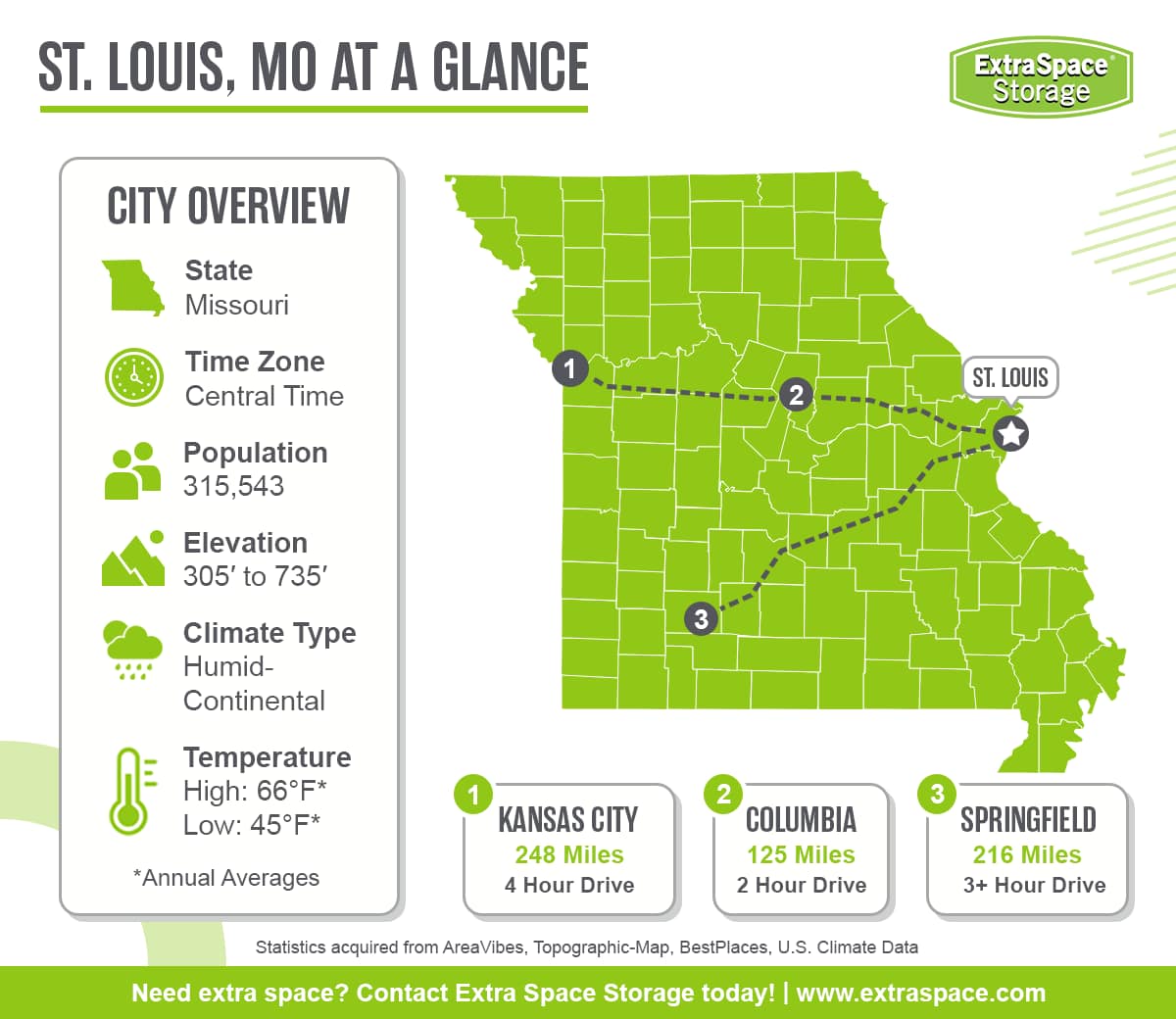
| Population | 315,543 |
| Average Home Price | $424,572 |
| Average Monthly Rent | $1,216 |
| Unemployment Rate | 4.1% |
| Median Household Income | $66,997 |
Statistics from AreaVibes, Council for Community and Economic Research (C2ER), & BestPlaces
Pros of Living in St. Louis
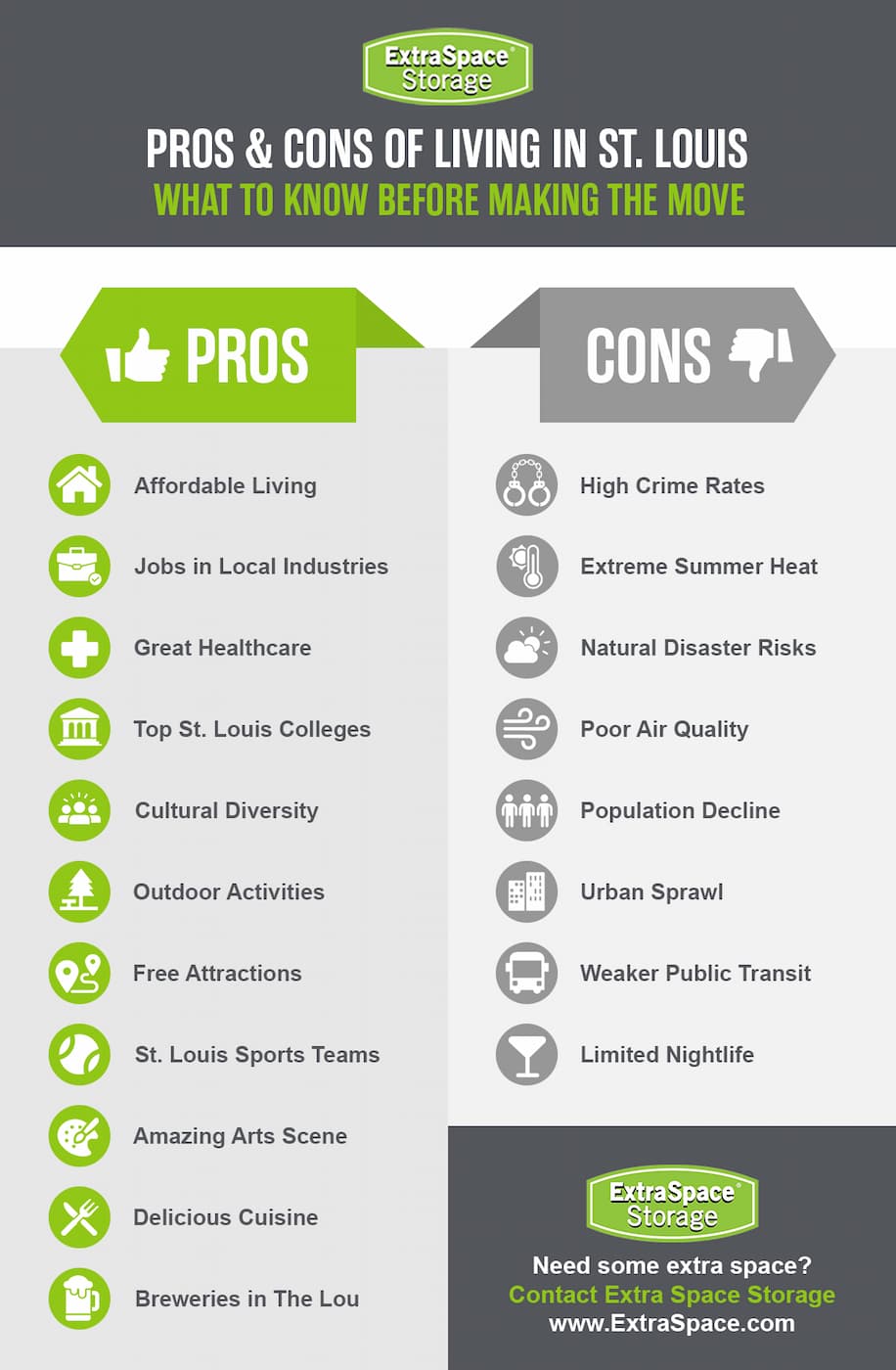
There are many benefits of moving to St. Louis, including its affordability, outdoor recreation, and strong connection to the arts and culture. Here are the pros of living in The Lou!
Pro: Affordable Living in a Larger City
Moving to a large city can be tough on your wallet, but you can find an affordable cost of living in St. Louis! Despite being a major city in the Midwest, living expenses in St. Louis are 11% lower than the national average, led by significant savings in healthcare and housing. Find affordable housing in St. Louis with a median home price that’s 21% less expensive than the national average and less expensive than those in nearby Kansas City, MO. And for lower-income residents seeking affordable public housing or income-based assistance, you can apply and check your availability with the federally funded St. Louis Housing Authority (SLHA).
Pro: Jobs in Major Local Industries
The Gateway to the West has an unemployment rate of 4.1%—which is lower than the state and national average—offering plenty of opportunities for professionals of all ages to find employment. Major St. Louis industries include manufacturing, aviation, biotechnology, transportation, finance, utilities, and healthcare. Here are some local opportunities to consider:
- If you’re looking for a job in St. Louis, Boeing, SSM Health, and BJC HealthCare are some of the biggest employers in the city.
- Our check out employment at Fortune 500 companies—such as Emerson, Edward Jones, and Graybar—that are headquartered in the St. Louis area.
- And as one of the best cities for remote work, STL offers numerous work-from-home opportunities at companies like Centene Corporation, Enterprise, and World Wide Technology—as well as having several St. Louis coworking spaces like Spaces, STL Fusion, and T-Rex.
Pro: Great Healthcare in The Lou
Living in St. Louis gives you access to some of the best healthcare in the United States!
- Barnes-Jewish Hospital, one of the nation’s top hospitals, specializes in cardiology and heart surgery, neurology and neurosurgery, orthopedics, obstetrics and gynecology, and cancer.
- St. Louis Children’s Hospital is the top-ranked children’s hospital in Missouri and one of the best children’s hospitals in the country for neonatology.
- Missouri Baptist Medical Center, known locally as Mo Bap, provides advanced cancer treatment for leukemia, lung cancer surgery, colon cancer surgery, and more.
- Cardinal Glennon Children’s Hospital offers top-notch pediatric care for your family.
- Mercy Hospital St. Louis is regionally recognized, providing quality cardiovascular care, behavioral health support, and other emergency services.
Pro: Top St. Louis Universities
If you’re looking to obtain higher education, there are plenty of respected universities and colleges in St. Louis to choose from! From world-class private institutions to community-focused public colleges, Mound City has strong academic programs, vibrant campus life, and great opportunities to grow professionally and personally.
- Washington University in St. Louis (WashU) for programs in the visual arts, design, business, and engineering.
- University of Missouri-St. Louis for research-focused programs and liberal arts majors.
- Saint Louis University for studying physical therapy, biology, nursing, and health sciences.
- Maryville University for learning about occupational therapy, business administration, and education.
- Harris-Stowe State University for majors in accounting, urban affairs, and educational studies.
Pro: Cultural Diversity
St. Louis is a welcoming city for people from all walks of life, creating a diverse cultural environment. In recent years, the region has seen rapid growth in its foreign-born population, bringing new languages, traditions, and businesses to the community. STL has become a hot spot for Hispanic culture, with local businesses, food, art, and the annual Cinco de Mayo celebration on Cherokee Street. And with sites like The Griot Museum of Black History and historic neighborhoods like The Ville, black culture in St. Louis is widely represented and celebrated. St. Louis has also played a key role in American music, specifically through the development of blues and jazz, producing legendary musicians such as Miles Davis and Clark Terry. The city’s inclusive spirit is further reflected in events like PrideFest, which celebrates and supports the St. Louis LGBTQ community.
Pro: Outdoor Activities in St. Louis
If you love getting fresh air or going on hikes, there’s no shortage of outdoor fun in St. Louis. Explore STL’s impressive range of green spaces, trails, and outdoor experiences throughout the metro area at places like:
- Missouri Botanical Garden for peaceful walks through the George Washington Carver Garden, Strassenfest German Garden, and the Climatron conservatory.
- Big Muddy Adventures for guided river experiences in Downtown St. Louis.
- Tower Grove Park for tennis courts, carriage rides, and park events.
- Francis Park for tree-lined walking paths, picnicking, and lush lily ponds.
- St. Louis Riverfront Trail for long-distance biking and hiking with Mississippi River views.
- Grant’s Trail for paved routes connecting local neighborhoods and parks.
Pro: Free St. Louis Attractions
There’s no shortage of free things to do in St. Louis, making it easy for residents and visitors to explore the city without spending money.
- Saint Louis Zoo to see over 16,000 animals across 500 species in exhibit areas like Historic Hill, River’s Edge, and The Wild.
- Saint Louis Science Center for interactive exhibits that encourage learning and family fun in STL.
- Missouri History Museum for exploring the region’s culture, diversity, and history.
- Citygarden for walking among international sculptures and landscaped tree gardens.
- Ulysses S. Grant Historic Site for visiting White Haven, the former home of President Ulysses S. Grant.
- Gateway Arch National Park for enjoying views of the Gateway Arch or visiting its free museum.
Pro: St. Louis Sports Teams
Fans of sports in St. Louis have plenty to cheer for year-round. From hockey and baseball to football and soccer, the city’s professional teams bring big game energy to their loyal fan bases every season:
- St. Louis Blues (NHL) at Enterprise Center
- St. Louis Cardinals (MLB) at Busch Stadium
- St. Louis Battlehawks (UFL) at The Dome at America’s Center
- St. Louis CITY SC (MLS) at Energizer Park
- St. Louis Slam (WFA) at local St. Louis high schools
Pro: Amazing St. Louis Arts Scene
Residents have tons of St. Louis art museums and performing arts shows to immerse themselves in! Get a taste of the city’s incredible arts scene, from live stage productions to educational exhibits celebrating STL culture, at places like:
- Contemporary Art Museum for modern art exhibitions, guided tours, and artist talks.
- Opera Theatre of Saint Louis for opera productions and community programs.
- Saint Louis Art Museum for world-class permanent collections and rotating exhibitions.
- The Black Rep for powerful African-American theatre productions and cultural storytelling.
- Pulitzer Arts Foundation for thought-provoking Contemporary art installations.
- St. Louis Symphony Orchestra for classical performances, family concerts, and live-to-film productions.
Pro: Delicious St. Louis Food
The Lou is a true foodie’s paradise, serving up everything from iconic local pizza to fresh seafood and legendary barbecue. Whether you’re craving comfort food or something sweet, St. Louis cuisine delivers bold flavors.
- Park Avenue Coffee for rich coffee brews and the city’s famous gooey butter cake.
- Anthonino’s Taverna for St. Louis pizza and Italian-Greek favorites.
- Broadway Oyster Bar for Cajun-inspired seafood in a lively atmosphere.
- Pappy’s Smokehouse for mouthwatering barbecue and slow-smoked meats.
- Asian Arch for finely-crafted Asian fusion dishes in Downtown STL.
- Chava’s Mexican Restaurant for authentic Mexican cuisine and margaritas.
Pro: St. Louis Breweries
While Anheuser-Busch may call St. Louis home, the city’s craft beer scene goes far beyond that brewery staple. From small-batch innovators to neighborhood taprooms, there are plenty of craft breweries in St. Louis to grab a locally made pint and enjoy the atmosphere.
- 4 Hands Brewery for creative, small-batch brews in a lively taproom.
- Schlafly Beer for a selection of over 70+ beers at one of the oldest craft breweries in STL.
- Perennial Artisan Ales for thoughtfully crafted artisan beers and ales.
- Urban Chestnut Brewing Company for old-world brewing in a modern beer hall.
- Civil Life Brewing Co. for finely-made ales and bottled wines.
- Rockwell Beer Co. for balanced craft beers in a relaxed patio setting.
- 2nd Shift Brewing for rotating selections and community events.
Get Everything You Need For An Easier Move to St. Louis
Cons of Living in St. Louis
There are a few reasons not to move to St. Louis, including its severe weather and air quality concerns. Before moving, carefully consider these cons of living in St. Louis.
Con: High Crime Rates
Moving to a large city often means an uptick in crime, and St. Louis is no exception—the city’s crime rates are far above the national average. While the crime rate in St. Louis has been historically high and remains comparatively high, crime has seen a significant drop over the past few years that outpaces most U.S. cities. This is thanks in part to the city’s past work with Cure Violence and current work with Mission St. Louis, which has programs like the Neighborhood Healing Network to help areas most impacted by violent crime. There are also plenty of safe neighborhoods in St. Louis, like Boulevard Heights, Lindenwood Park, and Princeton Heights, that offer quiet areas to settle down.
Con: Extreme Summer Heat
Due to St. Louis’s infrastructure, the city is particularly sensitive to heat. Its streets, largely made of asphalt, concrete, and metal, make it an “urban heat island” that traps heat and often attracts extreme heat waves in the summer. STL’s hot season can be exhausting, lasting nearly four months from late May to late September, with average temperatures ranging from highs of 89 degrees to lows of 70 degrees in July.
However, if you can tolerate high heat and humidity, there are plenty of parks and green spaces to enjoy during the city’s average 202 sunny days. Breathe in the sun and have a picnic at spots like Lafayette Park, Carondelet Park, or Lone Elk Park. Or take a break and beat the heat by visiting St. Louis pools and splash pads, including Benton Park Spray Fountain, Fairgrounds Pool, and Chambers Park Pool.
Con: Natural Disaster Risks
Nestled between the Mississippi and Missouri Rivers, St. Louis frequently experiences warm, humid conditions that can fuel severe storms. While St. Louis isn’t right in the heart of Tornado Alley, its geographic position still makes it important to prepare for tornado weather by keeping an eye on radar and taking shelter when necessary. The region is also near the New Madrid Seismic Zone, making earthquakes a rare but possible threat, and its riverfront location exposes it to the risk of major flooding. Though severe weather in St. Louis isn’t constant, it can be destructive, so preparation is essential.
Con: Poor Air Quality
Like many major metro areas, St. Louis’s urban activity and regional pollutants have contributed to poor air quality, which has progressively worsened. The area experiences elevated levels of inhalable pollutants, occasionally prompting air quality alerts and recommendations to limit prolonged outdoor activity. However, the City of St. Louis has developed Climate Action Plans designed to monitor and attempt to reduce greenhouse gas emissions. Additionally, STL’s Property Assessed Clean Energy (PACE) programs allow private property owners to finance energy-efficient, eco-friendly improvements and projects on their homes and businesses.
Con: Population Decline
Unlike many metropolitan areas that have experienced rapid population growth in recent years, St. Louis has faced significant population decline. Over the past several decades, the city has steadily lost residents largely due to westward suburban expansion, drawing families and businesses away from downtown. On top of that, persistent urban challenges—such as higher poverty levels—have made it more difficult for the city to retain and attract residents. To combat this, the City of St. Louis provides access to drop-in centers, including the Covenant House and the Center for Youth on the Rise, where individuals can receive assistance with addiction, mental health challenges, housing, and other essential resources.
Con: Urban Sprawl
Unlike many metropolitan areas that concentrate growth within their urban cores, St. Louis has experienced substantial outward development into surrounding suburbs. This shift has contributed to urban sprawl, as development stretches farther into surrounding suburbs—all while some city-proper neighborhoods experience disinvestment. As a result, infrastructure and public services can become more costly to maintain, with resources spread across a wider geographic area and fewer residents in certain districts. Vacant properties and uneven development patterns have also presented planning challenges. However, these conditions have opened the door for land redevelopment initiatives, neighborhood revitalization projects, and opportunities for more affordable housing in St. Louis compared to faster-growing cities.
Con: Weaker Public Transit
Although St. Louis is fairly walkable, especially Downtown St. Louis, the metro often struggles to offer extensive public transit. While you can travel East-West across the metropolitan area using the light rail system MetroLink, its planned North-South Green Line expansion was recently canceled. Despite this, you can still travel over 500 square miles on the MetroBus and even use Metro Call-A-Ride, an ADA service for individuals with disabilities, or STL Loop Trolley throughout the Delmar Loop.
Con: Limited Nightlife
St. Louis is known for its laid-back, community-focused atmosphere—which doesn’t always lend itself to a high-energy nightlife. While there are plenty of festivals, breweries, and outdoor fun, it doesn’t offer the same after-hours intensity as larger party hubs. That said, there are still several spots to enjoy St. Louis nightlife:
- The Pageant for live concerts, dancing, and themed events.
- The Crack Fox for cocktails, karaoke, and subculture theme nights.
- Blueberry Hill for live music and shows in a retro bar atmosphere.
- McGurk’s for casual drinks, outdoor patios, and Irish pub charm.
Should You Move to St. Louis?
Consider moving to St. Louis if you value a city that blends affordable living, rich culture, and abundant outdoor recreation. St. Louis is especially appealing for families who enjoy its vibrant neighborhoods and easy access to parks, though it suffers from urban sprawl. Before making a decision, weigh the pros and cons of St. Louis to see if it’s the right fit for your lifestyle.
St. Louis may be the right fit for you if…
- You want to live affordably in a major U.S. city.
- You enjoy tight-knit neighborhoods with community events.
- You love art, historic architecture, and cultural celebrations.
- You want access to parks, trails, and outdoor recreation.
- You’re looking for job opportunities in healthcare, aviation, biotech, and finance.
- You appreciate a brewery scene and laid-back vibe.
You may want to consider moving to another city if…
- You’re sensitive to hot weather and long summers.
- You don’t want exposure to tornadoes, earthquakes, or floods.
- You need a city with extensive public transit.
- You want a robust nightlife or entertainment scene.
- You prefer denser development and fewer issues with urban sprawl.
- You want a more rural city with exceptional air quality.
St. Louis Compared to Other Nearby Cities
Trying to decide between St. Louis and Kansas City, or figure out if St. Louis is better than Chicago or Nashville? Comparing factors like housing prices, commute times, unemployment rates, and leading industries can help you determine which metro best aligns with your lifestyle and career goals. Here’s how St. Louis stacks up against several nearby regional hubs.
| Factor | St. Louis, MO | Kansas City, MO | Chicago, IL | Nashville, TN |
| Average Monthly Rent | $1,216 | $1,512 | $3,230 | $1,741 |
| Average Home Price | $424,572 | $434,284 | $588,157 | $534,248 |
| Average Commute Time | 24 minutes | 22 minutes | 35 minutes | 25 minutes |
| Walk Score | 66/100 | 35/100 | 77/100 | 29/100 |
| Unemployment Rate | 4.1% | 3.6% | 5.7% | 3.4% |
| Major Industries | Aviation, biotechnology, transportation, manufacturing | Manufacturing, animal health, technology, finance | Business, healthcare, technology | Healthcare, entertainment, hospitality |
Statistics from Council for Community and Economic Research (C2ER), BestPlaces, Walk Score, & AreaVibes
Frequently Asked Questions About Moving to St. Louis
Is St. Louis expensive?
St. Louis is considered affordable, especially compared to major U.S. metros. The cost of living in St. Louis is below the national average, and housing prices are lower than in nearby cities like Kansas City and Nashville. Utilities, groceries, and transportation expenses are typically around or slightly under average, making the city great for families living on a budget.
Is St. Louis safe?
Safety in St. Louis varies widely by neighborhood. While St. Louis reports higher crime rates than the national average, some suburbs and residential areas are considered safe. Neighborhoods like Lindenwood Park and Princeton Heights are known for low crime rates. As with most cities, researching specific neighborhoods is important when evaluating safety.
Does St. Louis get tornadoes?
Yes, tornadoes in St. Louis are possible because it sits in the Midwest region of the United States, which experiences severe thunderstorms during the spring and summer. However, direct tornado strikes within the city are relatively uncommon. Local weather alerts, sirens, and preparedness systems help residents stay informed during severe weather.
What state is St. Louis in?
St. Louis is located in the State of Missouri in the Midwestern United States. The city sits along the western bank of the Mississippi River and directly borders Illinois across the river.
Is St. Louis a nice place to live?
St. Louis is a nice place to live, with residents appreciating its affordability, attractions, and small-town feel. The city is home to the Gateway Arch and Forest Park, which offer outdoor recreation and culture. It also has a growing food scene and historic, family-friendly neighborhoods with a tight-knit community that makes it great for those seeking a quieter, casual lifestyle.
***
Moving to St. Louis? Extra Space Storage provides self storage options to help with your transition. Find St. Louis self storage near you!