Moving Guide
How to Move a Washer & Dryer

Moving a washer and dryer ranks among the more demanding tasks on any moving day checklist. A standard washing machine can weigh anywhere from 130 to 250 pounds, and the plumbing, electrical, and venting connections involved make moving a washing machine and dryer particularly challenging. This guide will take you through how to move a washer and dryer, either to a new home or into storage, from preparation and equipment to safety on moving day.
Collect the Proper Moving Supplies
Having the right equipment ready before you start moving your washer and dryer will save time and keep you safe while moving. For this job, you'll want:
Appliance dolly: These have taller frames and built-in strap points specifically designed for heavy, upright units.
Ratchet straps: At least two ratchet straps to secure your appliance to the moving dolly.
Moving blankets or furniture pads: For cushioning in the moving truck to help avoid damage to your washer, dryer, or other belongings.
Adjustable wrench or slip-joint pliers: Used to disconnect water supply lines and any hardware holding your units in place.
Bucket and old towels: To catch any residual water that drains out when you disconnect the hoses.
Packing tape or painter's tape: Use these to secure doors, lids, and loose cords so nothing shifts or snags during the move.
Zip-lock bags for small parts and hardware: Keep screws, bolts, and other small components organized and together so nothing gets lost in transit.
Transit bolts for the washing machine: These lock the drum in place during transport to prevent internal damage—check your washer's original packaging, or order replacements online using your washer's make and model number.
Furniture sliders (optional): Helpful for easing heavy units across hard floors without scratching the surface or straining your back.
Forearm lifting straps (optional): These distribute the weight of heavy appliances more evenly across your arms and body, making lifting with a partner safer and less taxing.
Disconnect & Prepare Your Washer & Dryer
Following proper preparation before moving a washing machine and dryer can help you have a smoother transition. These are the steps to follow before starting the moving process.
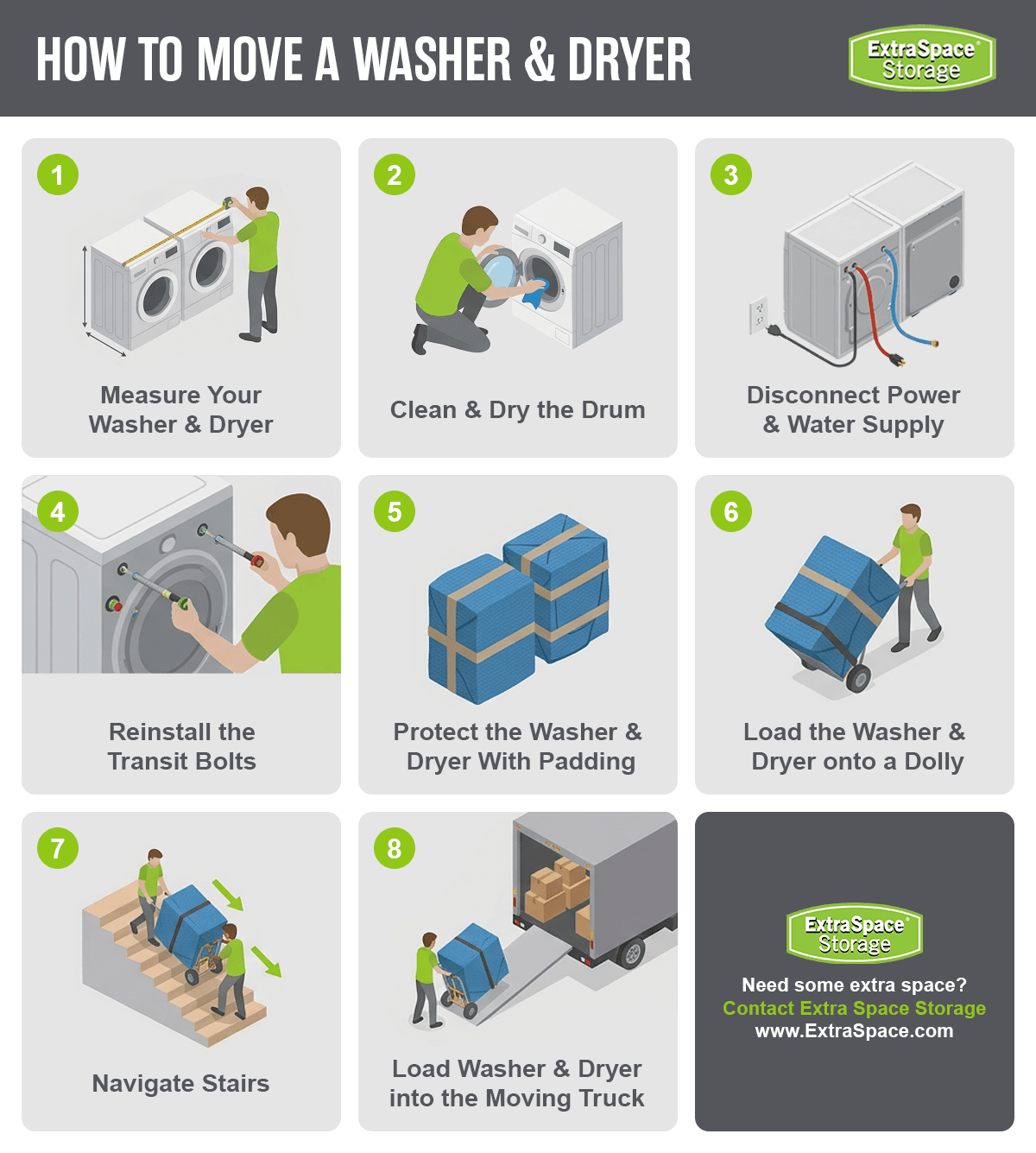
Measure the Washer & Dryer Before You Move
Before disconnecting anything, measure the height and width of both appliances, then measure every doorway, hallway, and stairwell on the path from the laundry room to the moving truck. If doorways are too narrow, it may be possible to temporarily remove interior door hinges to gain an extra inch or two of clearance. Sketch out your route and confirm the appliances will clear every tight point to avoid getting stuck mid-move with a 200-pound washing machine wedged in a hallway.
Clean & Dry the Drum
Run a cleaning cycle one to two days before your move. Once the cycle finishes, leave the lid or door open for at least 24 hours to allow the drum to dry out completely. Moving a washer that still holds moisture can lead to mold or mildew buildup inside the drum during transport.
Cut the Power & Disconnect the Water Supply
Turn off the circuit breaker that powers the washer before unplugging it. Once unplugged, bundle the power cord and tape it securely against the back of the machine so it won't catch or drag during the move.
Next, shut off both water supply valves behind the washer—typically one hot (red) and one cold (blue). Place a bucket and old towels on the floor underneath before you begin, then use a wrench or pliers to loosen and remove the supply hoses one at a time. Let any residual water drain into the bucket. Once the supply hoses are off, disconnect the drain hose from the standpipe and allow it to empty completely. Seal both hoses in a zip-lock bag to catch any remaining drips while you move the washing machine.
Reinstall the Transit Bolts
This step is one of the most important—and most commonly skipped—parts of moving a washing machine. Inside every washer is a drum suspension system that allows the tub to move freely during wash and spin cycles. That suspension is vulnerable to damage if the drum bounces around unsecured during transport. Transit bolts thread into slots in the rear of the washer and lock the drum firmly in place for the move.
Most washers ship with transit bolts included. If yours are long gone, replacements are typically available online using your washer's make and model number. Sourcing the correct transit bolts is always the best option if you can find them, but if you can't find replacements, wedge pieces of Styrofoam snugly between the drum and the washer's inner frame to help cushion movement during transport.
Electric Dryers
Turn off the circuit breaker for an electric dryer before unplugging it. Bundle the power cord and tape it to the back of the unit. Then disconnect the dryer vent hose from the wall exhaust port—it's typically held in place by a clamp or friction fit and comes loose with a quarter turn or a loosened screw. Tape or zip-tie the vent hose to the back of the dryer so it travels with the appliance rather than getting left behind or lost.
Gas Dryers
If you have a gas dryer, the disconnect process requires one additional step that deserves careful attention. If you're not confident in identifying the shutoff valve or working around gas connections, this is one of the specific situations where calling a licensed technician is the right call. The cost of a professional visit is minimal compared to the risk of an undetected gas leak.
Find Affordable Self Storage Near You
Extra Space Storage has over 4,000 locations across the U.S. with friendly customer service, advanced security features, and affordable month-to-month rates.
- Save up to 40% off online
Carefully Move the Washer & Dryer
Moving a washer and dryer can be tricky, so it's best to prepare beforehand. To get them from the laundry room to the moving truck without damaging your floors, your walls, or the machines themselves, follow this step-by-step process for a controlled and damage-free transition.
Protect the Washer & Dryer With Padding
With both appliances fully disconnected, it's time to move the washer and dryer one at a time. Pull each unit far enough away from the wall to safely work around it. Furniture sliders placed under the front feet can make this easier on hard floors without risking scratches. Wrap the appliance in a moving blanket or furniture pad and secure it with packing tape to protect against dings and scratches.
Load the Washer & Dryer onto a Dolly
Have one person tilt the appliance slightly forward while the other slides the dolly underneath, positioning the dolly's base plate at the bottom of the back panel. Once the washer or dryer is balanced on the dolly, use ratchet straps to secure it firmly to the dolly frame. For front-loading washers in particular, always position the dolly against the back panel—not the door side—to avoid putting any stress on the door.
Navigating Stairs
If you're moving a washer and dryer on a staircase, slow and steady communication with your partner is essential. Position the stronger person on the downhill side, controlling the weight and managing the dolly's descent one step at a time. The person on the uphill side manages the tilt angle, keeps the appliance stable, and sets the pace. Never let the dolly free-roll—maintain a firm grip on the handle throughout each step. If the stairwell is particularly narrow, check whether your appliance dolly has removable side arms—removing them can sometimes provide the extra clearance you need. If you're navigating more than a short staircase or a steep flight of stairs, consider hiring professional movers with stair-climbing dollies and proper training.
Load the Washer & Dryer into the Moving Truck
Use the truck's loading ramp to wheel each appliance in—never attempt to lift a washer or dryer directly into the truck bed without a ramp. Once inside, position both appliances upright against the side wall of the truck. Moving a washing machine or dryer on its side can damage internal components, so keep both units vertical throughout the move. Secure each appliance to the truck's anchor points using ratchet straps and confirm there's no lateral movement before you close the truck. Placing a moving blanket between the appliances and the truck wall can help prevent scuffs on both surfaces.
Reconnecting Your Washer & Dryer at Your New Home
Reconnecting a washer and dryer after your move is largely the disconnection process in reverse:
For the washer, reconnect the hot and cold hoses and tighten snugly with pliers, then reattach the drain hose to the standpipe.
For gas dryers, reconnecting the flexible gas line is best left to a professional. Consider hiring a licensed plumber or HVAC professional to help set up your gas dryer.
Before you remove the transit bolts from the washer, place a level on top of the unit and adjust the feet until the machine sits evenly. An unlevel washer tends to vibrate excessively or walk across the floor during spin cycles. Do the same for the dryer.
Remove the transit bolts, plug everything in, and run a short test cycle to confirm there are no leaks and everything sounds normal.
How to Move a Stacked Washer & Dryer
Moving a stacked washer and dryer adds a layer of complexity. If your stackable washer and dryer is connected by a stacking bracket—you'll need to separate them before they can be moved. Start by locating and removing the stacking bracket hardware, typically bolts or clips that secure the dryer's base to the top of the washer. With the bracket removed, two people should grip stable points along the base of the dryer—not the door or the control panel—and lift straight up in unison, keeping the appliance level throughout. Set the dryer on a flat, stable surface before moving the washer. Once separated, follow the same steps above to move the washing machine and dryer. For stacked units in very tight laundry closets where there isn't enough overhead clearance to safely lift the dryer off, hiring professional movers for a washer and dryer is worth the investment.
***
Moving soon? Find more tips and resources on the Extra Space Storage moving hub. And if you need somewhere to store your belongings, we have thousands of facilities located across the U.S. to help with your transition. Find a storage facility near you!

Author Profile
Quinn Johnson
Quinn Johnson is a moving expert and author for Extra Space Storage. He's moved over 15 times, including internationally, and helped countless others between their own homes. He's happy to lift some boxes for a friend as long as he's paid in pizza. As a writer and content creator for Extra Space Storage since 2019, Quinn shares helpful moving tips and info to alleviate the common stresses of moving.