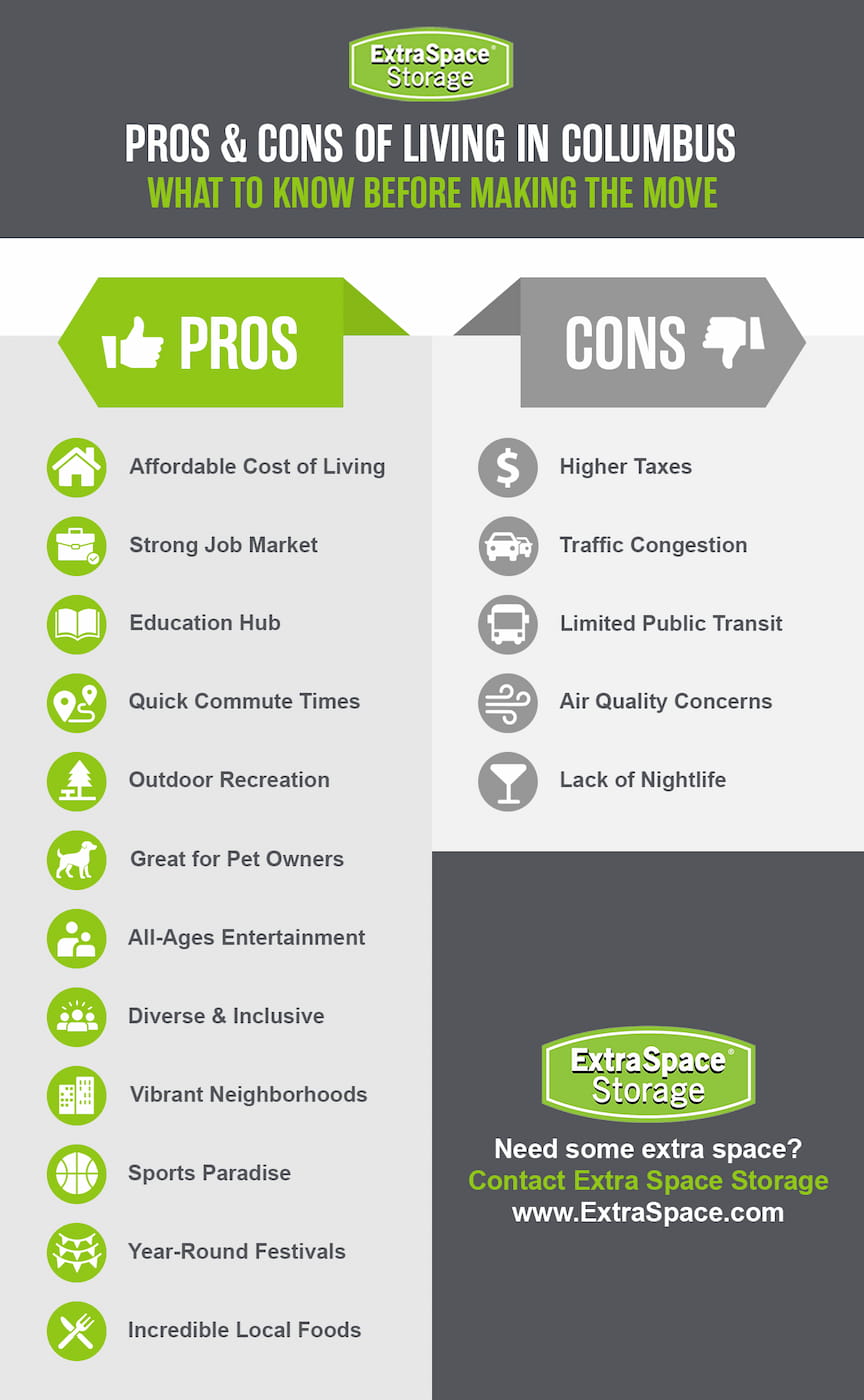
Columbus is one of best places to live in the Midwest, offering overall affordability, great jobs, and plenty to do. New residents especially love Columbus’ recreation and culture, but should prepare for drawbacks like high taxes and traffic congestion. Here are the pros and cons of living in Columbus!
Quick Facts About Columbus
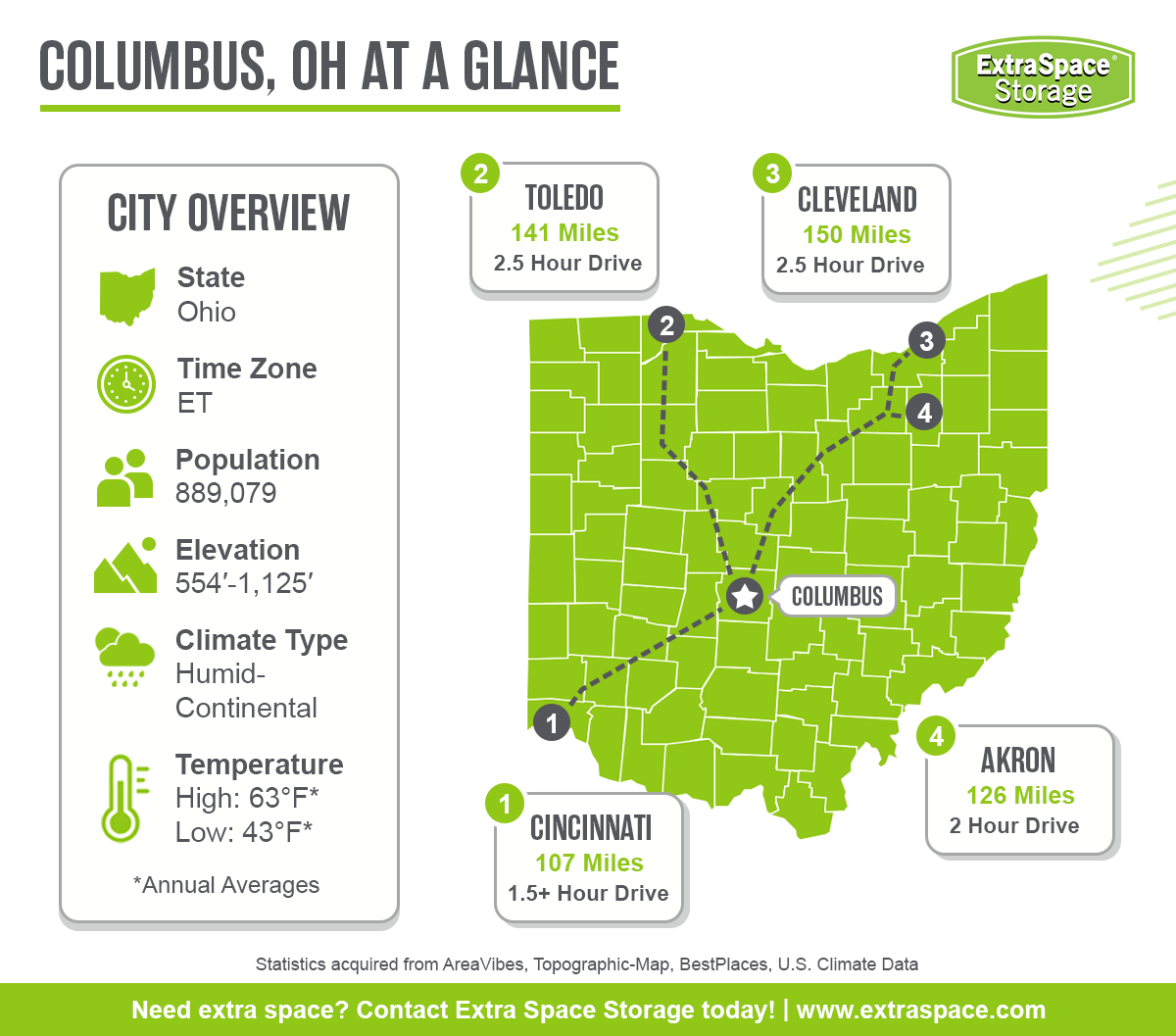
| Population | 889,079 |
| Average Home Price | $505,881 |
| Average Monthly Rent | $1,468 |
| Unemployment Rate | 3.8% |
| Average Commute Time | 22 minutes |
Statistics from AreaVibes, Council for Community and Economic Research (C2ER), & BestPlaces
Pros of Living in Columbus
Some benefits of living in Columbus include its high affordability, diversity, and entertainment options. Read more about these and other reasons to move to Columbus below!
Pro: Affordable Cost of Living
As the capital of Ohio—one of the most affordable states to live in—Columbus boasts similar affordability, making it a comfortable spot to settle down. The cost of living in Columbus is 7% lower than the national average, assisted by significant savings in areas such as healthcare, transportation, and utilities.
Additionally, the average home price in Columbus is relatively low, making housing costs 5% more affordable than the U.S. average. In fact, Columbus’ housing prices help make it one of the best cities for real estate, with properties lasting on the market for an average of 49 days.
Pro: Strong Job Market
Thanks to the robust Columbus job market and low unemployment rate, Arch City is considered one of the best cities for young professionals—and it’s equally appealing for established workers. As a major Midwestern hub, Columbus’ economy is fueled by a diverse range of key industries, including automotive technology, manufacturing, finance, fashion and retail, life sciences, and more.
Some of the largest employers in Columbus include renowned collegiate institution The Ohio State University, leading claims manager Safelite Solutions, or prominent healthcare system OhioHealth. You’ll also find Fortune 500 companies headquartered in Columbus, such as Nationwide, American Electric Power, or Huntington Bancshares. Plus, the city of Columbus has been named one of the top tech hubs in the U.S., thanks to Central Ohio’s data center boom, which has bolstered tech-focused employers such as Astute Technology, Veeam Software, and TeamDynamix.
Pro: Hub for Education & Research
Columbus stands out as a major center for higher education and research in the Midwest. This excellence is anchored by one of the nation’s top public universities and top research universities, The Ohio State University. OSU drives innovation across popular majors such as finance, biology, engineering, and psychology, while fueling a strong talent pipeline for the region. Beyond the campus, Columbus supports a robust research ecosystem—including medical research through the OhioHealth Research Institute and more than 40 research centers and labs across the metro area—making the city a magnet for academic, scientific, and industry collaboration.
Other notable research organizations headquartered or operating in Columbus include:
- Battelle, the world’s largest nonprofit research & development organization
- Spencer Research, a leader in consumer product testing, specializing in the global food & beverage industry
- L&E Research, with a significant presence supporting consumer & market research
Pro: Quick Commute Times
If you’re tired of long commutes, Columbus is a great place to live, offering refreshingly short commute times. The average one-way commute clocks in at just under 22 minutes, making Columbus the city with the fastest car commutes in the country. Additionally, Columbus gas prices fall below the national average, making the drive not only quick but affordable. With a well-connected highway system (including I-70, I-71, and I-270), getting to work or school is generally simple. And if you live and work in or near Downtown Columbus, you’ll benefit from the city center’s walkability and bikeability!
Pro: Incredible Outdoor Recreation
Staying active in Columbus throughout all four seasons is easy, thanks to abundant access to outdoor attractions. The city maintains more than 410 parks spanning over 14,000 acres, as well as 230 miles of regional trails, 170 playgrounds, and 20 nature preserves. Visit these areas for great outdoor recreation in Columbus:
- Goodale Park for pickleball, basketball, & tennis
- Antrim Park for fishing and lakeside relaxation
- Scioto Audubon to hike urban trails like the Scioto Greenway & Downtown Connector Trail
- Alum Creek Trail for biking along a scenic river corridor
- Hayden Falls Nature Preserve to see a dramatic waterfall, rugged cliff faces, & rare plant life
- Franklin Park Conservatory and Botanical Garden to explore over 400 plant species from around the world
- Olentangy River Water Trail to canoe or kayak along a peaceful urban waterway
Pro: Great for Pet Owners
For those living with pets, Columbus has an abundance of pet-friendly amenities and a welcoming community. The city features multiple off-leash dog parks that offer sprawling acres for dogs to run and socialize, such as Godown Dog Park, Scioto Audubon Dog Park, and Wheeler Memorial Dog Park. Affordable vets in Columbus are also accessible at nearby pet care centers, including Upper Arlington Veterinary Hospital, PAWS Veterinary Urgent Care, and Chittenden Veterinary Clinic.
On top of all that, many Columbus restaurants and breweries, as well as hotels, are pet-friendly, making it easy to include furry companions in daily life! Columbus also features plenty of dog bars—have an espresso at Bumble’s Backyard while your dog runs off-leash, sip mocktails at The Wag while your pup socializes, or watch sports at Rude Dog Bar Columbus while treating your best friend to bowls of Rude Dog Chili.
Pro: All-Ages Entertainment
There are tons of family-friendly activities in Columbus, offering well-rounded entertainment that balances big-city attractions with a strong local presence—including:
- Ohio Theatre or Palace Theatre for Broadway productions, classical concerts, & touring performances
- Center of Science and Industry (COSI) for exhibits like a dinosaur gallery, planetarium, & motion simulator
- Columbus Zoo and Aquarium, which offers over 600 species of animals from all over the world to view
- Bloc Garten for indoor climbing for all ages & skill levels
- Columbus Museum of Art and Wexner Center for the Arts for world-class art collections & special exhibitions
- LEGOLAND Discovery Center for rides, 4D movies, building with LEGO, & other family fun in Columbus
Pro: Diverse & Inclusive
Columbus is widely recognized for its cultural diversity and inclusive atmosphere, which shapes everyday life across the city. Over half of its recent growth is from international migration, and it recently attained a perfect score on the Municipal Equality Index. Additionally, Columbus is home to more than 300 foreign-owned businesses and supports minority-owned businesses through the Experience Columbus Small Business Program.
Residents experience the city’s diversity at cultural hubs throughout Columbus. The historic North Market brings together authentic international flavors from local vendors, while the King Arts Complex showcases African American culture and history with art collections, photos, and events like the Heritage Music Festival and MLK Day Open House. And the Stonewall Center provides year-round programming, from weekly meetings like Trans Talk Tuesday and Time Out Thursday to the annual Stonewall Columbus Pride festival—attracting hundreds of thousands of visitors.
Pro: Vibrant Neighborhoods & Districts
Columbus is a city of distinct neighborhoods, each offering its own culture and sense of place. Much of this character is concentrated along High Street’s “Five on High” districts. Downtown Columbus serves as the city’s business and civic core, while the Short North Arts District is known for galleries, boutiques, and nightlife. The Arena District anchors major sports and entertainment venues, and the University District brings a youthful, academic energy driven by The Ohio State University. Meanwhile, Arch City’s diversity comes alive through the food and festivals on the idyllic, brick-lined streets of German Village. Beyond High Street, cultural enclaves such as Italian Village and Hungarian Village add even more depth, reflecting the city’s layered heritage and welcoming feel.
Pro: Sports Paradise
Sports are deeply ingrained in Columbus culture, uniting residents through college and professional athletics alike. Game days at Ohio State University are legendary, as it’s one of the best NCAA schools for tailgating, offering packed crowds of over 100,000 visitors and unmatched energy surrounding Ohio Stadium, aka “The Horseshoe.” Once the game starts, thousands of fans fire up the atmosphere, cheering for clutch touchdowns and game-winning drives from recent national champion the Ohio State Buckeyes (FBS). Pro sports teams in Columbus add to the excitement, with passionate hockey fans supporting the Columbus Blue Jackets (NHL) as they rush across the ice, striking the puck at Nationwide Arena. And diehard soccer fans can cheer for the Columbus Crew (MLS) from the stands of ScottsMiracle-Gro Field.
Pro: Year-Round Festivals
Columbus comes alive with festivals and events throughout the year, offering something for every interest and season. Top Columbus events and festivals include:
- Columbus Arts Festival for local food vendors, visual artists, live performances, & more along the Scioto Mile riverfront
- Dublin Irish Festival for celebrating Irish dance, music, & art
- Ohio Black Expo to experience #BlackExpollence with African American vendors, performers, celebrities, & small businesses
- Ohio State Fair for classic summer fun with eclectic attractions, concerts, competitions, & iconic butter cow & calf sculptures
- Red, White & BOOM! for Fourth of July fun, including food trucks, live music from the Bicentennial Stage, & an incredible fireworks show
- Winterfair, Wildlights, & WinterFest Columbus for wintertime entertainment, from arts & crafts to dazzling light displays set to live music
Pro: Incredible Local Food
Columbus’ food scene is diverse, dynamic, and always growing, making it a destination for food lovers of all kinds. Residents will love digging in to everything from comfort food to upscale cuisine at some of these best restaurants in Columbus.
- The Guild House for an elevated Columbus breakfast in a modern rustic setting
- Schmidt’s Sausage Haus Restaurant for classic German Village comfort food & hearty local specialties
- The Pearl for refined seafood dishes in the heart of the Short North
- Lola & Giuseppe’s Trattoria for homestyle Italian cuisine at a family-run business
- Tai’s Asian Bistro for upscale, specialty sushi & creative Asian-inspired fare
- Budd Dairy Food Hall for locally sourced dishes, global flavors, & casual bites from a rotating lineup of chefs
Get Everything You Need For An Easier Move to Columbus
Cons of Living in Columbus
Some disadvantages of living in Columbus are its air quality and high traffic. While the city is relatively affordable and has plenty to do, there are a few reasons not to move to Columbus—so keep the following things in mind when making your decision.
Con: Higher Taxes
Though Columbus shines when it comes to home prices, taxes can be a challenge for new homeowners. Not only are property taxes in Ohio among the highest in the U.S., but the state also isn’t exempt from sales taxes and individual income taxes. Ohio’s property tax structure means rates vary by neighborhood and school district, and some areas come with a steeper annual bill.
That said, there’s still a nice variety of safe, affordable neighborhoods in Columbus—such as Clintonville, Worthington, and Downtown—which help offset taxes in a city that is, overall, budget-friendly. Additionally, these taxes help support schools, public services, and neighborhood maintenance, contributing to Columbus’ high quality of life and making it one of the most livable metros in the nation.
Con: Traffic Congestion
As in many other growing cities, Columbus traffic congestion has become more noticeable, recently recording an average of 58 hours stuck in traffic per year. However, the City of Columbus and the Ohio Department of Transportation (ODOT) are actively working to address this, spending over $3 billion in construction across 955 projects that total approximately 5,538 miles of pavement. Additionally, ODOT has already invested more than $400 million into Downtown Ramp Up, a series of projects to reconstruct the I-70 and I-71 corridor in Downtown Columbus for increased safety and traffic flow. It should also be noted that, compared to similarly sized cities, Columbus traffic remains relatively manageable—with average commute times among the nation’s lowest.
Con: Limited Public Transportation
Public transportation in Columbus is much more limited than in other similarly-sized metropolitan areas, particularly outside the downtown core, which means residents are heavily car-dependent. This is especially challenging given the city’s rapidly growing population.
That said, the city does offer some public transit options through Central Ohio Transportation Authority (COTA), which provides bus and shuttle service throughout Columbus and connects key areas such as Groveport’s Rickenbacker area and New Albany’s International Business Park. Residents also have access to convenient regional and national flight travel through John Glenn Columbus International Airport.
Looking ahead, the city is working to address its transportation challenges through the LinkUS initiative, which focuses on expanding public transit and improving infrastructure to create better connectivity across the region.
Con: Air Quality Concerns
Like many growing metropolitan areas, there are occasional challenges with pollution and air quality in Columbus, particularly during hot summer months when ozone levels rise. Increased development, vehicle traffic, and industrial activity can contribute to moderate air pollution on certain days.
Columbus consistently invests in green initiatives to combat these concerns. The city’s Climate Action Plan aims to reduce emissions by 45% by 2030 and achieve carbon neutrality by 2050. The Central Ohio Transit Authority (COTA) is also phasing out diesel-powered buses, investing in green technology, and planning to reach net-zero greenhouse gas emissions by 2045. And with thousands of acres of parks and ongoing environmental planning, residents still enjoy plenty of fresh-air escapes in a city actively working toward a cleaner, healthier future.
Con: Lack of Nightlife
Those seeking a nonstop, late-night party scene or entertainment districts common to major metros may find options more limited in Arch City. However, there are still plenty of bars, breweries, and live music venues to enjoy Columbus nightlife.
- The Walrus for cocktails, comfort food, & karaoke
- Forty Deuce Burlesque & Speakeasy for drinks & live performances in a hidden burlesque nightclub
- Good Night John Boy for pizza, drinks, & dancing to ’70s and ’80s music in a retro atmosphere
- Funny Bone Comedy Club for hilarious stand-up sets from touring comedians
- Axis Nightclub for drag shows or to dance the night away at the largest LGBTQ nightclub in Ohio
- Local breweries like Voodoo Brewing Company, Land-Grant Brewing Company, & Elevator Brewery & Draught Haus for craft beer from one of the nation’s top-tier beer scenes
Should You Move to Columbus?
You should move to Columbus if you value affordability, great job opportunities, a laid-back social scene, and a high quality of life without the stress or costs typically associated with larger, more densely populated metros. Consider your personal priorities—including budget, lifestyle, transportation needs, and more—before deciding whether you want to move to Columbus!
Columbus may be the right fit for you if…
- You want an affordable city with strong amenities.
- You’re seeking a career in healthcare, tech, finance, manufacturing, or higher education.
- You enjoy parks, trails, and outdoor activities year-round.
- You’re looking for a city with family-friendly neighborhoods and attractions.
- You appreciate diversity, inclusion, and community culture.
- You enjoy college and professional sports as part of local life.
You may want to consider moving to another city if…
- You don’t want to deal with high taxes.
- You prioritize a fast-paced nightlife scene.
- You strongly prefer coastal or mountain geography.
- You’re sensitive to traffic or air quality concerns.
- You need a robust public transportation system.
- You’re drawn to cities with a flashier, trendy vibe.
Columbus Compared to Other Nearby Cities
Deciding whether Columbus or another nearby Midwestern city is a better fit? Comparing Columbus to cities like Cincinnati, Cleveland, and Indianapolis can help clarify which location best matches your lifestyle, budget, and commute preferences.
| Factor | Columbus, OH | Cincinnati, OH | Cleveland, OH | Indianapolis, IN |
| Average Monthly Rent | $1,468 | $1,664 | $1,476 | $1,353 |
| Average Home Price | $505,881 | $446,938 | $399,663 | $364,401 |
| Average Commute Time | 22 minutes | 23 minutes | 24 minutes | 23 minutes |
| Walk Score | 41/100 | 49/100 | 57/100 | 31/100 |
| Unemployment Rate | 3.8% | 4.9% | 7.4% | 3.8% |
| Major Industries | Finance, healthcare & life sciences, manufacturing, technology | Healthcare & life sciences, finance, manufacturing, retail | Healthcare & life sciences, manufacturing, finance, research | Healthcare & life sciences, leisure & hospitality, manufacturing, retail |
Statistics from Council for Community and Economic Research (C2ER), BestPlaces, Walk Score, & AreaVibes
Frequently Asked Questions About Moving to Columbus
Is it expensive to live in Columbus, Ohio?
No, Columbus is considered an affordable place to live, with a cost of living 7% below the national average. Housing costs, utilities, healthcare, and transportation in Columbus are especially budget-friendly compared to many major U.S. cities.
Is Columbus, Ohio safe?
Although the Columbus crime rate is higher than the national and state averages, safety varies by area—and the crime rate is still lower than in nearby cities like Cincinnati and Cleveland. Neighborhoods such as Bexley, Clintonville, and Worthington are known for being safe places to live in Columbus.
What is the average temperature in Columbus, Ohio?
The average temperature in Columbus varies seasonally—typically ranging between 22°F and 84°F throughout the year. The city sees average daily highs of 75°F in the warmer months and 46°F in the colder months. Spring and fall are particularly comfortable seasons, making them favorites for residents.
What state is Columbus in?
Columbus is located in Ohio and serves as the state capital. Situated in the heart of the state along the Scioto River, it is the largest city in Ohio and a major economic, educational, and cultural hub in the Midwest.
Is Columbus a good place to retire?
Yes, Columbus is a good place to retire. The city offers a relatively low cost of living, accessible healthcare with top hospitals nearby, and a variety of cultural, recreational, and dining options. Its walkable neighborhoods and parks also provide plenty of opportunities for social engagement during retirement.
***
Moving to Columbus? Extra Space Storage offers secure storage in Arch City and throughout the U.S. to help with your transition. Find storage units near you!