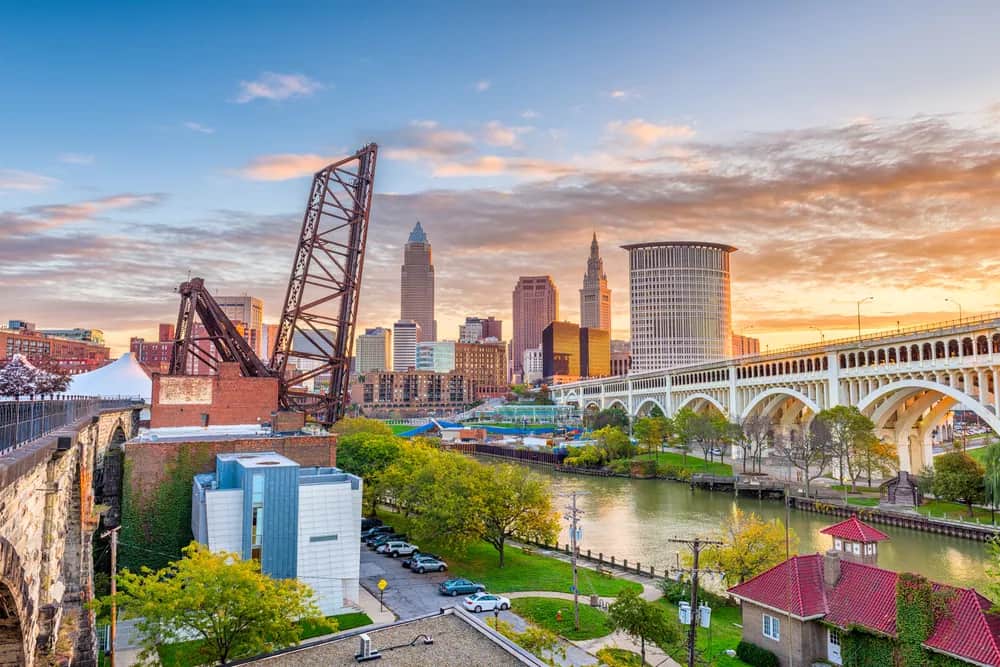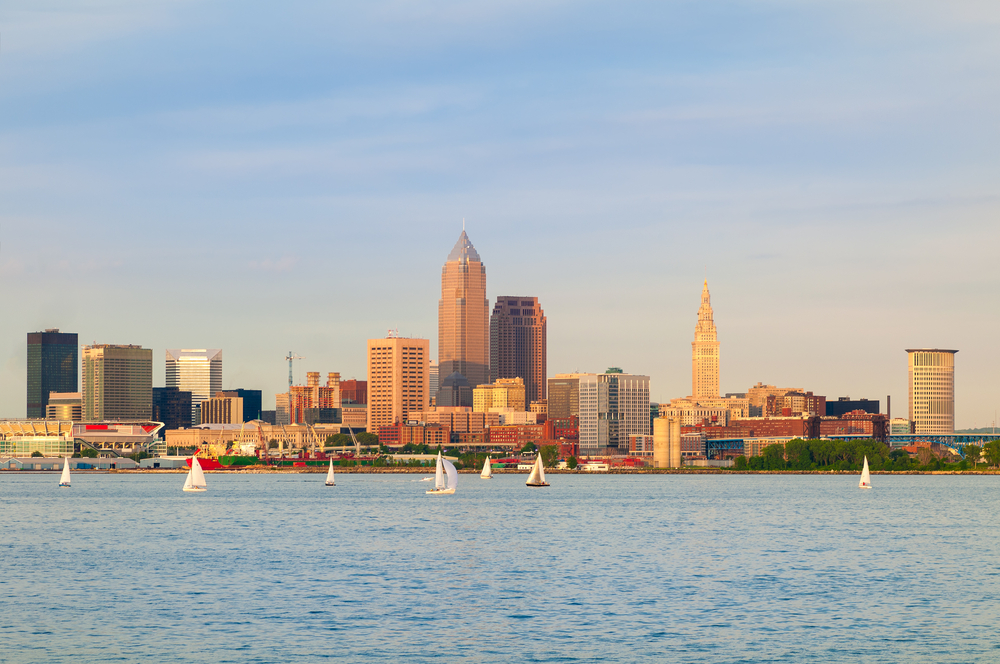

Cleveland is a good place to live because of its affordable cost of living, and universities, and people like Cleveland’s food and beverage scene and arts and culture! However, residents don’t like that city experiences harsh winters and its urban sprawl. Here are 17 pros and cons of living in Cleveland.
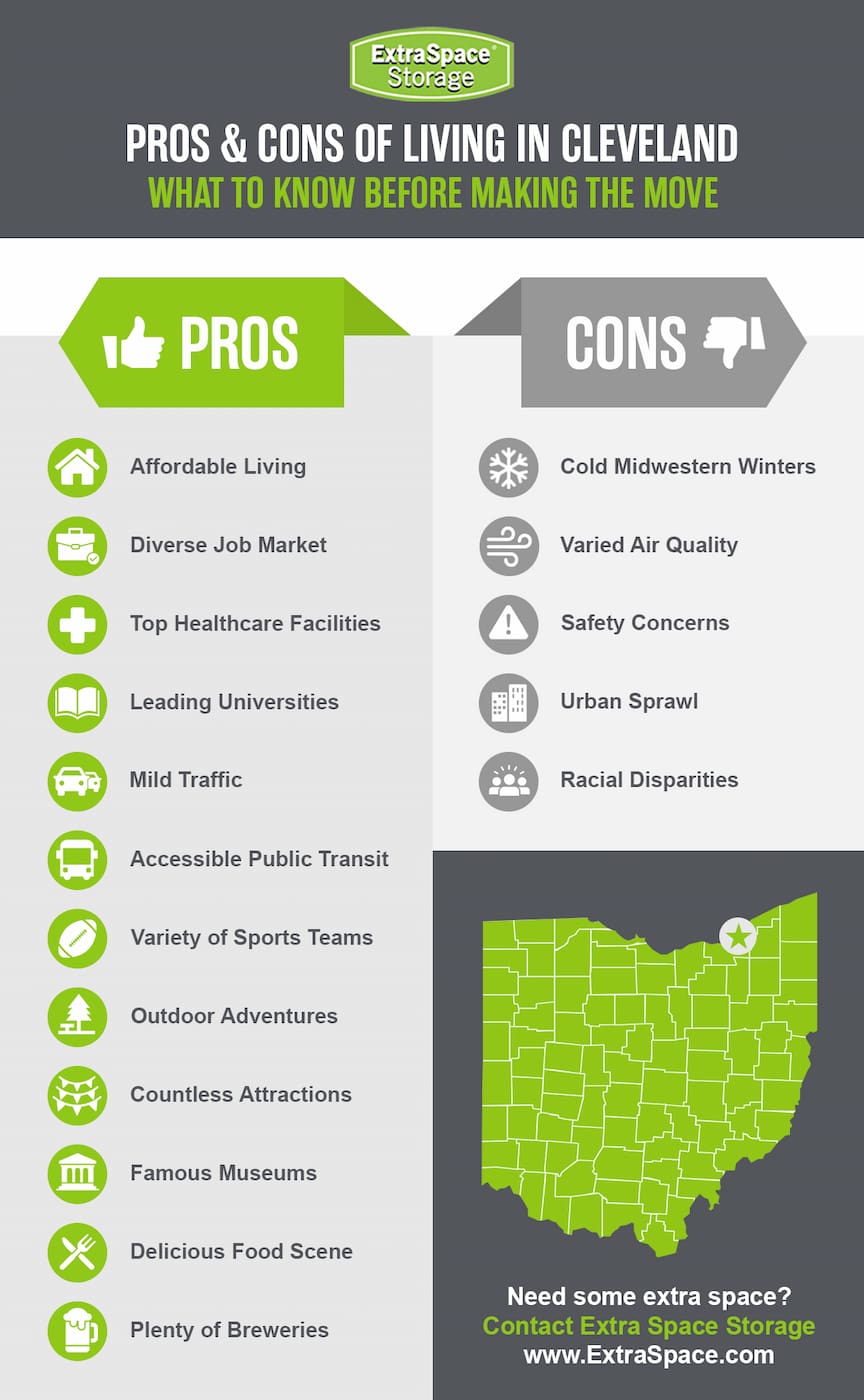
Quick Facts About Cleveland
| Population | 383,331 |
| Average Home Price | $399,663 |
| Average Monthly Rent | $1,476 |
| Average Days of Sunshine | 166 days |
| Average Commute Time | 24 minutes |
Statistics from AreaVibes, Council for Community and Economic Research (C2ER), & Best Places
Pros of Living in Cleveland
There are plenty of benefits of moving to Cleveland, including the city’s affordability, access to higher education, food and brewery scene, and more. Here are the pros to living in the CLE!
Pro: Affordable Living Near the Water
Living near the water can often break the bank, but not in The 216! C-Town is perfect for people looking for a budget-friendly lakeside city because healthcare, utilities, and transportation costs all fall below the national average. While the cost of living in Cleveland is 1% higher than the State of Ohio, it’s 7% lower than the national average. What’s more, housing in Cleveland is 4.2% lower than in similarly-sized Cincinnati, with a median home price of $399,663! Alternatively, if you’re looking to rent in Cleveland, prices are 12% lower than the national average with a median rent price of $1,476.
Pro: Diverse Job Market
Named one of the top hiring spots in 2025, finding a job in Cleveland is possible thanks to the abundance of job opportunities! The city is home to major companies like KeyBank, Progressive, and Sherwin-Williams—with information technology and financial services being among Cleveland’s top industries. Plus, Cleveland is one of the best cities for remote work—with co-working spaces like Orion Business Center and COHatch!
Pro: Excellent Healthcare Facilities
Life in Cleveland includes having access to fantastic medical care. The Cleveland Clinic, a major employer and renowned healthcare provider, is recognized as the best hospital in Ohio and one of the best hospitals in the world, with specialties in urology, rheumatology, cardiology, and heart and vascular surgery. Cleveland University Hospitals is also an option to find great healthcare services, as it is ranked as one of the best regional hospitals and nationally ranked for adult specialty care.
Pro: Leading Universities
Cleveland boasts top-tier higher education options, making it an ideal choice for people earning a degree. Here are some of the top universities in Cleveland that offer a wide range of programs:
- Cleveland State University: Located in Downtown CLE with a variety of undergraduate and graduate programs.
- John Carroll University: One of the best regional universities in the Midwest, this private institution that offers a strong Arts and Sciences program.
- Case Western Reserve University: Offers nearly 100 majors, minors, and concentrations—including art history, cognitive science, and computer gaming.
- Cleveland Institute of Art: Hone your skills in animation, game design, sculpture, photography, and more.
- Cleveland Institute of Music: Take advantage of state-of-the-art facilities while pursuing a high-quality education in music, performance, and composition.
Pro: Cleveland Has Mild Traffic
Compared to other large cities, residents say that Cleveland’s traffic is moderate, easy to navigate, and a reason for moving to the city. This is due to factors like the city’s infrastructure investments, resulting in significantly less congestion and why Cleveland is considered one of the cities with the least traffic. Its mild traffic is beneficial for those who commute downtown and to nearby areas—with an average commute time of 24 minutes, slightly less than the national average—allowing for easy travel and access to parking spaces.
Pro: Accessible Public Transit
You don’t need a car to live in Cleveland! With its great infrastructure, Downtown Cleveland is very walkable, and you can easily get around the Cleveland metro area with its robust public transportation system through the Regional Transit Authority. Cleveland’s RTA provides convenient and affordable transportation in Cleveland, including:
- An extensive network of bus routes with a rapid route
- A light rail system that runs throughout the city
- A ton of Cleveland bike share programs
- And free trolly rides during the weekdays
Pro: Variety of Cleveland Sports Teams
The City of Champions has strong, passionate fanbases for each of its local sports teams—professional and collegiate alike. Here are some sports teams in Cleveland you can root for:
- Cleveland Cavaliers (NBA) & Cleveland Monsters (AHL) at the Rocket Arena
- Cleveland Guardians (MLB) at Progressive Field
- Cleveland Browns (NFL) at Huntington Bank Field
- Cleveland State Vikings (NCAA D-1) at Wolstein Center
Pro: Plenty of Outdoor Adventures Available
The Forest City has more than enough outdoor activities for Cleveland residents. Whether you’re looking for your next picnic spot or want to enjoy the scenic beach views, these outdoor things to do in Cleveland have what you’re looking for:
- Cleveland Metroparks has 18 metro parks, over 300 miles of hiking trails, and eight lakefront parks to enjoy.
- Located in the heart of University Circle, Cleveland Botanical Garden has curated gardens and special exhibits to explore.
- Edgewater Beach in lower Edgewater Park offers a scenic shoreline and space to play beach volleyball or have a picnic.
- Euclid Beach Park, once the site of the famous Euclid Beach Amusement Park, features a 650-foot beach.
- Cuyahoga Valley National Park offers visitors waterfalls, native plants, wildlife, and more.
Pro: Countless Cleveland Attractions
CLE has a vibrant culture, with many world-renowned attractions featuring art, history, and more fun things to do. These top Cleveland attractions make for great weekend activities with family and friends:
- Cleveland Metro Parks Zoo for countless exhibits, education programs, & events
- Cleveland Aquarium for up-close looks at sharks in the Shark SeaTube
- Great Lakes Science Center for fun exhibits, summer day camps, & the Cleveland Clinic DOME Theater
- Karamu House, one of the oldest Black theaters in the U.S., for exciting productions like Queens Girl and Sistas
- Severance Music Center for Cleveland Orchestra performances and other concerns and programs
Pro: Famous Cleveland Museums
With world-class museums around every corner, Cleveland can appeal to everyone. Whether you love music or want to check out exciting rotating exhibits, these Cleveland museums will satisfy your arts craving.
- Rock & Roll Hall of Fame houses memorabilia & exhibits of famous musicians like Aretha Franklin, Marvin Gaye, or the Beatles
- Cleveland Museum of Natural History to meet a T-Rex in the Kirtland Hall of Prehistoric Life or explore the Reinberger Hall of Earth & Planetary Exploration
- Children’s Museum of Cleveland for classes and kid-friendly events in Cleveland
- Cleveland Museum of Art to catch fun events and rotating exhibits
- Museum of Contemporary Art Cleveland (MOCA) for engaging exhibits about nature and Indigenous culture
Pro: Delicious Food Scene
Cleveland is a melting pot of cultures, which is shown through a diverse assortment of delicious bites. Try the best food in Cleveland at these notable breakfast and lunch spots:
- Slyman’s for a hearty Cleveland breakfast
- Banter to try some of the best Polish boys in Cleveland
- Little Polish Diner for authentic Polish food in Cleveland
- Boom’s Pizza for diverse selections of pizza—including vegan options
- Zoma for delicious Ethiopian cuisine
Pro: Plenty of Breweries in Cleveland
C-Town has a wide selection of breweries for every beer lover! Find your new favorite beer at any of these Cleveland breweries:
- Noble Beast Brewing Co.: Small, independently owned brewery with carefully crafted drinks
- Butcher and the Brewer: Downtown Cleveland brewery with hand-built brews & draft wine
- Masthead Brewing Co.: Dog-friendly brewery featuring a 100-foot-long bar and barrel aged beer
- Great Lakes Brewing: Features an eco-friendly beer garden & a cozy beer cellar
- Terrestrial Brewing: Houses a five-barrel brewhouse & hosts Sunday Doggie Brunch events
Get Everything You Need For An Easier Move to Cleveland
Cons of Living in Cleveland
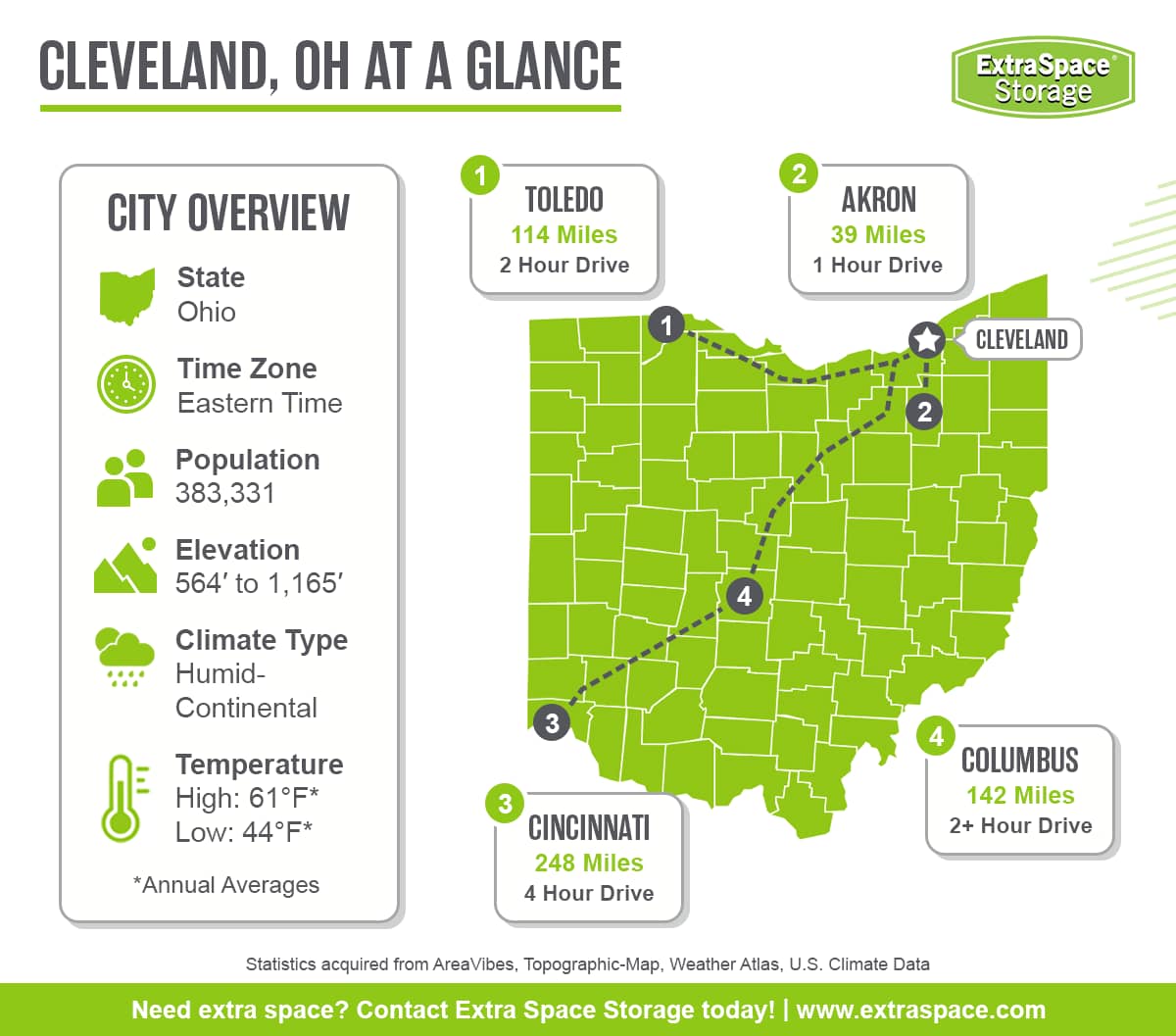
While Cleveland is a great place to visit and live, there are drawbacks of living in Cleveland to be aware of, like the city’s cold winters, poor air quality, and high crime rates. Here are some cons of living in Cleveland.
Con: Cold Midwestern Winters
Before you decide to pack up and leave for Cleveland, you’ll want to evaluate how you feel about cold weather. Since Cleveland is right next to Lake Erie, you can expect chilly temperatures and lots of snowfall due to the winter lake effect. Despite the cool temperatures, residents make the best of the weather with lots of fun winter activities, including:
- Attending the annual WinterLand to sip hot chocolate, go caroling, and celebrate the opening of the Cleveland Foundation Skating Rink with tree-lighting and fireworks
- Visiting the real A Christmas Story House & Museum
- Bundling up and enjoying live music during the Brite Winter Festival
Con: Varied Air Quality
The air quality in Cleveland has not always been the best. In the past, the city has even received an F rating for ozone pollution and a C for particulate matter like soot. Because of smog, those who have asthma or other allergies may be affected in Cleveland.
However, the city dedicates resources toward creating a safer environment for Cleveland residents through the Cleveland Division of Air Quality—with sections dedicated to air monitoring, outreach, and educating Cleveland residents through workshops. Additionally, a proposition is underway to build a land bridge from the Cleveland Mall to the North Coast Harbor, which will help combat local air pollution and create another waterfront area in Cleveland like those of Chicago or Austin.
Con: Safety Is a Known Concern
As is the case in many larger cities, crime can be a concern for those thinking about making a move—and Cleveland is no exception. The city has its share of concerns regarding crime and violence, with the crime rate being 183% higher than the national average.
This trend isn’t consistent as you move away from the city center, however. In fact, Cleveland suburbs offer tight-knit communities, easier access to green spaces, and more. Additionally, the city actively collaborates with multiple state law enforcement agencies to form a Violent Crime Reduction Initiative to ensure the safety and security of its residents. Some of the safest places to live in Cleveland include University Circle, Ohio City, Tremont, and more.
Con: Urban Sprawl
In recent years, Cleveland has dealt with urban sprawl because of economic shifts due to gentrification, which has led to residents being displaced. To address gentrification and displacement, the city has a Rescue & Transformation Plan, which addresses making housing affordable for all residents. Additionally, Cleveland Neighborhood Progress has a Middle Neighborhoods Initiative—aimed at stabilizing housing markets in the city’s middle neighborhoods—including Collinwood, West Park, and Old Brooklyn. There are also plans to develop and expand Downtown Cleveland by adding housing, restaurants, and more. On top of this, an initiative to make Cleveland a 15-minute city is underway, with a focus on safety and convenience.
Con: Cleveland’s Racial Disparities
Historically, Cleveland is one of the most racially segregated areas in the U.S., with a predominantly Black East Side and a predominantly white West Side. This can be attributed to factors like historical redlining and restrictive real estate covenants. Efforts to address the disparities include:
- DigitalC, a Cleveland-based nonprofit, which works to close the racial and digital divides in the city—specifically in underserved neighborhoods. Since January 2024, the nonprofit has helped over 4,500 homes have high-speed Internet.
- The City of Cleveland’s Racism as a Public Crisis Coalition works to tackle and reduce disparities in areas like housing and workforce development.
Despite the disparities, Cleveland remains diverse—with a population consisting of 46% Black residents and 35.5% of white residents.
Should You Move to Cleveland?
You should move to Cleveland if you’re a young professional looking for remote work, want a less congested city with easy commute times, or live in a city with a rich arts and culture scene. Before you pack up and move to Cleveland, consider your ideal lifestyle, as Cleveland experiences cold winters, varied air quality, and high crime rates.
Cleveland may be right for you if…
- You’re interested in careers in finance, healthcare, or information technology.
- You want to live in a large city with an affordable cost of living.
- You’re looking for a city with moderate traffic.
- You want to live in a city with a thriving food & beverage scene.
- You love spending time outdoors.
You may want to consider moving to another city if…
- You prefer a warm climate year-round.
- You have asthma or other allergies.
- You prefer living in a densely populated metropolitan area.
- You prefer living in a city with lower crime rates.
Cleveland Compared to Nearby Cities
Curious how Cleveland compares to nearby Pittsburgh, Detroit, and Chicago? Use the table below to decide which large metropolitan city is right for you based on your desired lifestyle.
| Factor | Cleveland, OH | Pittsburgh, PA | Detroit, MI | Chicago, IL |
| Average Monthly Rent | $1,476 | $1,599 | $1,620 | $3,230 |
| Average Home Price | $399,663 | $483,609 | $522,708 | $588,157 |
| Average Commute Time | 24 minutes | 24 minutes | 26 minutes | 35 minutes |
| Walk Score | 57/100 | 62/100 | 51/100 | 77/100 |
| Unemployment Rate | 7.4% | 3.4% | 8.2% | 5.4% |
| Major Industries | Healthcare, information technology, finance | Healthcare, education, steel | Manufacturing, healthcare, local government | Business, healthcare, technology |
Statistics from Council for Community and Economic Research (C2ER), Best Places, Walk Score, & AreaVibes
Frequently Asked Questions About Moving to Cleveland
Is Cleveland an expensive place to live?
Cleveland’s cost of living is 7% lower than the national average, making it an affordable large metropolitan city to live in. Living in Cleveland means affordable housing, utilities, transportation, and more.
Is Cleveland safe?
Despite the crime rate being 183% higher than the national average, there are plenty of safe and affordable neighborhoods in Cleveland to call home. Some of the city’s safest neighborhoods include Edgewater, Ohio City, and University Circle. Additionally, the city collaborates with state law enforcement to reduce crime through initiatives.
How cold does Cleveland get?
The average temperature in Cleveland in winter is 20 degrees. Plus, the city averages 54 inches of snow per year, significantly more than the national average. Despite the brutal winters, residents make the most of the cold weather with fun activities like winter festivals and ice skating.
What state is Cleveland in?
Cleveland is located in northeastern Ohio, on the southern shore of Lake Erie. The city is under 300 miles from Cincinnati, perfect for residents who want to take a day trip to a nearby metropolitan area for more sports and entertainment.
Is Cleveland a good place to live?
Cleveland is a good place to live because of its affordability, opportunities in remote work, and abundance of things to do. Residents of Cleveland enjoy the city’s diversity, thriving food and beverage scene, arts scene, access to Cleveland sports, and more!
***
Moving to CLE? Extra Space Storage offers self storage facilities across the Cleveland metro to help you with your move. Find Cleveland self storage today!