
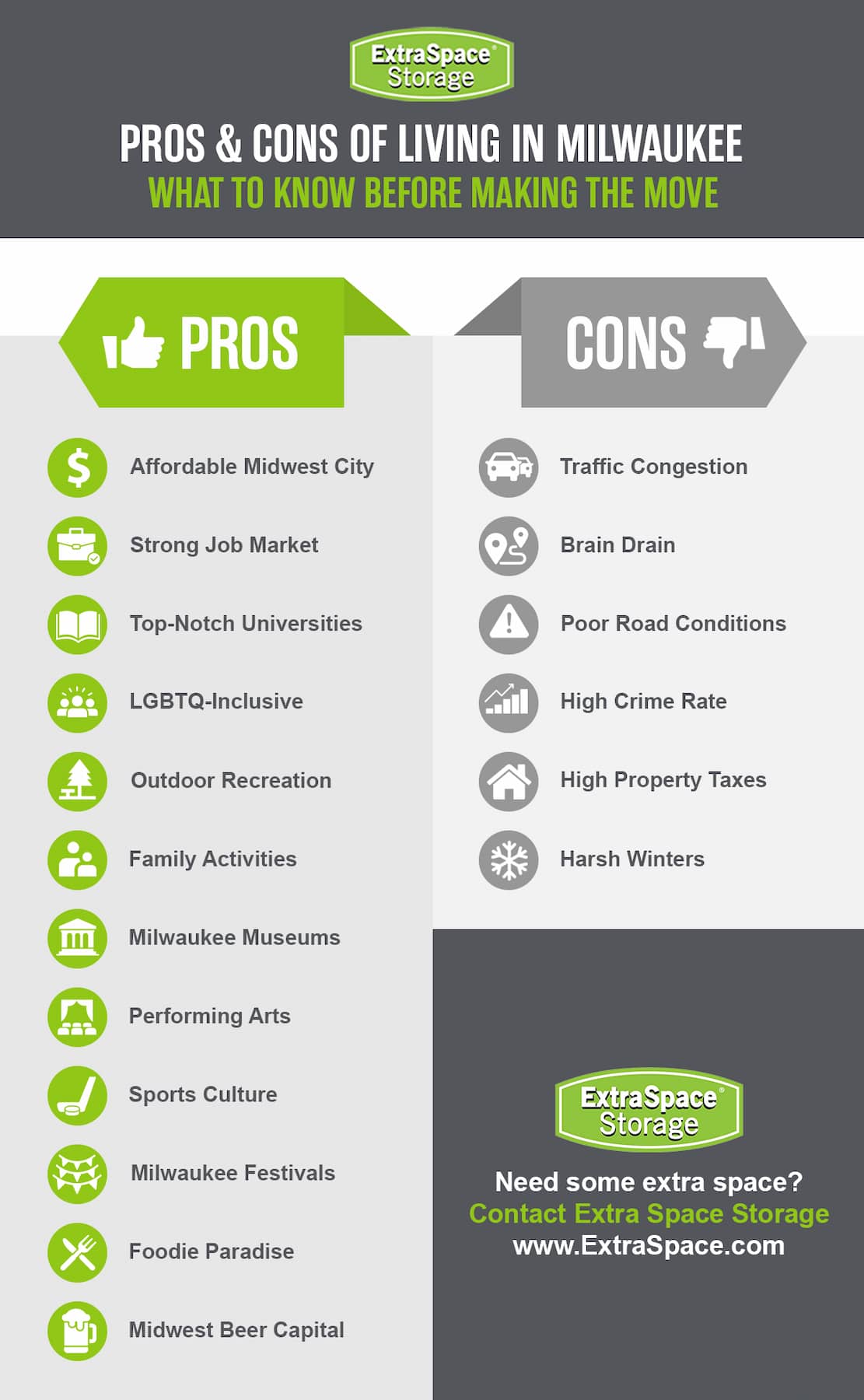
Milwaukee is a great place to live in the Midwest, offering residents a thriving job market and beautiful outdoor recreation. What residents like about living in Milwaukee is its short commute times, cultural attractions, and top-notch universities. However, moving to MKE does come with the disadvantages of high property taxes and harsh winters. Here are the pros and cons of living in Milwaukee!
Quick Facts About Milwaukee
| Population | 592,649 |
| Average Home Price | $578,988 |
| Average Monthly Rent | $1,650 |
| Average Commute Time | 22 minutes |
| Median Household Income | $43,125 |
Statistics from AreaVibes, Council for Community and Economic Research (C2ER), & BestPlaces
Pros of Living in Milwaukee
Cream City offers affordability, outdoor recreation, and top-notch higher education, making it a great place to live. Read more about the benefits of living in Milwaukee below!
Pro: Affordable Midwest City
The cost of living in Milwaukee is just 1% higher than the state and national averages, making it an affordable place to live while also having access to job opportunities, arts and culture, and a wide array of activities. On top of the reasonable overall cost of living, utilities are 7% lower than the national average, with goods and services being 3% lower. If budget is of particular concern to you, there are plenty of affordable neighborhoods in Milwaukee to look into before making a move.
Pro: Strong Job Market
The Milwaukee job market has been steady for years and currently sits at a 4.1% unemployment rate, lower than the national average. The job market is projected to grow by 28.3% over the next ten years as big-time employers make their way to the area, which is a positive sign for job-seekers wanting to build careers in key industries like medical technology, mechanical manufacturing, and water technology.
Milwaukee is also a hub for entrepreneurship, with support for small business owners coming from organizations like the Small Business Enterprise Program, Small Biz MKE, and the Small Business Development Center at UW-Milwaukee. In addition to its strong startup environment, you can find employment with one of the many Fortune 500 companies in Milwaukee, such as Northwestern Mutual, ManpowerGroup, and WEC Energy Group, as well as other top employers like Rockwell Automation, Harley-Davidson, and the Medical College of Wisconsin.
Pro: Top-Notch Universities
Those looking to further their education or get a career started can find opportunities at several universities and colleges in Milwaukee!
- Marquette University: Ranks within the top 20% of national universities & sixth nationally for job placement
- University of Wisconsin-Milwaukee: A public research university with 209 academic programs
- Milwaukee School of Engineering: A well-recognized college for students wanting careers in STEM
- Alverno College: The first Hispanic-Serving Institution in Wisconsin & one of the best colleges for women, offering a unique, ability-based curriculum
- Mount Mary University: A private women’s university with a wide variety of bachelor’s, master’s, & doctorate programs & a focus on women’s advancement
- Wisconsin Lutheran College: A best value college offering more than 45 undergraduate programs, 14 dual-degree programs, & six master’s degree programs
- Milwaukee Institute of Art & Design: Home to several highly-ranked art programs and one of the best colleges for art in America
Pro: Inclusive LGBTQ Scene
People from a variety of backgrounds will feel welcomed in the 414’s strong and inclusive LGBTQ Milwaukee community! Folks can find support and community through organizations and events like:
- Milwaukee LGBT Community Center for programming like Queer Crafternoon, Lending Library, & the Transgender & Gender Non-Conforming Program
- Equal Rights Commission, where citizen volunteers actively combat discrimination & encourage diversity
- Wisconsin LGBT Chamber of Commerce, for promoting economic growth with events like the LGBTQ Entrepreneur Bootcamp, LGBTQ Workplace Alliance, & Business Leadership Academy
- Sprocket Cafe, New Barons Brewing Cooperative, & more for supporting LGBTQ small businesses
- PrideFest Milwaukee at Henry Maier Festival Park & Milwaukee Pride Parade for live music, magic shows, & community building
Pro: Variety of Outdoor Recreation
Nature enthusiasts will rejoice at the large variety of things to do outside in Milwaukee that help residents stay active year-round! Popular parks in Milwaukee—as well as beaches along Lake Michigan—include:
- Bradford Beach for a game of sand volleyball & wading in the water
- Lake Park for bird-watching sessions, summertime concerts, & battling it out on the tennis courts
- Grant Park for walks along the Lake Michigan shoreline, hikes, & summer music events
- Veterans Park for kite-flying, bike-riding, & attending the Water Lantern Festival Milwaukee
- Brown Deer Park Golf Course, Lake Park Golf Course, & the tree-lined fairways at Dretzka Park Golf Course for a day of golfing
- Milwaukee Riverwalk for strolling along the water to look at public art, including pieces from the Water Tour project
Pro: Family Activities in Milwaukee
There’s a variety of fun things to do in Milwaukee that will help keep everyone entertained. With many kid-approved activities, families can find plenty of ways to spend time together.
- Milwaukee County Zoo to view exotic animals like green tree pythons, red-ruffed lemurs, & snow leopards
- Discovery World for interactive exhibits about science
- Betty Brinn Children’s Museum for hands-on play & accessible events
- David F. Schultz Aquatic Center to splash around & keep cool at the pool
- Mitchell Park Domes to see tropical, desert, & floral plants
Pro: Check Out Milwaukee Museums
Milwaukee offers a strong arts and culture scene, full of art museums and historical sites throughout the area.
- Bask in the beauty of more than 32,000 works of art at the Milwaukee Art Museum.
- Dive in to Wisconsin history, look at 200,000 botanical specimens, admire roughly 300,000 photographs, and watch a planetarium show at the Milwaukee Public Museum.
- Learn about motorcycle history at the Harley-Davidson Museum.
- Explore maritime history and enjoy views of Lake Michigan at the North Point Lighthouse.
- Learn about the Pabst family and marvel at the Gilded Age architecture at the Pabst Mansion.
Pro: Variety of Performing Arts
Love live music and theatre? There are a ton of venues for the performing arts in Milwaukee! Here are some venues to check out:
- First Stage for family-friendly theatre shows
- Skylight Music Theater for local play & musical productions
- The Florentine Opera for world-class performances put on by Milwaukee’s oldest professional performing arts organization
- Milwaukee Chamber Theatre for compelling stage productions
- Turner Hall Ballroom, for live music & concerts located inside the National Historic Landmark Turner Hall
- Riverside Theater for touring performances
- The Laughing Tap for live comedy shows
Pro: Sports Culture
If there’s one thing residents of this city love to do, it’s cheering on Milwaukee sports teams! From basketball to baseball, here are the teams to watch:
- Milwaukee Bucks (NBA) at Fiserv Forum
- Milwaukee Brewers (MLB) at American Family Field
- Milwaukee Admirals (AHL) or Milwaukee Wave (MASL) at the UWM Panther Arena
- Milwaukee Milkmen (AAPB) at Franklin Field
- Marquette Golden Eagles (NCAA D-I) women’s volleyball team at Al McGuire Center
Pro: Milwaukee Festivals
Known as the City of Festivals, residents can have fun at festivals and events year-round. From live music festivals to airshows, here are the most popular events in Milwaukee:
- Rock out to live music with thousands of other attendees across 11 stages with nationally-touring acts at Summerfest.
- Celebrate Celtic culture at the annual Milwaukee Irish Fest.
- Experience Eastern European food and culture at Polish Fest, the largest in America!
- Celebrate the culture with authentic food, music, and entertainment at German Fest Milwaukee—the largest German festival in North America.
- Have fun with rides, games, and classic fair foods at the Wisconsin State Fair.
- Catch high-flying thrills and water performances at the WaterStone Bank Air & Water Show.
Pro: Foodie Paradise
Residents have their pick of good places to eat in Milwaukee, with a unique restaurant around every corner! Here are a few Milwaukee restaurants that are favorites among residents:
- Allie Boy’s Bagelry & Luncheonette for hearty, bagel-focused breakfast or lunch
- San Giorgio Pizzeria Napoletana for authentic Neapolitan pizza
- Mader’s Restaurant for the best German food in Milwaukee
- Milwaukee Brat House for classic Wisconsin brats & comfort food
- Leons Frozen Custard for dessert in Milwaukee
Pro: Midwest Beer Capital
With a long history of breweries in Milwaukee, this city has rightly garnered the nickname of Brew City. See why MKE is recognized as one of the United States’ best beer cities and sometimes known as the beer capital of the Midwest when you visit these local breweries!
- Lakefront Brewery for locally brewed beer & fun events
- Third Space Brewing for enjoying handcrafted beer in their outdoor beer garden
- The Brewery for drinking beer brewed on-site & playing a game darts
- Miller Brewery for sampling classic brews & touring the historic site
- Estabrook Beer Garden, which has the first public beer garden in the U.S.
- Milwaukee Pedal Tavern for a mobile pub & pub crawl in the Historic 3rd Ward
- Sour Fest for unlimited samples of dozens of sour beers from across Wisconsin
Get Everything You Need For An Easier Move to Milwaukee
Cons of Living in Milwaukee
While there are plenty of upsides, there are still disadvantages to living in Milwaukee to consider before moving there, such as high property taxes and snowy winters. When deciding whether it’s the right city for you, keep these cons of moving to MKE in mind.
Con: Traffic Congestion During Rush Hour
Even though the average commute time in Milwaukee is only 22 minutes, certain areas of the city experience high congestion, like the Marquette Interchange and Zoo Interchange. Milwaukee also ranks as one of the worst cities for speeding, though traffic deaths have gone down due to city and community initiatives. If you want to avoid driving your own car, Milwaukee does have some other transportation options available for residents:
- Milwaukee County Transit System (MCTS) for bus service throughout the city
- Hop Milwaukee Streetcar for free rides in Downtown Milwaukee
- Milwaukee Scooters & Bublr Bikes for casual rides around town
- Lake Express Ferry for easy travel between Milwaukee & Muskegon, MI
- Milwaukee Intermodal Station & Milwaukee Mitchell International Airport for long-distance travel
Con: Brain Drain
Milwaukee has faced challenges in retaining college graduates and young professionals after graduation, as many move to larger metro areas looking for higher salaries and more opportunities. Referred to as “brain drain,” this affects the city’s ability to maintain talent in the workforce, despite the generally strong job market. To help address this, the city has launched initiatives such as the Millennial Task Force and programs like All-In Milwaukee—which connects students and graduates with local employers and encourages them to build careers in Milwaukee.
Con: Poor Road Conditions
Milwaukee has struggled with deteriorating road conditions and aging infrastructure throughout the area. The Department of Public Works reports that it would cost $821 million to bring the poorly rated roads up to good condition, with $752 million needed to repair neighborhood streets. Limited state funding has made it hard to keep up with repairs, but city leaders are exploring additional local funding options to improve roads and infrastructure.
Con: High Crime Rate
The city has a higher-than-average crime rate—but crime in Milwaukee has dropped significantly. To continue reducing crime, the Milwaukee Police Department has plans to utilize initiatives like Blueprint for Peace and the Alert Neighbor Program to address safety concerns in various Milwaukee neighborhoods. You’ll need to determine your personal comfort levels when choosing where to live in Milwaukee, as certain areas of the city are safer than others.
Con: Milwaukee’s High Property Taxes
If you’re thinking about buying a home in Milwaukee, you’ll need to take into account that Wisconsin has some of the highest property tax rates in the nation. Specifically, Milwaukee County has an average property tax of 1.68%, which is double the national average. Plus, the city’s housing prices are 8% higher than the state and national averages. However, finding homes in affordable neighborhoods can help offset the high taxes and home prices, and the city housing authority offers housing assistance for those who need it.
Con: Harsh Winters
One thing residents need to deal with each year is the harsh Milwaukee weather, particularly during the winter months. January is the snowiest and coldest month, averaging 13 inches of snow and an average temperature of 14 degrees. Fortunately, the weather in Milwaukee tends to be milder the rest of the year than in many other Midwestern cities, with July highs averaging around 83 degrees. While waiting for warmer weather, you can still experience fun indoor things to do in Milwaukee! Take skating lessons and glide across the ice during public hours at the Pettit National Ice Center, catch the latest blockbuster films and timeless classics at the Oriental Theatre, and more.
Should You Move to Milwaukee?
You should move to Milwaukee if you’re looking for outdoor recreation, a strong job market, and a variety of things to do. Before making the decision, consider your tolerance for weather, reliance on public transportation, and budget for housing.
Milwaukee may be the right fit for you if…
- You’re looking for a career in top industries like medical technology, manufacturing, and water technology.
- You want to attend high-ranking universities and colleges.
- You want a variety of things to do.
- You enjoy going to festivals and events.
You may want to consider moving to another city if…
- You want to live somewhere known for its safety.
- You want to pay lower property taxes.
- You rely on public transit.
- You dislike cold, snowy winters.
Milwaukee Compared to Nearby Cities
Wondering what Milwaukee vs. Madison is like, or if living in Milwaukee is a better option than in Chicago or Minneapolis? Compare MKE to other popular Midwest cities with these fast facts.
| Factor | Milwaukee, WI | Chicago, IL | Madison, WI | Minneapolis, MN |
| Average Monthly Rent | $1,650 | $3,230 | $1,291 | $1,426 |
| Average Home Price | $578,988 | $588,157 | $638,960 | $404,910 |
| Average Commute Time | 22 minutes | 35 minutes | 19 minutes | 23 minutes |
| Walk Score | 62/100 | 77/100 | 50/100 | 71/100 |
| Unemployment Rate | 4.1% | 5.4% | 2.0% | 3.9% |
| Major Industries | Medical technology, mechanical manufacturing, energy | Manufacturing, transportation, healthcare | Healthcare, manufacturing, information technology | Technology, agriculture, retail |
Statistics from Council for Community and Economic Research (C2ER), BestPlaces, Walk Score, & AreaVibes
Frequently Asked Questions About Moving to Milwaukee
What salary lets you live comfortably in Milwaukee?
A comfortable lifestyle in Milwaukee for a single adult with no children is an annual salary of nearly $44,000 before taxes. With a median household income in Milwaukee of around $43,125, it’s possible to make a decent living. Residents can buy a home in safe, affordable neighborhoods in Milwaukee without giving up access to great amenities.
Is Milwaukee safe?
While Milwaukee’s crime rates are significantly above the state and national averages, crime rates are slowly improving. Like any major city, safety varies by area, with neighborhoods like Northpoint, Story Hill, and Washington Heights—as well as Milwaukee suburbs like Brookfield and Waukesha—offering peaceful, friendly environments with low crime rates.
Is Milwaukee cold?
Winters in Milwaukee can be quite cold, with average temperatures ranging from 10 to 20 degrees. Freezing temperatures and frequent snow are common in January—during the winter season, the city averages about 45 inches of snow, which can make driving more difficult.
What state is Milwaukee in?
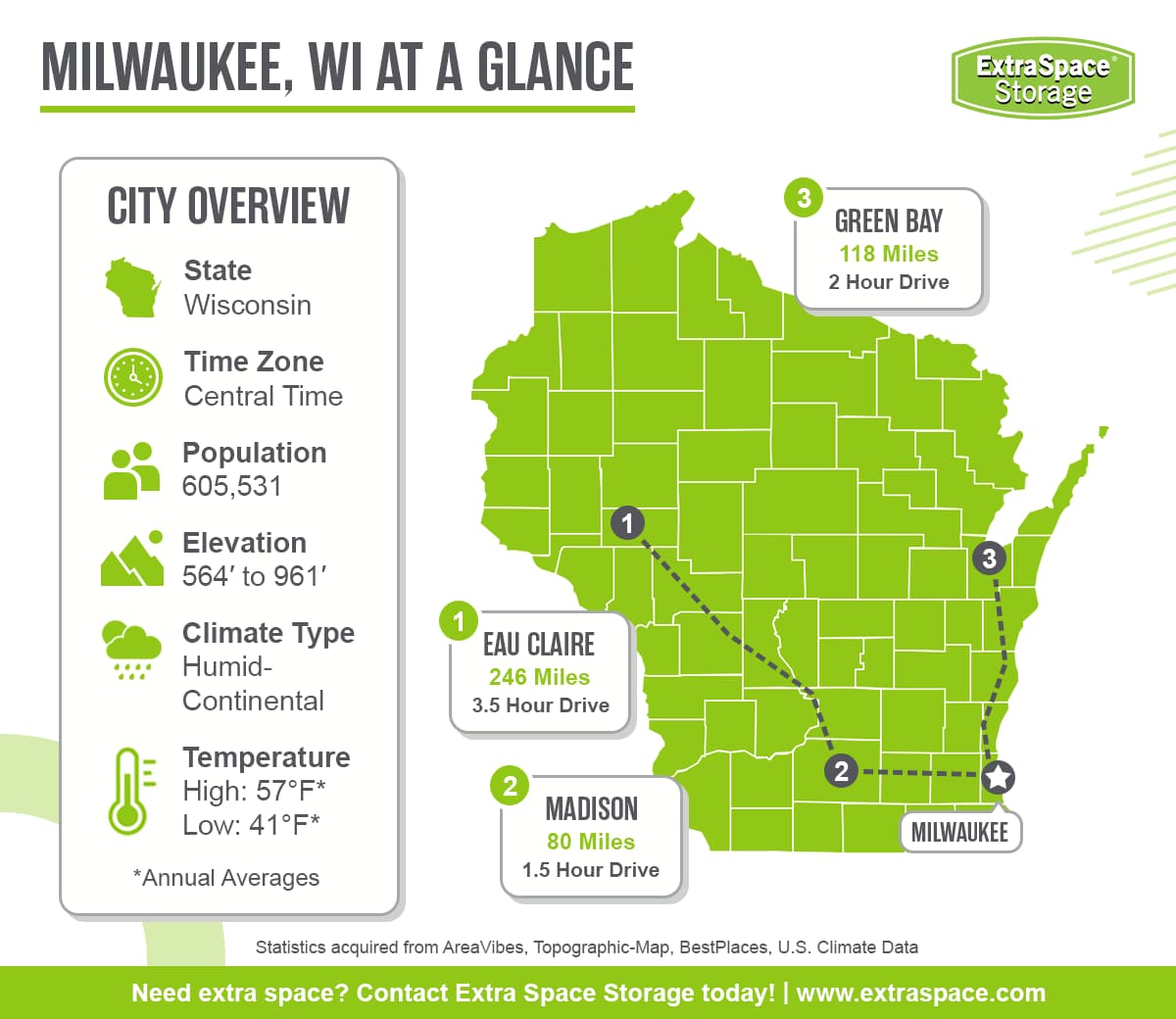
The largest city in Wisconsin, Milwaukee is located in the southeastern corner of the state, about an hour and a half north of Chicago, two hours south of Green Bay, and an hour and a half east of Madison. Situated along Lake Michigan, the city offers scenic lakefront views and outdoor recreation.
Is Milwaukee a nice place to live?
Milwaukee is a great place to live, whether you’re a young professional or want to settle down with a family. With a growing job market across many industries, an affordable cost of living, and plenty of things to do, Cream City has something for everyone. The City of Festivals also offers a fun social scene that includes live music and local breweries.
***
Relocating to Milwaukee? Extra Space Storage has storage facilities located throughout the city. Rent a storage unit near you today!