Helpful Relocation Resources for Baltimore, MD Newcomers
Relocating to Baltimore, MD? Whether you're still choosing a move date or already unpacking, this guide gathers the costs, resources, and local steps that matter most when settling in. From moving costs and storage to a first 30-day checklist and local resource directory, here's what you need to get set up as you plan your move to Baltimore.

Planning Your Move to Baltimore

Cost of Movers in Baltimore, MD
Find out what hiring movers costs in Baltimore when moving locally or long-distance. Explore hourly moving rates and what to expect for planning your move.

Best Movers in Baltimore, MD
Check out our recommendations for the best moving companies in Baltimore, MD.

Free & Cheap Moving Boxes in Baltimore, MD
Learn where to find free and cheap moving boxes near you in Baltimore—and where to recycle them!
Baltimore Self Storage & Moving Day Logistics
Whether you're dealing with lease gaps, a delayed home closing, or staging needs, self storage can be a practical option when moving in Baltimore. Learn how to use storage during your move and find a facility near you.
Self Storage in Baltimore
Extra Space Storage has dozens of locations across the Baltimore area, including facilities near Mount Vernon, Federal Hill, and Fells Point. Unit sizes range from 25 square feet to more than 300 square feet and can come with amenities and features like climate control, drive-up access, and more.
Choosing the Right Storage Unit in Baltimore
When selecting a storage unit in Baltimore, a few factors are worth weighing before reserving:
Climate Control: Baltimore summers are hot and humid, with average highs near 88 degrees and high humidity from June through September, and winters can bring snow. Climate-controlled units help protect sensitive items like furniture, electronics, documents, and clothing from temperature changes. → Climate-Controlled Storage Guide
Unit Size Guide: 5x5 (small closet or multiple boxes), 5x10 (studio apartment), 10x10 (1-bedroom home), 10x20 (2–3 bedroom home), 10x30 (large home or vehicle). → Storage Unit Size Guide
Access & Security: Look for extended or 24-hour gate access, electronic gate entry, on-site resident management, and video surveillance. These features are standard at most Extra Space Storage facilities. → 24-Hour Access Storage
Lease Flexibility: Month-to-month leases mean you're not locked into a long-term agreement, which is useful when move timelines are still in flux. Units can be upgraded or downsized as needs change.
How to Use Storage In Between Homes
If your lease ends before your new place is ready, or a closing date shifts, a storage unit can hold your belongings until you move in. Storage also helps when you're staging a home for sale or moving into a smaller apartment or home.
Explore Baltimore: Neighborhoods, Cost of Living, & What to Expect
Different Baltimore neighborhoods and areas have different housing types, costs of living, and commutes. Use these guides to compare your options before choosing where to land.
Cost of Living in Baltimore
Baltimore's cost of living is approximately 1% above the national average, with housing prices playing a large factor in overall costs. See how housing, utilities, groceries, and transportation compare before you set your budget.
Pros & Cons of Living in Baltimore
Every city comes with trade-offs. Review the advantages and challenges of living in Baltimore before you commit, from commute times to property taxes.
Things to Know About Baltimore
Some local knowledge doesn't show up in a quick search. Learn what residents wish they'd known before moving to Baltimore.
Best Neighborhoods in Baltimore
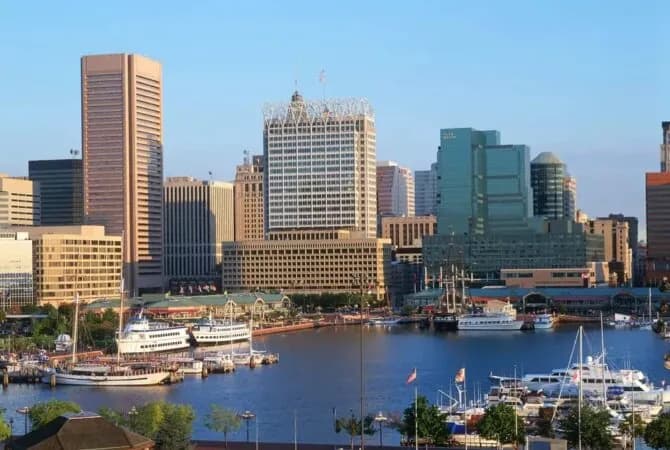
Safe, Affordable Neighborhoods in Baltimore
There are plenty of neighborhoods throughout Baltimore that balance affordability with safety. Check out top choices like Inner Harbor, Mount Washington, Riverside, and more.
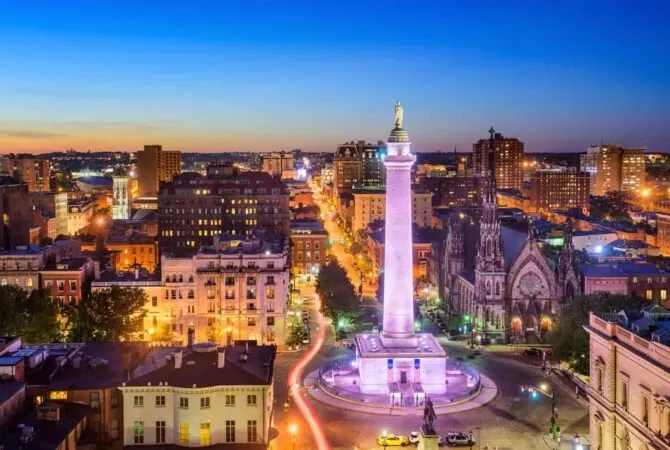
Best Neighborhoods in Baltimore for Singles & Young Professionals
With plenty of career opportunities and a growing art scene, Baltimore is a great city for young adults. Some of the best neighborhoods include Downtown Baltimore, Locust Point, Mount Vernon, and more.
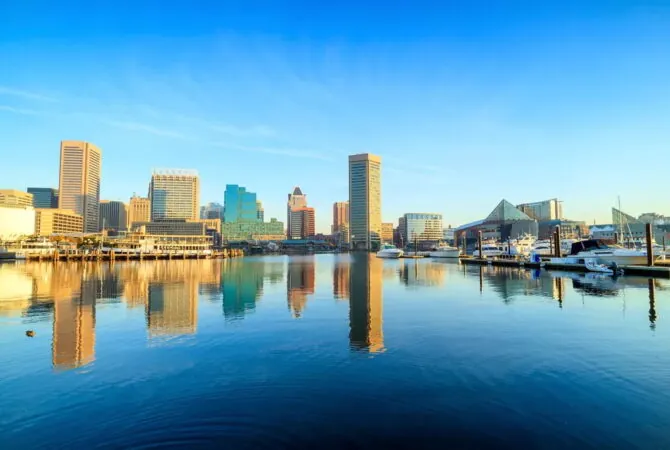
Best Neighborhoods in Baltimore for Families
Snippet: Baltimore has great family-friendly neighborhoods that offer top-rated schools and community amenities. Consider Federal Hill, Hampden, Roland Park, and more!
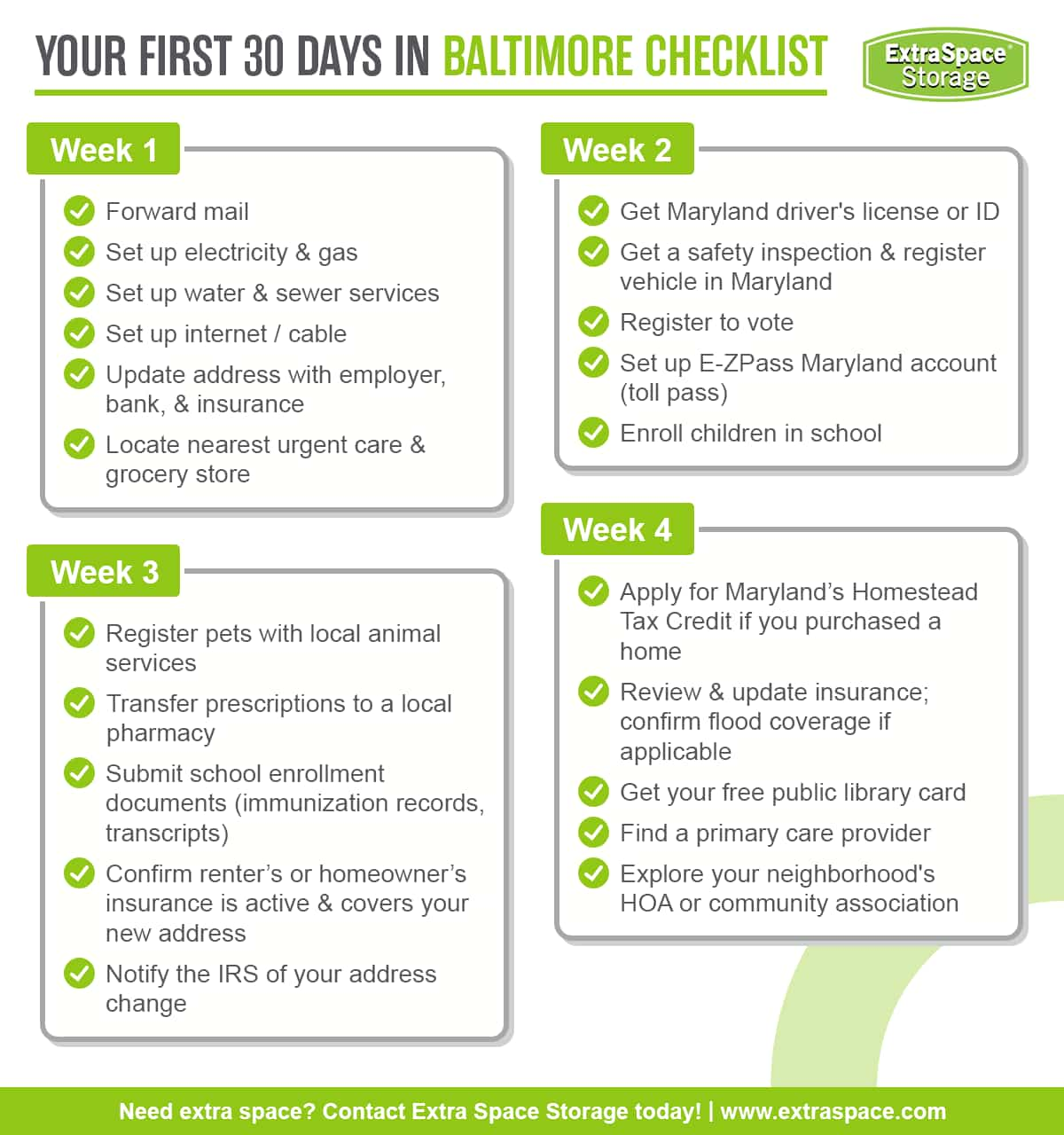
Your First 30 Days in Baltimore: Quick-Start Checklist
The first month after a move involves a set of administrative and practical tasks. This checklist organizes what new Baltimore residents need to handle, from week one to week four. Download our checklist below to help you settle in!
Local Resources for New Baltimore, MD Residents
There are a few must-do tasks to remember after moving to Baltimore—government setup, schools, healthcare, transportation, financial and legal steps, emergency preparedness, and employment. Unless noted, resources apply to Baltimore City, not Baltimore County.
Government & Administrative Setup in Baltimore
Maryland gives new residents 60 days to get a driver's license and to title and register their vehicles. Utilities, pet licensing, and most city services in Baltimore are handled through Baltimore City agencies, with 311 as the main contact for city services.
Government & Administrative Setup | |
Driver's License | New residents must get a Maryland driver's license within 60 days of becoming a resident. Apply at an MDOT MVA branch and bring documents proving your identity, Social Security number, and Maryland residency. → Get Your Driver's License |
Vehicle Registration | Title and register your vehicle within 60 days of moving to Maryland. A Maryland Safety Inspection is required before titling a used vehicle, and the MVA can issue a 30-day temporary tag so you can drive to an inspection station. Baltimore City is also in Maryland's Vehicle Emissions Inspection Program (VEIP), which requires an emissions test every two years. Vehicles kept in Maryland with out-of-state plates can be fined $7 per day after a 60-day warning period. → Title & Register Your Vehicle |
Voter Registration | Register to vote online, by mail, or through the Maryland MVA. The advance registration deadline is 21 days before election day. Maryland also offers same-day registration during early voting and on election day. → Maryland State Board of Elections |
Utilities Setup | Baltimore's primary electricity and natural gas provider is Baltimore Gas and Electric (BGE). The Baltimore City Department of Public Works handles water and sewer, plus trash and recycling. For internet access, find private providers available at your address. |
Toll Pass | Maryland tolls are fully electronic, with no cash lanes. E-ZPass Maryland accounts are managed through DriveEzMD. → DriveEzMD (E-ZPass Maryland) |
Pet Registration | Baltimore City requires a license for all dogs and cats over 4 months old. Proof of current rabies vaccination is required. A lifetime license ($100) is available for pets that are spayed or neutered, microchipped, and vaccinated. Animal Control complaints go through 311. → Baltimore City Pet License |
School & Family Resources in Baltimore
Baltimore City Public Schools serves students who live within city limits, while Baltimore County Public Schools serves the surrounding suburbs and unincorporated areas. Middle and high school students can participate in the citywide School Choice Process, so check timelines early if you have older children.
Schools & Family Resources | |
K–12 Public Schools | Baltimore City Public Schools serves over 76,000 students. Children who are five years old by September 1 must be enrolled in kindergarten. → Find a City School |
School Enrollment | Register online on the Student Enrollment Management System or bring proof of address, birth certificate, and up-to-date immunization records to the Office of Enrollment, Choice, and Transfers. Middle and high school students who want a school other than their zoned option apply through City Schools' choice process, which typically opens in December with applications due in mid-January.→ City Schools Enrollment |
Charter & Private | City charter schools run their own applications, and most charter deadlines fall in early February. Maryland's BOOST Scholarship Program provides awards for some students eligible for free or reduced-price meals to attend participating nonpublic schools. → BOOST Scholarship Program |
Higher Education | Colleges and universities in the city include Johns Hopkins University, University of Maryland Baltimore, Morgan State University, Coppin State University, University of Baltimore, Loyola University Maryland, Notre Dame of Maryland University, and Baltimore City Community College. In-state tuition eligibility is set by each public institution's residency policy. |
Child Care | Maryland's Child Care Scholarship Program helps eligible families pay for child care. → Child Care Scholarship Program |
Healthcare in Baltimore
Baltimore is home to several large hospital systems, along with urgent care clinics and pharmacies across the city. Maryland designates trauma centers through its state EMS agency, MIEMSS.
Healthcare Overview | |
Major Health Systems | Major health systems in Baltimore include Johns Hopkins Medicine, University of Maryland Medical System, LifeBridge Health, and MedStar Health. |
Finding a PCP | Use your health insurer's online provider directory to find in-network primary care doctors, then confirm the practice is accepting new patients. Each health system above also offers an online provider search. |
Urgent Care | Hospital systems and independent chains operate urgent care and walk-in clinics throughout Baltimore. Many accept walk-ins and online check-in; confirm network status with your insurer before your visit. |
Mental Health | The Baltimore City Health Department offers various mental health resources, including a 24/7 line for mental health and substance use help. The Behavioral Health System Baltimore offers various other mental health resources |
Pharmacy | Pharmacies in Baltimore include local options, supermarket pharmacies, and national chains such as CVS and Walgreens. To transfer a prescription, give your new pharmacy your previous pharmacy's contact information. |
Transportation in Baltimore
Baltimore's transit system is run by the state, through MDOT MTA, and connects to rail service toward Washington, DC, and New York City. Drivers should plan for tolled harbor tunnels.
Transportation Essentials | |
Toll Pass Setup | Open an E-ZPass Maryland account through DriveEzMD to pay the base toll rate. Without a transponder, you can register your plate and card for Pay-By-Plate on Maryland toll facilities. Drivers who use neither are billed a Video Toll by mail at a higher rate. E-ZPass Maryland transponders work across the E-ZPass network. → DriveEzMD (E-ZPass Maryland) |
Key Toll Roads | Fort McHenry Tunnel (I-95) and Baltimore Harbor Tunnel (I-895) cross the harbor. The I-95 Express Toll Lanes run northeast of the city toward Harford County. |
Public Transit | MDOT MTA operates buses, light rails, subways, and trains. Pay with the CharmPass mobile app. A one-way core-service fare includes free transfers for two hours. The city also runs the Charm City Circulator, a free downtown bus service. |
Airport Access | Baltimore/Washington International Thurgood Marshall Airport (BWI) is the primary airport in Baltimore. It is reachable by car and by public transport. Follow airport signage for rideshare pickups. |
Major Roadways | I-95 runs through the city between Washington, DC, and Philadelphia. I-83 (Jones Falls Expressway) connects downtown to northern neighborhoods and Baltimore County. I-695 (the Baltimore Beltway) circles the region, with the Key Bridge segment closed until the replacement opens. I-895, I-70, and the Baltimore-Washington Parkway (MD 295) also serve the metro. |
Financial & Legal Setup in Baltimore
Baltimore City residents pay both a state income tax and a city income tax, and the city's property tax rate is the highest in Maryland. Homeowners should apply for the state's Homestead Tax Credit soon after buying.
Financial & Legal Considerations | |
State Income Tax | Maryland has a graduated state income tax, plus a local income tax collected on the same state return. Baltimore City's local rate is 3.20% (tax year 2026). Update your withholding with your employer using Maryland Form MW507. |
Homestead Exemption | Maryland does not offer a traditional homestead exemption. Instead, the Homestead Tax Credit limits how much the taxable assessment on a principal residence can rise each year. Baltimore City's cap is currently 4%, and the City Council has approved raising it to 5% beginning in fiscal year 2028. Homeowners must submit a one-time application to the Maryland State Department of Assessments and Taxation (SDAT). Income-based relief is available through the Homeowners' Property Tax Credit. → Maryland Homestead Tax Credit (SDAT) |
Homeowners Insurance | Some Baltimore homeowners may need to purchase flood coverage, in addition to their standard homeowner or renter policy. Check your address on the FEMA Flood Map before choosing coverage. |
Vehicle Insurance | Maryland requires liability coverage of at least $30,000 per person and $60,000 per accident for bodily injury and $15,000 for property damage, matching uninsured motorist coverage, and $2,500 in personal injury protection (PIP). Coverage lapses are reported to the MVA and can result in daily fees. → Maryland Insurance Administration |
Address Updates | Update your address with the IRS (Form 8822), Social Security Administration, banks, your health insurer, your voter registration, and USPS. → USPS Change of Address |
Baltimore Emergency Preparedness & Safety
Baltimore City uses 311 for non-emergency police and fire calls, and the city's Office of Emergency Management sends alerts through BMORE Alert. Save these contacts before you need them.
Emergency Contacts & Safety Resources | |
Emergency | 911 |
Baltimore City Non-Emergency | Call 311 for non-emergency police and fire calls and other city services (inside city limits). → Baltimore City Important Phone Numbers |
Poison Control | 1-800-222-1222 |
State Crisis Line | Maryland residents can reach crisis support by calling or texting 988. |
988 Suicide & Crisis Lifeline | 988 (call or text) |
Emergency Alerts | Sign up for BMORE Alert, Baltimore City's official mass notification system, to receive emergency alerts by phone, text, and email. → BMORE Alert |
Natural Disaster Info | Baltimore can be affected by hurricanes and tropical storms, extreme summer heat, winter storms, and flooding. The Office of Emergency Management publishes preparedness guidance and local hazard information. → Baltimore City Office of Emergency Management |
FEMA Flood Map | Check your property address to see if you are in a flood-prone area. → FEMA Flood Map |
Employment Resources in Baltimore
Healthcare and higher education are two of Baltimore's largest industries, alongside finance, research, and port-related logistics. These state and local resources can help with your job search.
Employment Resources in Baltimore | |
Major Industries | Healthcare, higher education, biomedical research, financial services, and port and logistics operations. |
Top Employers | Major employers in Baltimore City include Johns Hopkins University, Johns Hopkins Medicine, the University of Maryland, the U.S. Social Security Administration, H&S Bakery, and Marriott International. |
Job Search Tools | LinkedIn, Indeed, and Glassdoor list Baltimore openings. Filter by city or ZIP code. |
State Job Portal | The Maryland Workforce Exchange lists job openings and connects job seekers with American Job Centers. → Maryland Department of Labor — Employment |
Unemployment Benefits | File and manage claims through the Maryland Unemployment Insurance Portal (BEACON), and document weekly job searches in the Maryland Workforce Exchange. Benefits depend on prior wages and eligibility. If you're moving after a job loss, check how a move affects your claim. → Maryland Unemployment Insurance |
Professional Networking | The Greater Baltimore Committee, a regional business and civic organization, connects employers, nonprofits, and institutions across the Baltimore region. Industry associations and alumni groups also host local events. → Greater Baltimore Committee |
Staffing & Temp Agencies | Robert Half operates a Baltimore office placing temporary and full-time candidates in finance, technology, administrative, and legal roles. Baltimore City's Mayor's Office of Employment Development (MOED) also runs free job centers with career assistance and training. → MOED Job Centers |
Baltimore Community Resources & Amenities
Public Library: The Enoch Pratt Free Library operates a Central Library and neighborhood branches across the city. Anyone who lives or owns property in Maryland is eligible for a free library card with an approved ID. Maryland residents can also register online for an eCard with access to eBooks and audiobooks on Libby and films on Kanopy.
Parks & Recreation: Baltimore City Recreation & Parks manages city parks, pools, and recreation centers, including Druid Hill Park and Patterson Park. Baltimore County runs its own separate parks department.
Neighborhood Associations & Civic Resources: Many Baltimore neighborhoods have active community associations. Live Baltimore, a nonprofit, publishes neighborhood profiles and homebuying resources, and the Department of Planning shares area-by-area project updates.
Local Media: The Baltimore Banner, The Baltimore Sun, and WYPR 88.1 FM cover local news.
Quinn Johnson
Quinn Johnson is a moving expert and author for Extra Space Storage. He's moved over 15 times, including internationally, and helped countless others between their own homes. He's happy to lift some boxes for a friend as long as he's paid in pizza. As a writer and content creator for Extra Space Storage since 2019, Quinn shares helpful moving tips and info to alleviate the common stresses of moving.