Helpful Relocation Resources for Charlotte, NC Newcomers
Relocating to Charlotte, NC? Whether you're still finalizing your move date or you've already handed over the keys, our helpful Charlotte relocation guide brings together resources, costs, and local knowledge that actually matter when settling in. From moving costs and the best moving companies to a moving checklist for your first 30 days, here's everything you need for your move to Charlotte.

Planning Your Move to Charlotte

How Much Does It Cost to Move to Charlotte?
Hiring movers in Charlotte for local or regional moves costs between $200 and $4,971, while long-distance movers in Charlotte run between $3,125 and $17,333, depending on distance and the size of your home. For detailed pricing, see the full guide below.

Best Moving Companies in Charlotte
Moving away from Charlotte or moving to Charlotte from a nearby metro area? We've researched and compiled the top moving companies in the area to help with your transition. See our top choices and get a quote today.

Free & Cheap Moving Boxes in Charlotte
Charlotte has no shortage of places to find free or affordable moving boxes—from online exchanges and Buy Nothing groups to local retailers and self storage facilities—as well as options for recycling them once you're done.
Charlotte Self Storage & Moving Day Logistics
Self storage can be a convenient solution for a variety of scenarios when moving in Charlotte. See how you can use storage during your move, and find a facility near you.
Self Storage in Charlotte
Whether you need short-term storage during a home transition or a longer-term solution after your move, Extra Space Storage has facilities throughout the Charlotte metro—offering a wide range of unit sizes and convenient amenities like climate control. Find a unit near your new home today.
Choosing the Right Storage Unit in Charlotte
The right storage unit for you depends on what you're storing, how long you'll be renting it, and how often you need access. Here are four key factors to consider:
Climate Control: Climate-controlled storage is strongly recommended for providing extra protection against Charlotte's heat and humidity—especially if you're storing sensitive items like furniture, electronics, documents, and clothing. → Climate-Controlled Storage Guide
Unit Size: 5x5 (small closet or boxes); 5x10 (studio apartment); 10x10 (1-bedroom home); 10x20 (2–3 bedroom home); 10x30 (large home or vehicle). → Interactive Storage Unit Size Guide
Access & Security: Look for 24-hour or extended access hours, as well as security features like electronic gate access, on-site management, and video surveillance. Extra Space Storage facilities include most of these features as standard. → Find 24-Hour Access Storage in Charlotte
Lease Flexibility: Month-to-month leases mean you're not locked into a long-term rental agreement, which is ideal when move timelines are uncertain. You can also upgrade or downsize as your needs change.
How to Use Storage In Between Homes
Short-term storage can help bridge the gap between your old address and your new one. Lease gaps, delayed home closings, and staging situations are all common reasons to rent self storage during a Charlotte move.
Explore Charlotte: Neighborhoods, Cost of Living, & What to Expect
Charlotte's metro spans a wide range of neighborhoods—from walkable urban areas to established family suburbs and emerging corridors in between. Commute times, cost of living, and more vary by area. Use these guides to determine which part of Charlotte is right for your lifestyle.
Cost of Living in Charlotte
Charlotte's cost of living sits 1% below the national average, with overall housing costs running 15% lower than the national rate—making it one of the more affordable cities to call home in the Southeast.
Pros & Cons of Charlotte
Charlotte offers a growing job market and mild climate, but also a higher-than-average crime rate and limited public transit. Here's a closer look at the pros and cons of calling the Queen City home.
Things to Know About Charlotte
From why locals say "Uptown" instead of "Downtown" to what to expect from the weather and neighborhoods, this guide covers local Charlotte knowledge that doesn't always turn up in a quick search.
Best Neighborhoods in Charlotte

Safe, Affordable Neighborhoods in Charlotte
Many Charlotte neighborhoods, such as Ballantyne West, Barclay Downs, Chantilly, Providence Crossing, and Sardis Woods, offer safety and community appeal. These areas are characterized by reasonable home prices and a variety of amenities,

Best Neighborhoods in Charlotte for Singles & Young Professionals
Charlotte is a top choice for singles and young professionals due to its affordable housing, vibrant neighborhoods, and job opportunities. Top neighborhoods include Belmont, Dilworth, First Ward, and more!

Best Neighborhoods in Charlotte for Families
Charlotte offers families affordable housing, excellent schools, and a variety of family-friendly activities. Some top neighborhoods include Ballantyne West, Barclay Downs, Elizabeth, and more.
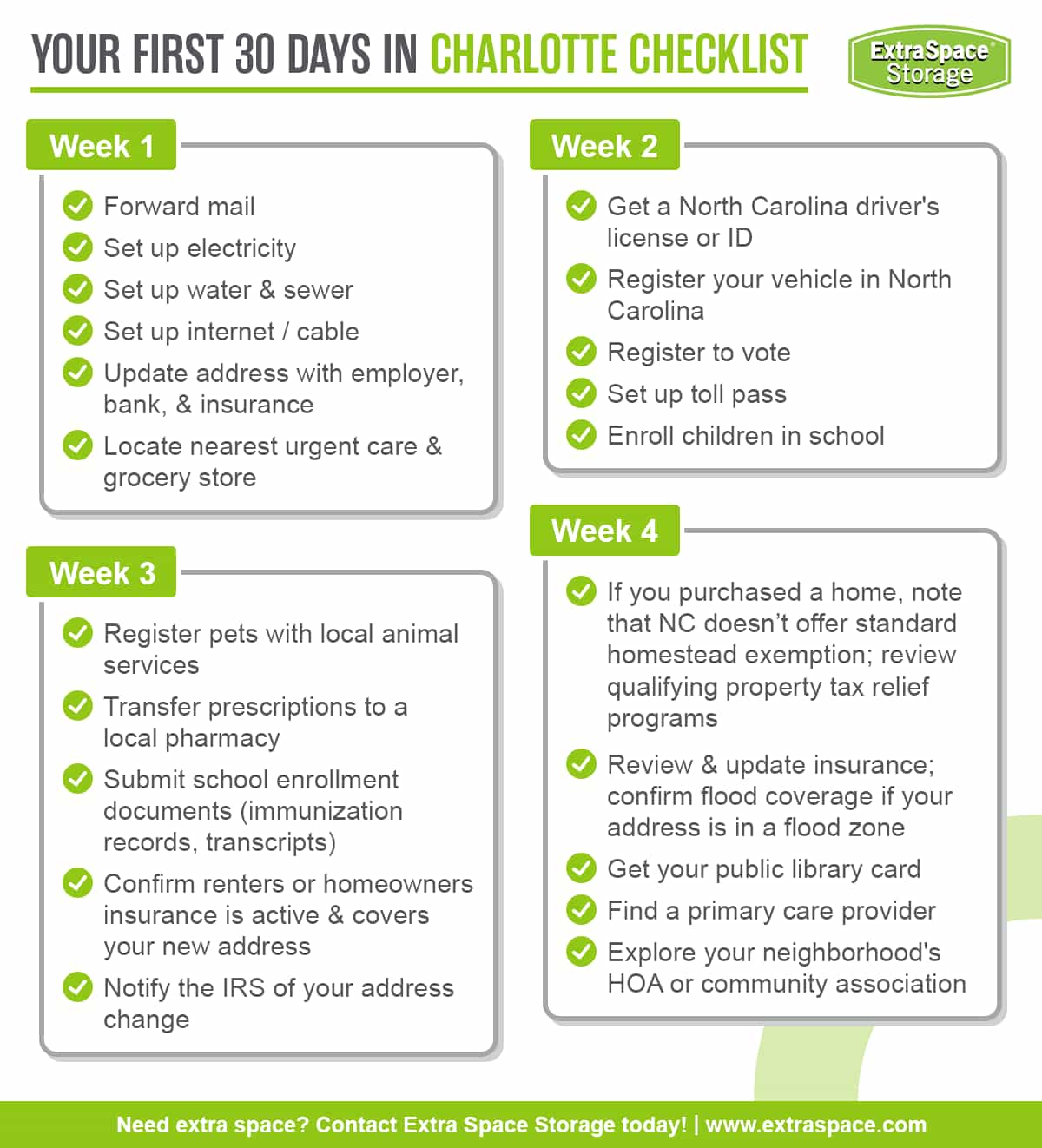
Your First 30 Days in Charlotte: Quick-Start Checklist
Moving to a new city comes with a long list of administrative tasks, from updating your address to transferring licenses and setting up local services. This week-by-week checklist covers the most important things to take care of after moving to Charlotte so nothing slips through the cracks.
Local Resources for New Charlotte, NC Residents
This section covers the essential steps for establishing yourself as a Charlotte resident, from getting your driver's license and setting up utilities to understanding state income tax and insurance requirements.
Government & Administrative Setup in Charlotte
New North Carolina residents have several time-sensitive tasks to complete, including getting a state driver's license, registering your vehicle, updating your voter registration, and setting up local utilities. Here's what to expect and where to go.
Driver's License | New residents have 60 days from establishing NC residency to obtain a North Carolina driver's license. Required documentation includes proof of identity, a Social Security number, and two proofs of NC residency (such as a utility bill and lease). Printed evidence of vehicle insurance coverage is also required. → NC DMV |
Vehicle Registration | Your vehicle must be be registered in NC within 30 days of establishing residency. You'll need your vehicle title, a completed MVR-1 Title Application, MVR-180 Odometer Disclosure, a valid driver's license, and valid North Carolina vehicle insurance information. Bring these documents to your local DMV office. → NC DMV |
Voter Registration | Register online, by mail, or in person through the NC State Board of Elections or the Mecklenburg County Board of Elections. → NC State Board of Elections |
Utilities Setup | The primary electricity and natural gas providers for the Charlotte metro are Duke Energy and Piedmont Natural Gas, respectively. Water and sewer services are managed through Charlotte Water, while trash and recycling are handled by City of Charlotte Solid Waste Services. For internet, major providers include Spectrum, AT&T Fiber, Google Fiber, and more. |
Pet Registration | Mecklenburg County requires dogs and cats to have a current rabies vaccination and an annual license. Registration is managed through Charlotte-Mecklenburg Animal Care & Control. → Animal Care & Control |
School & Family Resources in Charlotte
Charlotte-Mecklenburg Schools (CMS) is the primary public school district serving Charlotte and Mecklenburg County. Here's what families need to know about K-12 education, higher education, and early childhood care in the area.
K–12 Public Schools | Charlotte-Mecklenburg Schools (CMS) is the public school district for Mecklenburg County. Call the CMS registration office or use the zone finder to locate your assigned school by address. → CMS School Locator |
School Enrollment | School enrollment documentation typically includes proof of residency, a birth certificate, up-to-date immunization records, and a recent report card or unofficial transcript (for high school students). CMS magnet programs have separate application deadlines, which can be found on the CMS academic calendar. → Student Enrollment |
Charter & Private Schools | North Carolina has an active charter school sector. A statewide directory of charter and private schools is available through the NC Department of Public Instruction. North Carolina also offers the Opportunity Scholarship Program, a state-funded voucher for qualifying students attending private schools. → NC DPI School Directory |
Higher Education | Major colleges and universities in Charlotte include the University of North Carolina at Charlotte, Johnson & Wales University – Charlotte, Queens University Charlotte, Johnson C. Smith University, and Central Piedmont Community College. North Carolina requires 12 months of established residency to qualify for in-state tuition. |
Child Care | North Carolina's Child Care Resource & Referral (CCR&R) agencies provide a statewide database of licensed providers and information on subsidized child care. → NC Child Care |
Healthcare in Charlotte
Charlotte's healthcare landscape is anchored by two major regional health systems, with extensive networks of hospitals, clinics, and specialty practices across Mecklenburg County. New residents can use online directories to find a primary care provider after arriving.
Major Health Systems | Atrium Health is the largest health system in the Charlotte region, operating multiple hospital campuses and outpatient facilities. Novant Health is another major regional system with a significant Charlotte presence. Both systems offer online provider finders. |
Finding a PCP | Use your insurance company's provider directory to locate in-network primary care physicians. Major insurers with significant NC coverage include Blue Cross Blue Shield of NC, Aetna, Cigna, and UnitedHealthcare. |
Urgent Care | Major urgent care networks with Charlotte-area locations include Atrium Health Urgent Care, Novant Health GoHealth Urgent Care, and AFC Urgent Care. Most locations accept walk-ins, with same-day appointment scheduling available online for most networks. |
Mental Health | Atrium Health's behavioral health division offers private mental health and substance use services throughout Charlotte. Mecklenburg County Community Support Services also provides several behavioral health resources. For immediate crisis support, the 988 Lifeline is available 24/7 by calling or texting 988. |
Pharmacy | In addition to many local pharmacies, major pharmacy chains serving Charlotte include CVS, Walgreens, and Walmart Pharmacy. |
Transportation in Charlotte
Charlotte is a car-dependent city, but public transit options have expanded significantly in recent years. New residents should plan for highway-heavy commutes, set up a toll pass early, and get familiar with the Charlotte Area Transit System (CATS) for buses and light rail routes.
Toll Pass Setup | NC Quick Pass is North Carolina's electronic toll system. Transponders can be ordered online or picked up at select retailers and DMV locations, and invoices can be paid via the app, by phone, by mail, or in person. Accounts without a transponder are billed through Toll-by-Plate, which carries an additional surcharge. → NC Quick Pass |
Key Toll Roads | The primary toll roads new residents will encounter are the I-77 Express Lanes (running north of Charlotte toward Mooresville), the Monroe Expressway (US-74 Southeast, through Union County), and the I-485 Express Lanes (connecting US-74 and I-77). |
Public Transit | Charlotte Area Transit System (CATS) operates the LYNX Blue Line light rail and the CityLYNX Gold Line streetcar to connect central areas of the city. For areas outside the city center, there is also an extensive bus network throughout Mecklenburg County. → CATS Routes & Fares |
Airport Access | Charlotte Douglas International Airport (CLT) is located approximately six miles west of Uptown Charlotte and serves as a hub for several major airlines. Rideshare pickup is designated on the upper level of Departures/Ticketing between Zones 1 and 3. On-site parking options include hourly, daily, and long-term options. |
Major Roadways | The key highways for navigating the Charlotte metro are I-77 (north-south spine through the city), I-85 (northeast-southwest corridor toward Greensboro and Atlanta), I-485 (the Charlotte outer belt/loop), US-74 (east-west connector), and US-29/NC-49 (North Tryon Street corridor toward University City). |
Financial & Legal Setup in Charlotte
North Carolina has a few state-specific financial considerations that new residents—particularly homeowners—should address in the first few months after moving.
State Income Tax | North Carolina imposes a flat state income tax rate, which was phased down to 3.99% from 4.25% in 2026. New residents should update their W-4 withholdings with their employer after establishing NC residency. |
Homestead Exemption | North Carolina does not offer a standard homestead exemption for new homeowners. The state does provide the Elderly/Disabled Exclusion and Disabled Veteran Exclusion for qualifying residents seeking property tax relief. → NC Department of Revenue—Property Tax |
Homeowners Insurance | North Carolina does not mandate separate wind or flood coverage by law, but mortgage lenders will require flood insurance through the National Flood Insurance Program (NFIP) for properties in designated flood zones. Check your address on FEMA's Flood Map Service Center before purchasing. → NC Department of Insurance |
Vehicle Insurance | NC minimum liability requirements are $50,000 per person, $100,000 per accident, and $50,000 for property damage, plus required uninsured motorist coverage at the same minimums. New residents must have an in-state policy. |
Address Updates | Key parties to notify of your new address include the IRS (Form 8822 or irs.gov/addresschange), Social Security Administration, financial institutions, health insurance provider, and voter registration. → USPS Change of Address |
Charlotte Emergency Preparedness & Safety
Charlotte's inland location means its primary weather risks differ from coastal North Carolina. New residents should be aware of late-summer storm season, the occasional threat of winter ice events, and how to sign up for local emergency alerts.
Emergency | 911 |
Charlotte-Mecklenburg Police (Non-Emergency) | (704) 336-7600 |
NC Poison Control | 1-800-222-1222 |
988 Lifeline (Crisis Line) | Call or text 988 |
Emergency Alerts | Mecklenburg County/Charlotte emergency notification system → Sign up for CharMeck Alerts |
Natural Disaster Info | Charlotte is susceptible to weakened tropical systems from July to October that can produce high winds, flash flooding, and even isolated tornadoes. Ice storms are more common than snow in winter and can significantly impact roads. → Learn about travel and road conditions |
FEMA Flood Map | Homeowners are susceptible to flooding in low-lying or flood-prone areas. Check your address to know your home's risk levels. → FEMA's Flood Map Service Center |
Employment Resources in Charlotte
Charlotte's job market is anchored by financial services, healthcare, manufacturing, energy, and a growing technology sector. New residents can find a range of resources for job searching and networking.
Major Industries | Financial services is Charlotte's defining industry—the city is the second-largest U.S. banking center, home to Bank of America's headquarters and major Wells Fargo operations. Healthcare, energy, technology, and professional services round out the primary sectors. → Charlotte Regional Business Alliance |
Major Employers | Major employers in Charlotte across sectors include Bank of America, Atrium Health, Wells Fargo, Duke Energy, and Lowe's. |
Job Search Tools | Filter LinkedIn, Indeed, and Glassdoor results for Charlotte, NC. Tiny Money is a Charlotte-specific job board to explore. |
State Job Portal | NCWorks is the North Carolina Department of Commerce's workforce portal, offering state-managed job listings, unemployment benefits information, and workforce development programs. |
Unemployment Benefits | If newly unemployed after a move to North Carolina, file through the NC Division of Employment Security. Note that eligibility may be affected if you voluntarily left previous employment to relocate. |
Professional Networking | The Charlotte Regional Business Alliance and the Charlotte Chamber of Commerce both serve as active professional networking hubs in Queen City. |
Staffing & Temp Agencies | Major staffing agencies with strong Charlotte-area presence—like Robert Half, Randstad, and Manpower—are useful for new residents seeking contract or temp-to-hire roles while establishing themselves in the market. |
Charlotte Community Resources & Amenities
Putting down roots in a new city takes time. These Charlotte resources can help you get connected to your community faster.
Public Library: Charlotte Mecklenburg Library (CML) operates more than 20 branches throughout the county. A library card is free with proof of Mecklenburg County residency and provides access to both physical and digital resources, including Libby and Kanopy.
Parks & Recreation: The Mecklenburg County Parks and Recreation department manages an extensive network of parks, greenways, recreation centers, and sports facilities. Notable greenways include the Little Sugar Creek Greenway and Briar Creek Greenway.
Neighborhood Associations & Civic Resources: The City of Charlotte's Housing and Neighborhood Services department offers several community engagement programs. The city also runs CLT Community, an online platform that lets you connect with various programs under one account.
Local Media: The primary print and digital news publications in Charlotte are the The Charlotte Observer and The Charlotte Ledger. For broadcast and online coverage of weather, traffic, and local news, residents turn to Queen City News, WCNC Charlotte, and WSOC-TV.
Quinn Johnson
Quinn Johnson is a moving expert and author for Extra Space Storage. He's moved over 15 times, including internationally, and helped countless others between their own homes. He's happy to lift some boxes for a friend as long as he's paid in pizza. As a writer and content creator for Extra Space Storage since 2019, Quinn shares helpful moving tips and info to alleviate the common stresses of moving.