Helpful Relocation Resources for Atlanta, GA Newcomers
Moving to Atlanta, GA? Wherever you are in the moving process, this Atlanta relocation guide will take you through the resources, costs, and local knowledge that will get you going on the right foot when you've settled into your new home. From moving costs and storage to utilities, schools, and a first 30-day checklist, here's everything you need to know when relocating to Atlanta.

Planning Your Move to Atlanta

How Much Does Moving to Atlanta Cost?
On average, local and mid-range moves to Atlanta range from $200 to $5,943, while long-distance and cross-country moves run between $2,393 and $16,993. See breakdown by move type and home size.

Best Moving Companies in Atlanta
Need to hire movers for your Atlanta move? We've compiled local and long-distance moving companies to help with your transition. Compare options and get a quote before your move date with our complete guide.

Free & Cheap Moving Boxes in Atlanta
From local grocery stores and liquor stores to online exchanges like Facebook Marketplace and Craigslist, there are plenty of options for finding affordable or free moving boxes before you move to Atlanta.
Atlanta Self Storage & Moving Day Logistics
Self storage is a practical option when moving to Atlanta in case you're handling things like lease gaps, home closing delays, and staging needs. Extra Space Storage has multiple locations throughout the Atlanta metro that can accommodate moves of any size, from Midtown and Buckhead to Sandy Springs and the Westside.
Self Storage in Atlanta
Extra Space Storage has self storage facilities across Atlanta and the surrounding metro area. Find a location near your new neighborhood and reserve a unit online with no credit card required.
Choosing the Right Storage Unit in Atlanta
A few factors to consider when selecting a unit for your Atlanta move:
Climate Control: Atlanta summers regularly exceed 90°F with high humidity. Climate-controlled units maintain temperatures typically between 55 and 80 degrees year-round and are strongly recommended for furniture, electronics, documents, and clothing. → Climate-Controlled Storage Guide
Storage Unit Size: 5x5 (small closet or boxes); 5x10 (studio apartment); 10x10 (one-bedroom); 10x20 (two- to three-bedroom home); 10x30 (large home or vehicle). → Interactive Storage Unit Size Guide
Access & Security: Look for extended or 24-hour access, electronic gate access, on-site resident managers, and video surveillance. Extra Space Storage facilities include these as standard. → Find Atlanta Facilities with 24/7 or Extended Access
Lease Flexibility: Month-to-month leases mean you're not locked into long-term contracts, which helps you have the flexibility to handle uncertain moving timelines.
How to Use Storage In Between Homes
If there's a gap between your lease end date and your new home's availability, or if you're staging a home before closing, storage can bridge the transition. Our guide covers how to use storage during a move to Atlanta and beyond. → Learn More About Using Storage Between Homes
Explore Atlanta: Neighborhoods, Cost of Living, & What to Expect
Atlanta's metro area encompasses dozens of distinct neighborhoods and suburbs, each with different commuting times, housing costs and styles, and community character. The following guides can help you identify which area fits you best before moving to Atlanta and committing to a lease or purchase.
Cost of Living in Atlanta
Atlanta's cost of living is about 3.9% below the national average, with housing and goods and services where residents tend to see the most savings. For a full breakdown of housing, groceries, healthcare, and transportation costs, see our guide.
Pros & Cons of Atlanta
Before and after your move to Atlanta, it helps to have an honest picture of the city's benefits and drawbacks to help you adjust. Atlanta's positives are its job market, schools, and outdoor activities, while downsides include the cost of living and more.
Things to Know About Atlanta
Atlanta has its own quirks, hidden gems, and local knowledge that don't always show up in a quick search—from how residents think about the Perimeter to the city's annual events. Our local guide tells you what to expect when relocating to Atlanta.
Best Neighborhoods in Atlanta

Safe, Affordable Neighborhoods in Atlanta
Atlanta offers a vibrant lifestyle with various safe and affordable neighborhoods ideal for singles, families, and retirees, including Cabbagetown, Candler Park, Midtown, and more.

Best Neighborhoods in Atlanta for Singles & Young Professionals
Atlanta is known for its strong job market—with Fortune 500 companies and tech. The top neighborhoods in Atlanta for singles and young professionals are Buckhead, Inman Park, and more.

Best Neighborhoods in Atlanta for Families
Atlanta is a family-friendly city with excellent schools, low crime rates, and diverse neighborhoods. The five best neighborhoods for families include Buckhead, Old Fourth Ward, Ormewood Park, and more.
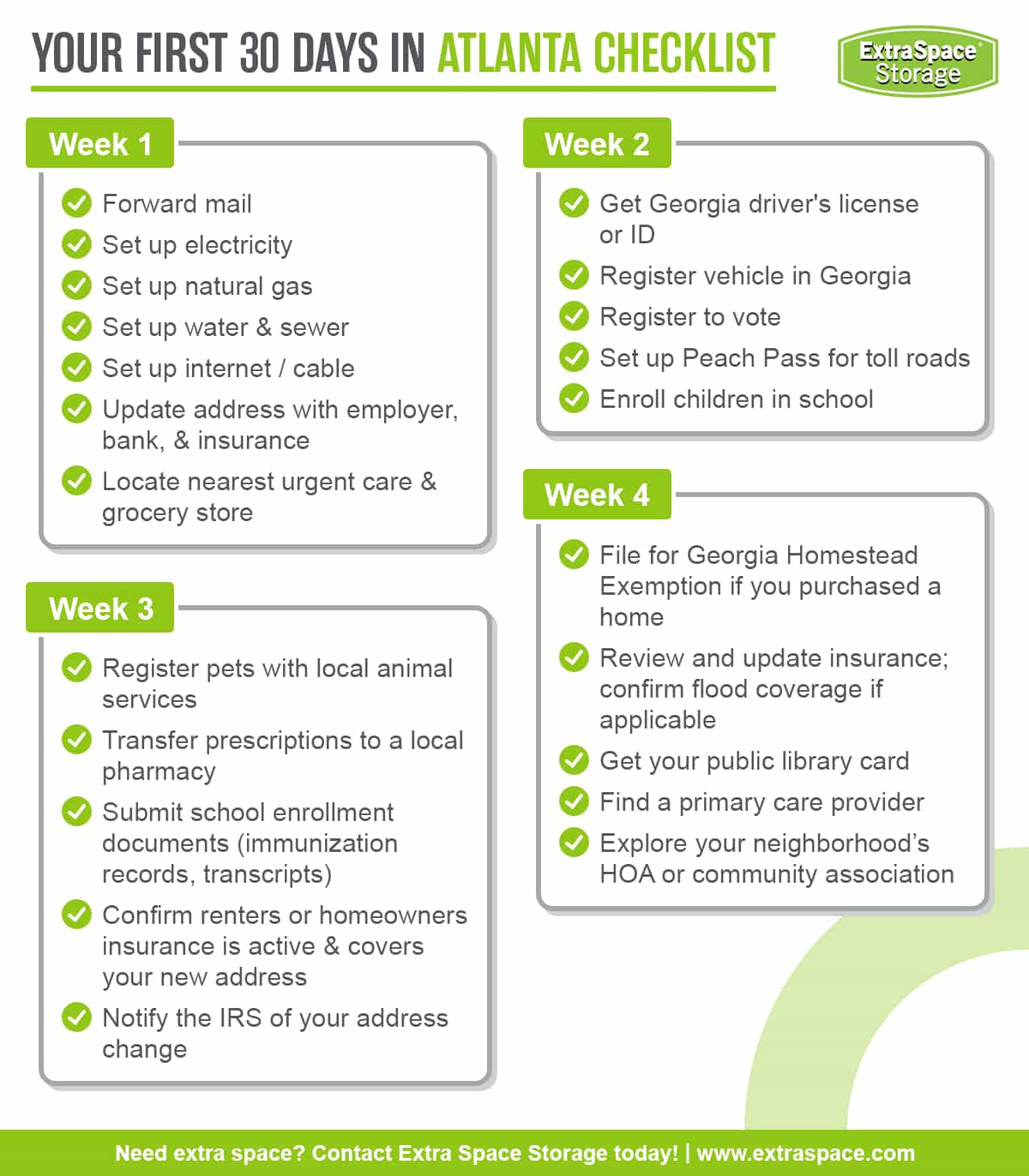
Your First 30 Days in Atlanta: Quick-Start Checklist
Especially when moving to a new city, there's a long list of administrative tasks to accomplish—like registering with utility companies, updating the DMV and post office, enrolling kids in school, and more. Use this checklist to track your highest-priority setup tasks during the first month after your Atlanta relocation.
Local Resources for New Atlanta, GA Residents
This section covers the practical setup tasks every new Atlanta resident needs to complete—from driver's licenses and utility accounts to healthcare, schools, transportation, and financial considerations specific to Georgia.
Government & Administrative Setup in Atlanta
New Georgia residents have a 30-day window to transfer their driver's license, register their vehicle, and update voter registration. Utility setup typically takes one to three business days per provider. The sections below cover where to go and what to bring for each after you've relocated to Atlanta.
Driver's License | New Georgia residents must obtain a Georgia license from Georgia DDS within 30 days of establishing residency. Bring proof of identity (passport or birth certificate plus Social Security card), two proofs of Georgia residency, and your current out-of-state license. A vision test is required; a written test may be required if your out-of-state license has no equivalent. |
Vehicle Registration | Register your vehicle within 30 days. Use the Georgia DRIVES online system or visit the Fulton County Tag Office in person. Annual renewal required. |
Voter Registration | Register online at Georgia My Voter Page, by mail, or in person at any county elections office. The deadline is 29 days before an election. |
Utilities Setup | Electricity: Georgia Power serves most of the Atlanta metro. Start service online at Georgia Power Start Service. Natural gas: Atlanta Gas Light (AGL) maintains the distribution pipelines, but Georgia's gas market is deregulated—you choose a certified gas marketer separately. Compare certified marketers through the Georgia Public Service Commission. AGL handles all pipeline emergencies: 770-907-4231 (metro Atlanta). Water/sewer: Contact the City of Atlanta Department of Watershed Management at (404) 546-0311 or online. Internet providers serving most of Atlanta include Comcast Xfinity, AT&T Fiber, and Google Fiber (select neighborhoods). |
Pet Registration | Dogs and cats must be licensed annually with proof of a current rabies vaccination. Register with Fulton County Animal Services. |
School & Family Resources in Atlanta
Atlanta Public Schools (APS) serves City of Atlanta addresses. Residents in surrounding suburbs fall under separate districts—Fulton County Schools, Cobb County, Gwinnett County, or others depending on location. Confirm your district by address before submitting enrollment paperwork.
K–12 Public Schools | Atlanta Public Schools (APS) operates schools within city limits. Use the APS school finder by address to identify your assigned school. For suburban addresses outside city limits, verify your district through Fulton County Schools, Cobb County School District, or Gwinnett County Public Schools depending on location. |
School Enrollment | Required documents for APS enrollment: proof of address, birth certificate, Georgia immunization form (Form 3231), and eye/hearing/dental certificate (Form 3300). Magnet program applications have separate deadlines, typically November through January for fall enrollment. |
Charter & Private | Georgia's private school directory is available through the Georgia Department of Education. The Georgia Special Needs Scholarship (GSNS) is available for students with IEPs transferring from public schools. |
Higher Education | Major institutions in Atlanta include Georgia Tech, Emory University, Georgia State University, Clark Atlanta University, Morehouse College, and Spelman College. Georgia residency for in-state tuition requires 12 months of domicile in the state. |
Child Care | Bright from the Start is Georgia's child care licensing and subsidy agency. Income-based subsidies are available for qualifying families via United Way 211 Atlanta. |
Healthcare in Atlanta
Atlanta has a large, competitive healthcare market with multiple major health systems operating across the metro. For primary care, use your insurance company's provider finder to identify in-network physicians near your new address.
Major Health Systems | Emory Healthcare operates multiple hospital campuses, including Emory University Hospital, Emory Saint Joseph's Hospital, and Emory Decatur Hospital. Piedmont Healthcare includes Piedmont Atlanta, Piedmont Midtown, and locations across the metro. Wellstar Health System includes Wellstar Atlanta Medical Center and Wellstar Kennestone among others. Grady Health System operates Grady Memorial Hospital, a Level I Trauma Center and public safety-net hospital serving the metro. |
Finding a PCP | Use your insurance company's provider finder to identify in-network physicians near your new address. Emory, Piedmont, and Wellstar each maintain online provider directories linked above. |
Urgent Care | Wellstar Urgent Care operates locations across the Atlanta metro with walk-in availability and online check-in. Piedmont Urgent Care accepts walk-ins and online scheduling. For pediatric urgent care, Children's Healthcare of Atlanta (CHOA) operates urgent care locations across the metro. |
Mental Health | The Georgia Crisis & Access Line (GCAL) provides 24/7 crisis intervention and behavioral health linkage statewide: 1-800-715-4225. The 988 Suicide & Crisis Lifeline is also available by call or text. |
Pharmacy | Major pharmacy chains with extensive Atlanta-area coverage include CVS, Walgreens, Kroger Pharmacy, and Publix Pharmacy. Publix Pharmacy offers a free select antibiotics and cholesterol medications program. |
Transportation in Atlanta
Most Atlanta residents commute by car. Setting up a Peach Pass transponder early avoids Toll-by-Plate surcharges on the metro's managed lanes network. MARTA provides rail service along four lines connecting Downtown, Midtown, Buckhead, and Hartsfield-Jackson Airport.
Toll Pass Setup | Georgia's toll system uses the Peach Pass transponder, managed by the Georgia State Road & Tollway Authority (SRTA). Purchase a transponder online or at Kroger stores statewide. Toll-by-Plate is available but carries a 25% surcharge above standard toll rates. |
Key Toll Roads | I-85 Express Lanes (northeast of Downtown, inside I-285): dynamically priced HOV/toll lanes. I-75/575 Express Lanes (Northwest Corridor): dynamically priced from I-285 to Canton. I-285 Top End Express Lanes (between I-75 and I-85): dynamically priced. SR 400: toll at Abernathy Road in Sandy Springs; connects Buckhead to north suburbs. |
Public Transit | MARTA operates heavy rail on four lines (Red, Gold, Blue, Green) and an extensive bus network. Pay with a Breeze Card, available at all rail stations and online. Key connections for new residents: Red/Gold lines serve Hartsfield-Jackson Airport (College Park station), Midtown, and Buckhead. Blue/Green lines serve east/west corridors. For outlying suburbs not served by MARTA rail, Xpress Regional Commuter Service (now operated by the Atlanta-region Transit Link Authority) runs express bus routes. |
Airport Access | Hartsfield-Jackson Atlanta International Airport (ATL) is served by all major carriers, with Delta Air Lines as the primary hub carrier. MARTA's Red and Gold lines provide direct rail service to the Domestic Terminal. Rideshare pickup is located at the Ride App Center on Level 1 of both domestic and international terminals. |
Major Roadways | I-285 (the Perimeter) is the primary ring road around metro Atlanta. I-75 and I-85 merge into the Downtown Connector through the city core. I-20 is the primary east-west corridor through Downtown. SR 400 runs north-south from Buckhead to Cumming and north metro suburbs. New residents will quickly encounter the local shorthand, "ITP" (inside the perimeter) vs. "OTP" (outside the perimeter), which is widely used to describe Atlanta neighborhoods and suburbs. |
Financial & Legal Setup in Atlanta
Georgia has a state income tax and several property-specific programs new homeowners should address promptly. The Homestead Exemption application deadline is April 1 of the tax year—missing it means waiting until the following year.
State Income Tax | Georgia has a flat state income tax rate of 5.19% for tax year 2025, with the rate scheduled to decrease by 0.10% annually toward a target of 4.99% under HB 111 and HB 1437. Notify your employer's HR department to establish Georgia state withholding upon relocating. |
Homestead Exemption | Georgia homeowners who occupy their property as a primary residence are eligible for a state Homestead Exemption ($2,000 reduction in assessed value for state taxes). Fulton County offers additional county-level exemptions. The City of Atlanta also provides a Basic Homestead Exemption. Applications must be filed with the Fulton County Tax Assessor by April 1 of the tax year. The exemption renews automatically once approved. |
Homeowners Insurance | Standard Georgia homeowners policies include windstorm coverage. However, flood insurance is not included in standard policies and must be purchased separately through the NFIP or a private insurer. |
Vehicle Insurance | Georgia requires minimum liability coverage of 25/50/25 ($25,000 bodily injury per person, $50,000 per accident, $25,000 property damage). Uninsured motorist coverage is required at the same minimum levels. Georgia does not require Personal Injury Protection (PIP). |
Address Updates | Key parties to notify after your move: IRS (irs.gov or Form 8822), Social Security Administration (ssa.gov), financial institutions, health insurance provider, voter registration, and employer HR. |
Atlanta Emergency Preparedness & Safety
Atlanta's primary seasonal hazard is winter ice—the city's hilly terrain and limited deicing infrastructure mean that ice events can cause significant road closures even with modest accumulation. New residents should keep ice melt, a blanket, and basic emergency supplies in their vehicles during winter months. Spring brings moderate tornado risk and severe thunderstorm activity across the metro.
Emergency | 911 |
Atlanta Police Non-Emergency | (404) 658-6666 |
Poison Control | 1-800-222-1222 |
State Crisis Line | Georgia Crisis & Access Line (GCAL): 1-800-715-4225 (24/7) |
Emergency Alerts—Fulton Countys | Sign up for emergency notifications with Alert Fulton. |
Emergency Alerts—City of Atlanta | ATL Ready provides citywide alerts and preparedness resources. |
Natural Disaster Info | Winter ice storms are Atlanta's most disruptive recurring hazard. Tornado season is primarily spring; NWS Atlanta issues watches and warnings. Some low-lying areas near the Chattahoochee River basin are prone to flash flooding. |
FEMA Flood Map | Check your property address with the FEMA Flood Map. |
Employment Resources in Atlanta
Atlanta is a major corporate hub, home to 15 Fortune 500 companies and a significant and growing technology and fintech sector. The city also has an active film and television production industry, driven by Georgia's film tax credit program, and one of the largest airport-based employment ecosystems in the country through Hartsfield-Jackson.
Major Industries | Atlanta's economy is anchored by technology and fintech, corporate headquarters activity, logistics and distribution, film and television production, healthcare, and hospitality/convention business. The metro is home to 15 Fortune 500 company headquarters. |
Top Employers | Major employers are Delta Air Lines, The Home Depot, United Parcel Service (UPS), The Coca-Cola Company, Chick-fil-A, Cox Enterprises, Emory University, and Wellstar Health System. |
Job Search Tools | LinkedIn, Indeed, and Glassdoor—filter by Atlanta for the widest reach. Georgia Works aggregates state-managed and regional listings. |
State Job Portal | Georgia Department of Labor manages state job listings, workforce development programs, and unemployment benefits. |
Unemployment Benefits | If you're newly unemployed after relocating to Georgia, review eligibility requirements before filing for unemployment benefits. Georgia's maximum weekly benefit and eligibility window differ from higher-wage states. |
Professional Networking | Network via the Metro Atlanta Chamber of Commerce, Technology Association of Georgia, or Technology Village. |
Staffing & Temp Agencies | Randstad and Robert Half both maintain significant Atlanta-area presences and are useful options for new residents seeking contract or temp-to-hire roles while building a local network. |
Atlanta Community Resources & Amenities
Public Library: The Atlanta-Fulton Public Library System serves Fulton County residents. A free library card requires a valid Georgia photo ID and proof of address. Digital lending includes Libby (ebooks and audiobooks), Kanopy (streaming films), and hoopla.
Parks & Recreation: Piedmont Park is Atlanta's primary urban park, with 200+ acres in Midtown and free public access. The Atlanta BeltLine is a 33-mile trail and greenway corridor connecting 45 neighborhoods, with ongoing trail expansion. The Chattahoochee River National Recreation Area provides hiking, kayaking, and fishing access along the Chattahoochee River through multiple units across the north metro. City parks are managed by Atlanta Parks & Recreation
Neighborhood Associations & Civic Resources: Atlanta's 25 Neighborhood Planning Units (NPUs) serve as the formal community voice to city government. Find your NPU and local neighborhood association through the
Local Media: The Atlanta Journal-Constitution is the primary metro daily newspaper, while the Atlanta Business Chronicle covers local business news.
Quinn Johnson
Quinn Johnson is a moving expert and author for Extra Space Storage. He's moved over 15 times, including internationally, and helped countless others between their own homes. He's happy to lift some boxes for a friend as long as he's paid in pizza. As a writer and content creator for Extra Space Storage since 2019, Quinn shares helpful moving tips and info to alleviate the common stresses of moving.