Helpful Relocation Resources for Austin, TX Newcomers
Relocating to Austin, TX? Whether your move is still in the works or already underway, this guide brings together the key resources, costs, and local insights that matter most. From moving expenses and top-rated movers to a 30-day checklist to help you settle in, here's everything you need to know to move to Austin with confidence!

Planning Your Move to Austin
How Much Does It Cost to Move to Austin?
Local moves within Austin often range from $200-$4,000, and long-distance moves between $3,418-$12,534. For detailed local and cross-country pricing, check out our complete guide.

Best Moving Companies in Austin
Moving away from Austin—or moving to Austin from a nearby city? We've compiled a list of top Austin moving companies to simplify your search. Check out our recommendations and get a quote today.

Free & Cheap Moving Boxes in Austin
Searching for moving boxes around Austin? Here's where to find free and affordable moving supplies near you. And after unpacking and settling in, use our guide to discover where to recycle moving boxes in Austin.
Austin Self Storage & Moving Day Logistics
From dealing with gaps between move-out and move-in dates to various staging needs, self storage can be a convenient solution when moving in Austin. Discover how you can use storage during your transition and find a facility near you.
Self Storage in Austin
Extra Space Storage has multiple storage locations throughout the Austin metro to help make your move easier. Whether you need short-term storage during the transition or a longer-term solution, there are convenient self storage options across the city. Find a location near your new address today.
Choosing the Right Storage Unit in Austin
Selecting the right unit for your needs often comes down to four key factors:
Climate Control: Austin summers regularly exceed 100°F, making climate-controlled storage strongly recommended for furniture, electronics, documents, clothing, and other heat-sensitive belongings. → Climate-Controlled Storage Guide
Unit Size: Common unit sizes include 5x5 (small closet/boxes), 5x10 (studio apartment), 10x10 (1-bedroom), 10x20 (2–3 bedroom home), and 10x30 (large home or vehicle). → Storage Unit Size Guide
Access & Security: Extra Space Storage facilities are often equipped with high-quality security features like electronic gate access, video surveillance, and on-site management. Many locations offer extended access hours or 24-hour access for your convenience. → 24-Hour Access Storage
Lease Flexibility: Month-to-month leases mean no long-term commitment, which is great for unpredictable moves. Change your unit size as your storage needs shift.
How to Use Storage In Between Homes
Self storage can bridge the gap between your old home and your new one—covering everything from lease overlaps and home closing delays to decluttering before staging. → Learn More About Storage for Moving
Explore Austin: Neighborhoods, Cost of Living, & What to Expect
Austin's metro spans a wide range of neighborhoods, each with distinct housing costs, commute times, and amenities. Whether you're looking to settle down in a central, urban neighborhood or a more family-friendly, suburban area, the following guides can help you find the right fit before your move.
📊 Cost of Living in Austin
Austin's overall cost of living is 3% below the national average. While housing runs slightly above average, residents save on everyday expenses like transportation, healthcare, utilities, and various goods. Learn more about the cost of living in Austin below.
⚖️ Pros & Cons of Austin
While ATX is filled with top jobs, family fun, and a renowned live music and culture scene, the city experiences extreme heat and lots of traffic. Before deciding to relocate, check out this guide for a clearer understanding of what Austin offers.
📖 Things to Know About Austin
From how the city's geography might affect your commute to what "Keep Austin Weird" means for day-to-day life, this guide covers genuine local knowledge that won't always show up in a quick search.
Best Neighborhoods in Austin

Safe, Affordable Neighborhoods in Austin
Despite rising living costs, several Austin neighborhoods remain affordable and safe. Notable areas include Allandale, Garrison Park, Hyde Park, North University, and more.

Best Neighborhoods in Austin for Singles & Young Professionals
Austin stands out as a prime destination for young professionals, offering job opportunities and vibrant neighborhoods. Top neighborhoods include Downtown Austin, North University, Old West Austin, and more!

Best Neighborhoods in Austin for Families
If you're moving to Austin with your family, you'll find affordable neighborhoods and top-rated schools. Some of the best areas to settle down include Allandale, Cherrywood, Hyde Park, and more.
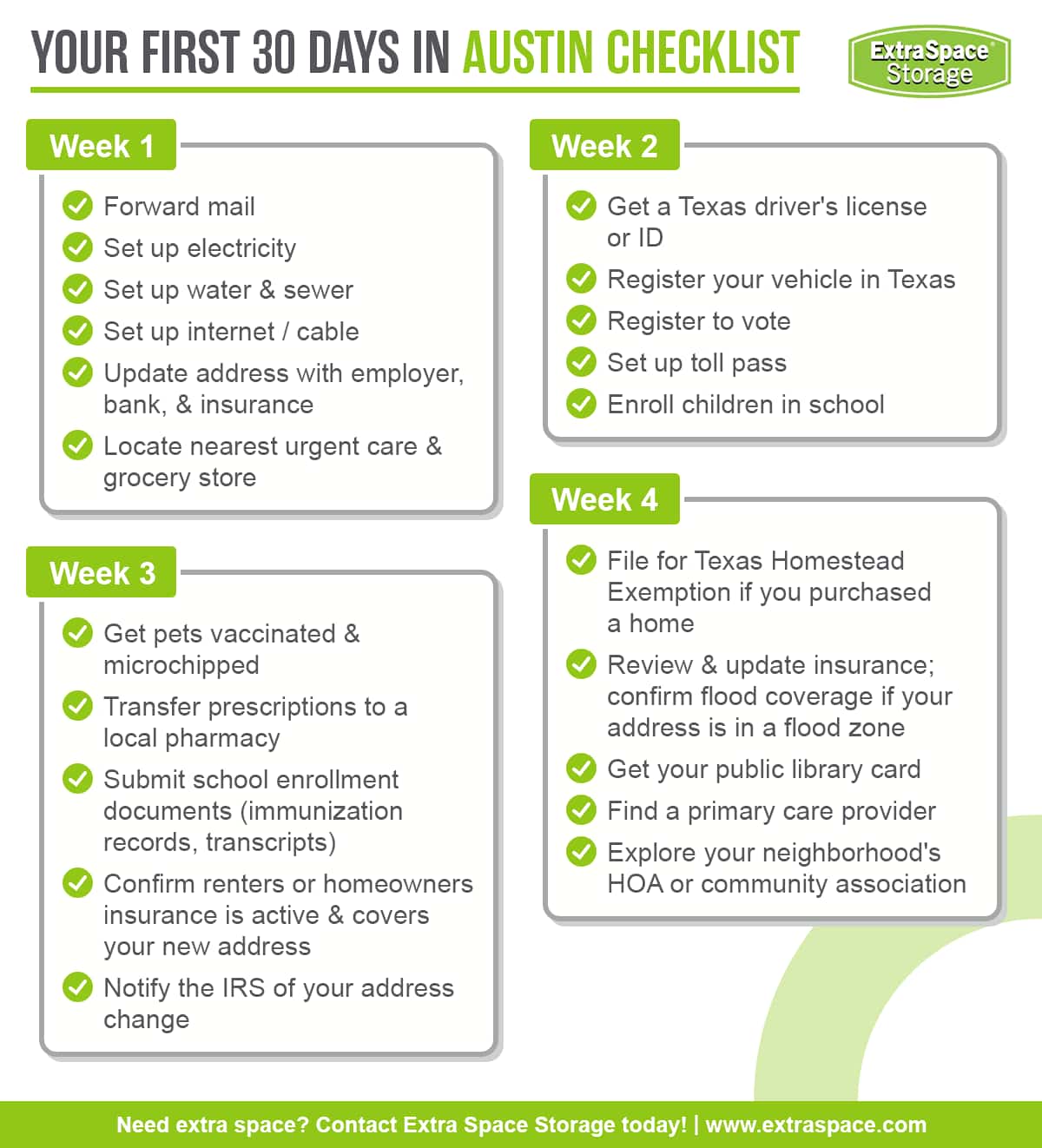
Your First 30 Days in Austin: Quick-Start Checklist
New to Austin and not sure where to start? From getting your utilities on to completing your Texas residency setup, work through this week-by-week checklist to ensure you don't miss any essentials.
Local Resources for New Austin, TX Residents
This section outlines essential resources for new Austin residents completing tasks related to government services, healthcare, education, employment, transportation, finances, and emergency preparedness.
Government & Administrative Setup in Austin
Handling your Texas residency paperwork should be high on your to-do list right after you arrive. New Austin residents must complete several key tasks, including getting a driver's license (within 90 days), registering their vehicle (within 30 days), signing up to vote, setting up utilities, and complying with local pet regulations.
Driver's License | Texas requires a new driver's license from the Texas Department of Public Safety (DPS) within 90 days of residency. Required documents include proof of identity, proof of Texas residency, proof of lawful presence, vehicle registration and insurance, and Social Security number. → Texas DPS |
Vehicle Registration | Visit the Travis County Tax Office to register your vehicle within 30 days of residency. You must pass an emissions inspection prior to registration and be ready to show proof of ownership and insurance. → TxDMV |
Voter Registration | Register to vote—or update your registration—online at VoteTexas.gov or in person at the Travis County Tax Office. Texas has a 30-day pre-election registration deadline. |
Utilities Setup | Austin Energy is the city's sole electricity provider—residents can set up electricity, water, solid waste, and recycling through the City of Austin Utilities. The primary natural gas provider is Texas Gas Service. For internet, major providers include Google Fiber, AT&T Fiber, and Spectrum. |
Toll Pass | TxTag and EZ TAG are the primary toll passes for Austin-area roads. Set up online at hctra.org/Home. |
Pet Registration | While the city doesn't require formal pet registration, rabies vaccinations are mandatory under state law, and microchipping is required by the City of Austin. → Austin Animal Center |
School & Family Resources in Austin
The primary public K-12 school district in Austin is the Austin Independent School District (AISD), though several additional districts serve the suburban and surrounding areas. Here are key resources for public school enrollment, charter and private school options, higher education, and child care assistance.
K–12 Public Schools | The Austin Independent School District (AISD) is the city's primary K-12 public school district. Use the AISD school finder to confirm home school by address. |
School Enrollment | For enrollment, you'll need your child's birth certificate, immunization records, parent or guardian ID, proof of guardianship, and proof of residency. Magnet program application deadlines vary—confirm timelines here. |
Charter & Private | Use the Texas Education Agency (TEA) directory to search for private and charter school options. Explore the Texas Education Freedom Accounts (TEFA) for private school financial assistance opportunities. |
Higher Education | Major colleges and universities in Austin include the University of Texas at Austin (UT Austin), Austin Community College (ACC), St. Edward's University, Concordia University Texas, and Huston-Tillotson University. To qualify for in-state tuition at UT Austin, 12 months of established Texas residency is required prior to enrollment. |
Child Care | Child care assistance is primarily managed by the Texas Workforce Commission (TWC). |
Healthcare in Austin
Austin has a growing healthcare landscape, offering a broad range of services throughout the metro area. As a new resident, one of your first priorities will be choosing an in-network primary care provider (PCP) and identifying convenient care options nearby.
Major Health Systems | Ascension Seton and St. David's HealthCare are two of the biggest health networks in Central Texas, each offering multiple hospitals across the Austin metro. |
Finding a PCP | Use your insurance company's provider directory to find an in-network PCP near your new address. Major insurers with Austin networks include BlueCross BlueShield of Texas, Aetna, and UnitedHealthcare. |
Urgent Care | CareNow Urgent Care, Austin Regional Clinic (ARC), and Texas MedClinic are some of Austin's primary urgent care networks. Most clinics accept walk-ins, while others offer same-day appointments. |
Mental Health | Major behavioral health organizations in Austin include Integral Care and NAMI Central Texas. For immediate crisis support, call 512-472-4357. |
Pharmacy | Pharmacy chains with a strong Austin presence include H-E-B Pharmacy, CVS, and Walgreens. Free, generic prescription programs are available through the Medical Access Program (MAP). |
Transportation in Austin
Austin is a largely car-dependent city with an extensive toll road network, so setting up a toll pass early is key to saving money and reducing stress. Learn more about toll roads and toll passes, major roadways, Austin-area airports, and public transit options below.
Toll Pass Setup | There are two main toll road operators in the region—TxDOT and The Mobility Authority. Toll tags accepted on Austin-area toll roads include TxTag, EZ TAG, TollTag, ExpressToll, KTAG, PIKEPASS, and SunPass. Set up a toll transponder online at hctra.org/Home. Drivers without a transponder pay around 50% more on Austin toll roads. |
Key Toll Roads | Major toll roads in Austin that newcomers will commonly encounter include Loop 1, SH 45 N, SH 45 SE, and SH 130. |
Public Transit | Capital Metro (CapMetro) is the primary public transportation provider in Austin—offering a comprehensive bus system and rail line. Fares | Routes |
Airport Access | Austin-Bergstrom International Airport (AUS) is the main airport serving the city, located just southeast of Downtown Austin. Major carriers include Southwest, American, United, Delta, and Spirit. Rideshare pickup is located beneath the Consolidated Rental Car Facility. Several convenient parking options are available. |
Major Roadways | Key highways for navigating the Austin metro include I-35 (primary north-south), MoPac Expressway/Loop 1 (north-south), US-183 (north-south), and SH-71 and US-290 (east-west). |
Financial & Legal Setup in Austin
While Texas doesn't have a state income tax, there are still a few important financial considerations worth addressing in the first few weeks after your move—such as filing for a homestead exemption, updating your address, and ensuring you meet state insurance requirements.
State Income Tax | Texas doesn't have a state personal income tax. If you've moved from a state with income tax, submit an updated W-4 with your employer to stop state income tax withholding. |
Homestead Exemption | Texas homeowners can file for a homestead exemption through the Travis Central Appraisal District (TCAD), which reduces the appraised value of your primary residence for school district tax purposes. Additional exemptions apply for residents over 65, those with disabilities, and veterans. The deadline is typically April 30. |
Homeowners Insurance | Standard homeowners policies typically exclude flood damage, and while not required by the state, residents may want to purchase flood insurance separately through the National Flood Insurance Program (NFIP)—especially if your property is at risk. |
Vehicle Insurance | Minimum liability requirements for vehicle insurance in Texas are 30/60/25 ($30,000 injuries per person/up to $60,000 per accident; $25,000 property damage). Vehicle insurance policies in Texas automatically include Personal Injury Protection (PIP) coverage. |
Address Updates | Key parties to notify after your move include the IRS, Social Security Administration, Texas DMV, voter registration, financial institutions, health and life insurance providers, and your employer. |
Austin Emergency Preparedness & Safety
As you settle into Austin, it's important to familiarize yourself with local emergency resources and the types of risks unique to Central Texas. The region is prone to extreme heat, flash flooding, and occasional severe storms—so taking a few minutes to understand these hazards and how you'll be notified can make a big difference in staying safe.
Emergency | 911 |
Austin Non-Emergency | 3-1-1 or 512-974-2000 |
Poison Control | 1-800-222-1222 |
Travis County Crisis Line | 512-472-4357 |
Emergency Alerts | |
Natural Disaster Info | The primary natural disaster risk in Austin is flooding. Other risks to be aware of include severe storms, hail, and heatwaves. → Austin Emergency Management Resources |
FEMA Flood Map | All Austin homeowners should research their flood zone designation via msc.fema.gov to understand their risk. |
Employment Resources in Austin
Austin's economy is anchored by its technology industry, with a growing presence in manufacturing, financial services, and life sciences. From top employers to networking opportunities, here's some helpful information to know when seeking employment in Austin.
Major Industries | Major industries in Austin, TX include technology—which gives the city its "Silicon Hills" nickname—along with finance, manufacturing, and life sciences. |
Top Employers | Apple, Dell Technologies, Silicon Labs, and Oracle are some of Austin's top employers. |
Job Search Tools | Search for Austin jobs on LinkedIn, Indeed, and Glassdoor, or check out local resources like Built In Austin, the Austin Chamber of Commerce job board, or AustinJobs.com listings. |
State Job Portal | The Texas Workforce Commission (TWC) offers state-managed job listings, unemployment benefits, and workforce development services. |
Unemployment Benefits | If newly unemployed after your move, the Texas Workforce Commission (TWC) administers Texas unemployment benefits. Note that relocation alone does not establish eligibility—standard requirements apply. |
Professional Networking | The Austin Chamber of Commerce and Networking Austin are fantastic networking groups in Austin. |
Staffing & Temp Agencies | Insight Global, The HT Group, and Scion Staffing have a major presence in Austin and can help connect you with temporary or contract roles for immediate income. |
Austin Community Resources & Amenities
Building local connections after a move requires intention. These local resources can help you discover your community in Austin.
Public Library: The Austin Public Library system operates multiple branches across the city. Library cards are typically free for all residents—simply fill out an application online, then bring your ID and proof of residence to pick it up at any library location. Digital access options include Libby, Kanopy, hoopla, and more.
Parks & Recreation: Austin Parks & Recreation manages over 300 parks and green spaces in the city, including Zilker Metropolitan Park and Barton Creek Greenbelt. Travis County Parks also operates its own parks system in surrounding areas outside city limits.
Neighborhood Associations & Civic Resources: The City of Austin's Community Registry helps connect residents with their local neighborhood association.
Local Media: Major local resources that can help you stay informed after your move include the Austin American-Statesman, KUT 90.5 FM, and ABC affiliate, KVUE.
Quinn Johnson
Quinn Johnson is a moving expert and author for Extra Space Storage. He's moved over 15 times, including internationally, and helped countless others between their own homes. He's happy to lift some boxes for a friend as long as he's paid in pizza. As a writer and content creator for Extra Space Storage since 2019, Quinn shares helpful moving tips and info to alleviate the common stresses of moving.