Helpful Relocation Resources for Houston, TX Newcomers
Relocating to Houston, TX? Whether you're still finalizing your plans or you've already arrived, our helpful guide provides resources and local knowledge to help you settle in quickly. From moving costs and self storage options to info on utilities, schools, healthcare, and more, here's everything you need for your Houston move—including a checklist for your first 30 days in the city!

Planning Your Move to Houston

How Much Does It Cost to Move to Houston?
Local and long-distances moves within Houston typically cost between $200-$15,404, based on distance traveled and the volume of your belongings. For a detailed breakdown of both local and long-distance pricing, see our full guide.

Best Moving Companies in Houston
Planning a short-distance move within Houston or from a nearby city? We’ve identified some of the most consistently reviewed moving companies in the area. See our top picks and get a quote today!

Free & Cheap Moving Boxes in Houston
From grocery stores and recycling drop-offs to online exchanges and large retailers, there are several places to check for free or low-cost boxes near you. And once you've finished moving, use our guide to find where to recycle your boxes in Houston!
Houston Self Storage & Moving Day Logistics
With one of the largest and most spread-out metro areas in the country, Houston can make self storage a smart buffer for lease gaps, home closings, and staging needs. A well-located facility can take real pressure off your move timeline. See how to use storage during your move and find a unit near you.
Self Storage in Houston
Extra Space Storage has multiple locations across the Houston metro. Given the area's heat and humidity—summer temperatures regularly exceed 90°F—climate-controlled storage in Houston is strongly recommended for temperature-sensitive items like clothing, furniture, electronics, artwork, and more.
Choosing the Right Storage Unit in Houston
Not sure which storage unit is the best fit for your needs? Here are four factors to consider when renting storage in Houston:
Climate Control: Houston summers regularly exceed 90°F with high humidity. Climate-controlled units typically maintain an environment between 55 and 80°F year-round, helping protect furniture, electronics, documents, and more from heat damage and moisture. → Climate-Controlled Storage Guide
Unit Size: 5x5 (small items and boxes); 5x10 (studio apartment contents); 10x10 (one-bedroom apartment); 10x20 (two to three-bedroom home); 10x30 (large home or vehicle storage). → Storage Unit Size Guide
Access & Security: Extra Space Storage facilities in Houston typically offer extended access hours (6 a.m. to 10 p.m. at most locations), electronic gate entry, video surveillance, and on-site management. Some locations offer 24-hour access. → 24-Hour Access Storage
Lease Flexibility: All units are month-to-month, so you're not locked into a long-term commitment. This is helpful when move timelines are uncertain. Upgrade or downsize units as your needs change.
How to Use Storage In Between Homes
If your move-in date doesn't align with your move-out date, a storage unit in Houston can help bridge the gap. Whether you're dealing with a lease overlap, home closing delay, or staging needs, Houston self storage gives you a flexible place to keep your belongings during the transition. → Learn More About Storage for Moving
Explore Houston: Neighborhoods, Cost of Living, & What to Expect
Houston is one of the largest metropolitan areas in the country, with dozens of distinct neighborhoods and a wide geographic footprint. Houston housing costs, commute times, school districts, and neighborhood character vary significantly from one area to the next. The guides below can help you identify which part of the city is the right fit for you.
Cost of Living in Houston
Houston's overall cost of living is 5.9% below the national average. Housing costs run about 23% below the national average for buyers and roughly 15% below for renters. See our complete guide for a full breakdown of cost of living in Houston!
Pros & Cons of Houston
Examining the pros and cons of living in Houston either before or after your move can help set accurate expectations for day-to-day life.
Things to Know About Houston
Some of the most useful info about living in Houston don't show up in a quick search. This guide provides local knowledge to help you adjust to life in Houston more easily.
Best Neighborhoods in Houston

Safe, Affordable Neighborhoods in Houston
Houston is a vibrant and rapidly growing city in Texas. Some of the most affordable neighborhoods include, Downtown, Kingwood, Midtown, and more!

Best Neighborhoods in Houston for Singles & Young Professionals
Houston is an attractive city for singles and young professionals, offering diverse job opportunities and vibrant social scenes. Key neighborhoods include Downtown, Greater Heights, Midtown, and more!

Best Neighborhoods in Houston for Families
Houston is a top choice for families, offering affordable housing and excellent schools. Explore some of the best family-friendly neighborhoods including Greater Heights, Houston Museum District, River Oaks, and more!
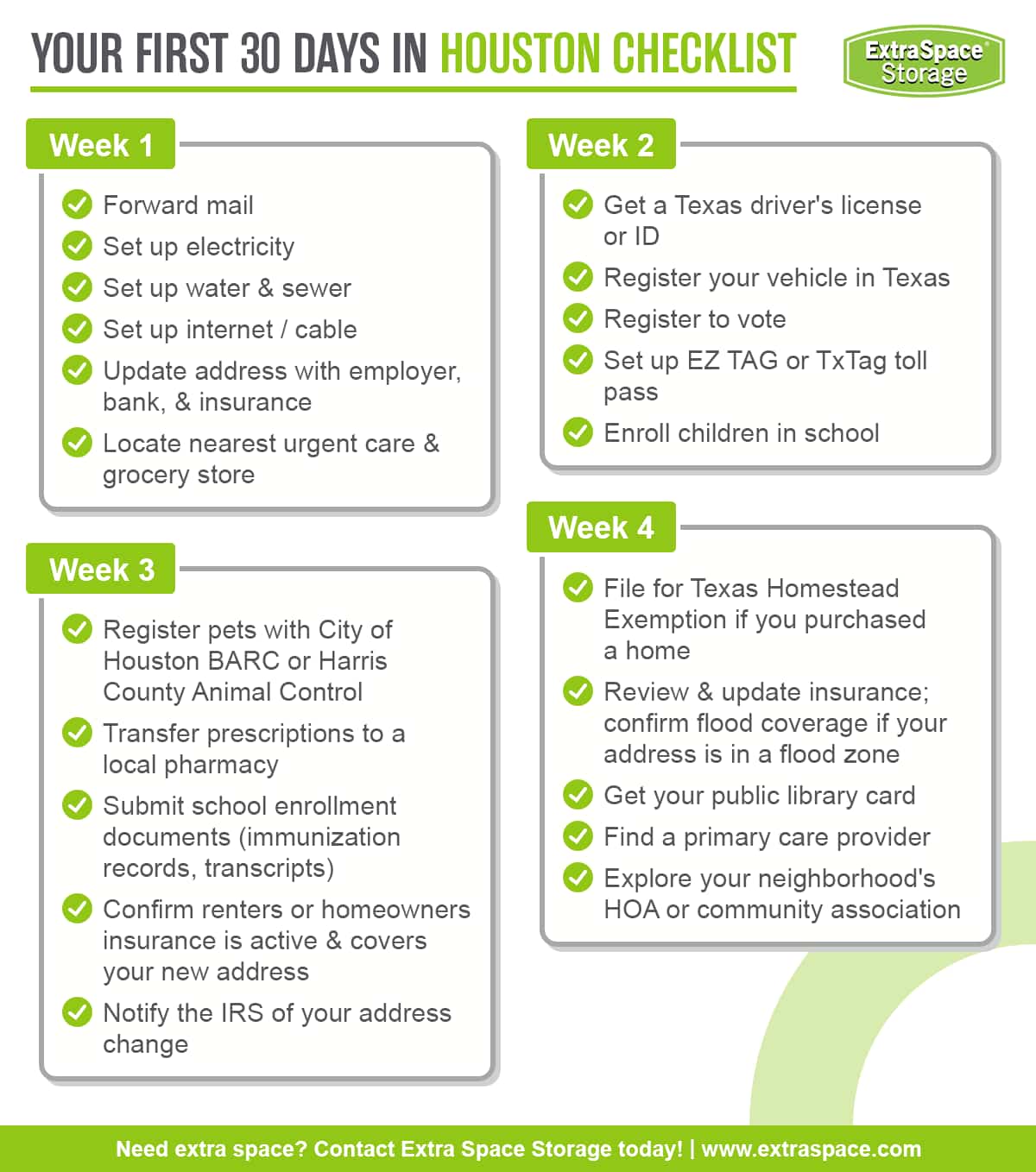
Your First 30 Days in Houston: Quick-Start Checklist
Use this moving checklist to track the most important setup tasks during your first month as a Houston resident. Items are organized by week and link to the relevant resource sections below.
Local Resources for New Houston, TX Residents
This section covers the practical tasks new Houston residents need to work through—organized by category to make the process easier to manage. Covering everything from government registration and utilities to healthcare, emergency contacts, and employment, here's what you need to settle into the Houston, TX area.
Government & Administrative Setup in Houston
New Texas residents need to take care of a few key administrative tasks in the first weeks after arriving—including getting a Texas driver's license, registering a vehicle, and setting up utilities. The table below covers the key agencies, processes, and links.
Driver's License | New Texas residents have 90 days to obtain a Texas driver's license. Apply through the Texas Department of Public Safety. Required documents include two proof-of-Texas-residency items, Social Security card, and prior state driver's license. Appointments are strongly recommended at Houston-area locations. |
Vehicle Registration | Vehicles must be registered within 30 days of establishing Texas residency. Register through the Harris County Tax Office or online at txdmv.gov. |
Voter Registration | Register online at VoteTexas.gov. The deadline is 30 days before any election. Updating your Texas driver's license address may automatically update your voter registration through the Texas DPS. |
Utilities Setup | Electricity: Texas has a deregulated market—new residents choose their own provider at powertochoose.org*. Natural gas: CenterPoint Energy. Water & sewer: Houston Public Works. *Residents in some suburban areas may be served by a Municipal Utility District (MUD)—verify by address. |
Pet Registration | City of Houston residents should register pets through the City of Houston Bureau of Animal Regulation and Care (BARC). Residents outside city limits will go through Harris County Animal Control. All dogs and cats over three months of age must be licensed and vaccinated. |
School & Family Resources in Houston
Houston is served primarily by Houston Independent School District (HISD), the second-largest school district in Texas. HISD covers most of the city and includes a wide range of campus options, as well as an extensive Magnet and Vanguard program network. Families in suburban areas may fall under separate districts, including Katy ISD, Cypress-Fairbanks ISD, or Klein ISD.
K-12 Public Schools | Enter your address in the SchoolFinder tool to identify your family's assigned schools by zone and grade level, or use the School Choice website to explore options outside your zone. |
School Enrollment | Required documents include proof of Houston-area address, your child's birth certificate, current immunization records, prior school records or transcripts, parent photo ID. |
Charter & Private | Find charter school admission applications through the Texas Education Agency. The Texas Education Freedom Accounts (TEFA) program—launched for the 2026-27 school year—provides eligible families approximately $10,000-$30,000 per student toward private school tuition and approved educational expenses. |
Higher Education | University of Houston, Rice University, Texas Southern University, and Houston Christian University are popular four-year universities in Houston. San Jacinto College is the primary community college option. Establishing Texas residency for in-state tuition requires at least 12 consecutive months of living in the state. |
Child Care | Child care in Texas is regulated by Texas HHS Child Care Regulation. You can look for providers through their child care search tool. |
Healthcare in Houston
Houston is home to the Texas Medical Center, the world's largest medical complex—featuring multiple distinct hospitals, research institutions, and academic institutions. New residents have access to multiple major health systems and a broad network of primary care providers, urgent care locations, and specialists. The table below provides a starting point for navigating healthcare in the Houston area.
Major Health Systems | Houston Methodist: Consistently ranked as the best hospital in the state by U.S. News. Memorial Hermann Health System: One of the largest not-for-profit health systems in Southeast Texas. UTHealth Houston: Multi-specialty academic group practice providing comprehensive, integrated care. Baylor St. Luke's Medical Center: A highly-ranked institution in the St. Luke's Health System. |
Finding a PCP | Use your insurance company's provider directory to find in-network primary care physicians in Houston. Most major health systems also offer provider search tools on their websites. |
Urgent Care | NextCare, CareNow (HCA-affiliated), and Memorial Hermann GoHealth Urgent Care all have multiple locations across the Houston metro. Most offer online check-in or hold-my-place scheduling. |
Mental Health | The Harris Center for Mental Health and IDD is the primary public behavioral health authority for Harris County. Mental Health America of Greater Houston also provides a number of mental health resources. For immediate crisis support, call or text 988 (Suicide & Crisis Lifeline). |
Pharmacy | CVS, Walgreens, Kroger Pharmacy, and H-E-B Pharmacy all have locations throughout the metro. |
Transportation in Houston
Houston is primarily a car-dependent city with an extensive highway and toll road network. New residents will need to set up a toll pass promptly. For those relying on public transit in Houston, METRO operates three light rail lines and a citywide bus network.
Toll Pass Setup | EZ TAG is the primary Houston toll pass, issued by the Harris County Toll Road Authority. Physical EZ TAGs can be purchased online, through the app, or at store locations. Without a toll pass, Toll-by-Plate invoices are mailed to the registered vehicle owner with added per-transaction fees. |
Key Toll Roads | Beltway 8 / Sam Houston Tollway, Hardy Toll Road, Westpark Tollway, Fort Bend Parkway, SH 99 / Grand Parkway |
Public Transit | Metropolitan Transit Authority of Harris County (METRO) operates three light rail lines and an extensive bus network. You can purchase individual passes or pre-load a physical or virtual RideMETRO Fare Card. METROLift paratransit services are also available for eligible riders. |
Airport Access | George Bush Intercontinental Airport (IAH) is approximately 18 miles north of downtown and is the primary airport for domestic and international travel. Rideshare pickup is available via designated zones at each terminal. William P. Hobby Airport (HOU) is a smaller airport approximately ten miles south of downtown. |
Major Roadways | Houston's major roadways include I-10 (running east-west), I-45 (running north-south), I-69/US-59 (running southwest-northeast through downtown), I-610 (the inner loop), Beltway 8 / Sam Houston Tollway (the middle loop—formerly known as the outer loop), SH 288 (running south toward Pearland), and SH 99/ the Grand Parkway (the outermost loop circling the city). |
Financial & Legal Setup in Houston
Texas has several state-specific financial and legal considerations that are commonly overlooked by new residents—particularly around income taxes, property tax exemptions, and insurance requirements. The items below apply whether you're renting or purchasing a home in the Houston area.
State Income Tax | Texas has no state income tax. No state withholding adjustments are needed on your W-4. Note: Texas property taxes are among the highest in the country, which is a relevant consideration for homebuyers evaluating overall tax burden. |
Homestead Exemption | Houston homeowners can reduce the taxable value of their primary residence by applying for the Homestead Exemption through the Harris Central Appraisal District. The filing window is January 1 through April 30 of the tax year. |
Homeowners Insurance | Standard homeowners policies typically do not cover flood damage. Houston's flat terrain, clay-heavy soil, and extensive bayou system create meaningful flood risk across much of the metro. Flood insurance is available separately through FEMA's National Flood Insurance Program (NFIP) or private carriers. Review the FEMA flood map before purchasing a home. |
Vehicle Insurance | Texas requires minimum liability coverage of 30/60/25: $30,000 for bodily injury per person, $60,000 per accident, and $25,000 for property damage. While Personal Injury Protection (PIP) is automatically included in all Texas auto policies, drivers are allowed to opt out by signing a waiver. |
Address Updates | Key parties to notify: USPS, IRS, Social Security Administration, financial institutions, health insurance provider, and employer HR. Updating your address with the Texas DPS when obtaining a new driver's license may automatically update your voter registration. |
Houston Emergency Preparedness & Safety
Houston's primary natural hazard is flooding, which affects a significant portion of Harris County due to the region's flat terrain and limited drainage. Hurricane season runs June through November, and tropical weather systems regularly reach the Houston area. New residents should register for local emergency alerts and review flood zone information for their address early on.
Emergency | 911 |
City/County Non-Emergency | Houston Police Department: (713) 884-3131 (within Houston city limits). Harris County Sheriff: (713) 221-6000 (outside Houston city limits). City services: 311. |
Poison Control | 1-800-222-1222 |
State Crisis Line | 988 (nationwide Suicide & Crisis Lifeline) |
Emergency Alerts | Sign up to AlertHouston for general local alerts and the State of Texas Emergency Assistance Registry (STEAR) if you or a loved one will require assistance during an emergency event due to disability, limited mobility, or other qualifying needs. |
Natural Disaster Info | Flooding is the primary risk for Houston-area residents. Hurricane season runs June through November, with tropical systems regularly affecting the area. Tornado risk is moderate, particularly in spring months. New residents should check the FEMA flood map and consider flood insurance regardless of their designated flood zone. |
Employment Resources in Houston
Houston's economy is anchored by the energy, healthcare, manufacturing, and logistics industries, though the metro's job market has also expanded significantly into aerospace, technology, and finance. The resources below are a starting point for new residents navigating the Houston job market.
Major Industries | Energy, healthcare and life sciences, manufacturing, logistics, aerospace, finance, and technology are Houston's leading industries. The Greater Houston Partnership provides current economic data and industry overviews. |
Top Employers | ExxonMobil, Shell USA, Chevron Phillips Chemical, Memorial Hermann Health System, Houston Methodist, NASA's Johnson Space Center, Port Houston, Hewlett Packard Enterprise, JPMorgan Chase |
Job Search Tools | Filter by Houston, TX on LinkedIn, Indeed, and Glassdoor for the widest reach. WorkInTexas.com is the Texas Workforce Commission's official job board and may show positions not listed on national platforms. |
State Job Portal | The Texas Workforce Commission manages state job listings, workforce training programs, and unemployment benefits. |
Unemployment Benefits | File online within three weeks of becoming unemployed. Eligibility requires prior Texas earnings or multi-state consideration—those who relocated before securing work should review eligibility requirements carefully. |
Professional Networking | Greater Houston Partnership is the primary regional chamber, offering broad cross-industry programming. Houston Technology Center is focused on the tech and innovation sector. |
Staffing & Temp Agencies | Robert Half, Randstad, and Express Employment Professionals all have a strong presence in Houston for contract and temp-to-hire roles. Specialized energy staffing firms—including Spencer Ogden and NES Fircroft—are also active in the market. |
Houston Community Resources & Amenities
Once you're settled in, Houston offers a range of public resources for staying connected and engaged.
Public Library: Houston Public Library operates 44 locations across the city. A library card is available to any resident with proof of a Houston-area address. Digital access is available through Libby, Kanopy, and Hoopla.
Parks & Recreation: Houston Parks and Recreation manages the city's park system, including major destinations such as Memorial Park, Hermann Park, Buffalo Bayou Park, and Terry Hershey Park. Additionally, the four Harris County Precincts manage several parks outside city limits.
Neighborhood Associations & Civic Resources: Houston's Super Neighborhoods program organizes the city into 88 designated areas, each with a designated community liaison. Most established neighborhoods also have independent neighborhood associations.
Local Media: Houston Chronicle is the city's primary newspaper. Major local TV news stations include KHOU 11 (CBS 11), KPRC 2 (NBC 2), and KTRK (ABC 13).
Quinn Johnson
Quinn Johnson is a moving expert and author for Extra Space Storage. He's moved over 15 times, including internationally, and helped countless others between their own homes. He's happy to lift some boxes for a friend as long as he's paid in pizza. As a writer and content creator for Extra Space Storage since 2019, Quinn shares helpful moving tips and info to alleviate the common stresses of moving.