Moving Guide
Your Complete Guide to Commercial Moving

Planning a commercial move is one of the most logistically demanding projects a business can undertake—whether you're a small team relocating down the street or a large company moving to a new city. Between coordinating IT infrastructure, managing employee communication, and keeping operations running during the transition, the margin for error is narrow. This guide covers everything from creating an office relocation timeline and choosing a commercial moving company to understanding how much an office move costs on average.
What Is Commercial Moving?
Commercial moving—sometimes called office moving or business relocation—is the professional relocation of a company's physical workspace, including furniture, equipment, IT systems, and records. Unlike a residential move, it involves stakeholders, stricter building access rules, and firm deadlines tied to lease agreements or business operations—requiring more advanced planning, specialized equipment, and experienced commercial movers. Business relocations can range from a small startup switching office suites to a large company coordinating a multi-floor move across the city.
How to Plan an Office Move
Most office relocations are planned in phases, starting several months before moving day. The timeline below outlines key steps to include on your office moving checklist.
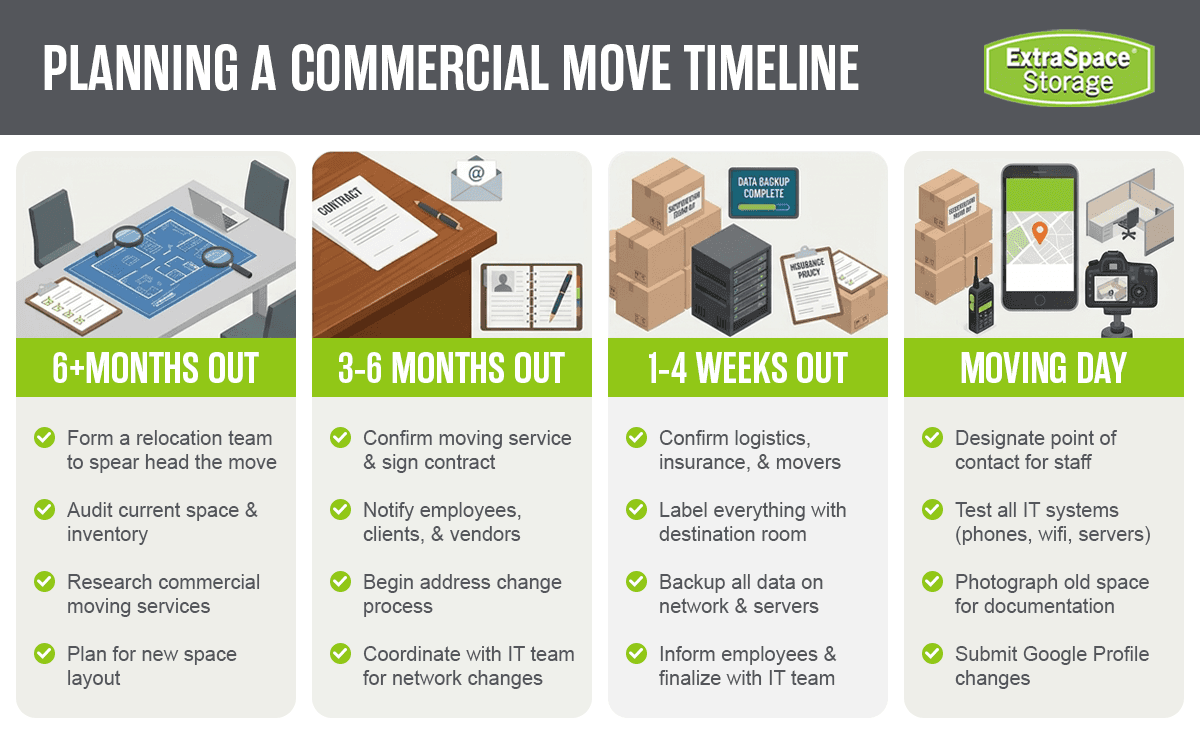
6+ Months Out: Planning & Vendor Selection
Form a relocation team with a dedicated project lead and create an office move checklist.
Inventory all furniture and equipment, and identify what's moving, being sold, or donated.
Research commercial moving companies and get at least three binding estimates.
Review your lease for notice requirements and obligations.
Confirm the new building's move-in rules, including permitted hours, elevator reservations, and certificate of insurance requirements.
Begin planning your new space layout with your office designer or facilities team.
3–6 Months Out: Logistics & Communication
Finalize your office mover selection and sign the contract.
Notify employees, key clients, and vendors of the move date and new address.
Begin the address change process with the USPS, IRS, state licensing authorities, and your bank.
Order new business cards, letterhead, and any other branded materials.
Coordinate with your IT team on network infrastructure needs, including cabling, server room build-out, or ISP provisioning.
1–4 Weeks Out: Final Preparation
Confirm all logistics, including elevator reservations, loading dock access, mover's insurance certificates, and parking.
Arrange disposal or donation pickup for anything not making the move.
Label every piece of furniture and equipment with the destination room.
Back up all data.
Brief employees on packing procedures and expectations for moving day.
Finalize your IT cutover plan, including when servers go offline, when they come back up, and who is responsible for each step.
Moving Day & After: Settling In
Designate point-of-contact staff at both the old and new locations to help coordinate the move.
Test all IT systems—phones, internet, and server access—before employees arrive.
Photograph the old space after move-out for lease documentation.
Within the first week, update your address across your website, Google Business Profile, email signatures, social media profiles, and vendor accounts—and send a move announcement to clients and vendors confirming you're fully operational.
How to Choose a Commercial Moving Company
Not every moving company has experience with commercial relocations. It's important to take the time to evaluate each commercial office mover carefully and ask some key questions before hiring a moving company.
Licensing & Insurance
Any commercial mover operating across state lines must hold an active USDOT number and FMCSA operating authority. For local moves, verify state licensing. Ask for certificates of insurance covering cargo and liability before signing a contract.
Compare Estimates
Get at least three written estimates and request that each be binding rather than non-binding. A binding estimate locks in your price based on a defined scope, while a non-binding estimate can increase based on actual weight or time. When comparing estimates, watch for line items that vary significantly between companies—this often signals that one mover has missed scope items that will show up later as add-ons.
Ask About Commercial Moving Experience
Ask how many office relocations similar to yours the moving company has completed. Find out whether they have dedicated IT equipment handlers or whether general laborers will be moving your servers. Ask about their damage claims process and request client references from comparable moves.

Find Affordable Self Storage Near You
Extra Space Storage has over 4,000 locations across the U.S. with friendly customer service, advanced security features, and affordable month-to-month rates.
- Save up to 40% off online
How Much Does It Cost to Move an Office?
Commercial moving costs vary widely based on office size, distance, and the complexity of what's being moved. The table below shows typical price ranges:
Office Size | Estimated Cost Range | Key Variables |
Small (under 25 employees) | $750–$20,000 | Distance, packing scope, IT complexity |
Mid-sized (25–100 employees) | $5,000–$50,000 | IT infrastructure, furniture volume |
Large (100–200+ employees) | $15,000–$100,000+ | Multi-floor logistics, specialized equipment, complex IT |
The main cost drivers for a commercial move are square footage, headcount, distance, IT complexity, and timing. Local moves are typically priced by the hour, while interstate moving rates are based on weight and mileage. Moving during peak season (May through August) or scheduling for after-hours and weekends typically adds 10–25% to standard rates. Professional packing services run roughly $300–$4,000 depending on volume. Plan for potential add-on charges as well, including elevator fees, stair carries, long-carry charges, and storage if you need temporary staging.
How to Move Your Office IT Systems
IT is often the most time-sensitive—and expensive—part of a commercial move. The core principle is simple: your IT team handles anything involving data, configuration, or security, while the moving company manages the physical transport of equipment. In practice, this means your IT team backs up and verifies all data before anything is disconnected, along with documenting cabling and network configurations. If your business runs on physical servers, begin server and rack migration planning well in advance—and if you're considering migrating to cloud-based infrastructure, an office move can be a natural opportunity to make that transition.
Start planning the network infrastructure at your new location at least three months out. Internet provisioning, cabling, and server room build-out can take longer than expected—especially in older buildings. If your business relies on a phone system, confirm your number porting or transition plan well in advance. Before employees arrive on day one, test all key systems—phones, internet, VPN access, and internal servers. The goal is zero IT surprises when operations begin.
How Self Storage Can Support a Commercial Move
Self storage is a practical tool in a commercial move, especially when timeliness or space constraints don't align. Commercial storage can help in several ways during an office move:
Use storage to bridge the gap when the new space isn't ready before the old lease ends.
Store surplus furniture while deciding what to sell or donate.
Stage a phased move when departments are relocating at different times.
Archive records offsite that don't need to be at the new location.
Commercial Moving FAQs
How far in advance should I plan an office move?
Small offices with fewer than 25 employees typically need about three months of lead time. Mid-sized offices of 25 to 100 employees should plan for around six months. Larger companies with complex IT or build-out requirements may need anywhere from six months to a full year.
How much does it cost to move a business office?
Costs vary considerably by office size—small offices typically run $750–$20,000, mid-sized offices $5,000–$50,000, and larger companies $15,000–$100,000 or more. IT complexity, distance, and timing all affect the final number. Getting three binding estimates from licensed commercial movers is the most reliable way to set your budget.
What should I look for in a commercial moving company?
Verify that the mover holds an active USDOT number and FMCSA operating authority, and request a binding estimate, a certificate of insurance, and client references. If you're relocating IT systems, ask specifically about their IT relocation process and whether they coordinate with your internal IT team.
When is the best time of year for a commercial move?
September through April tends to be the best time of year to move, offering better mover availability and more competitive rates than peak summer. Moving mid-week and mid-month can further reduce costs and help avoid competing with other tenants for elevator and loading dock access.
What address changes are needed when an office moves?
For official and legal updates, notify the USPS, IRS, your bank, your insurance provider, and any state and local licensing agencies. For public-facing and operational updates, refresh your website, Google Business Profile, social media profiles, email signatures, business directories, and vendor and supplier accounts. It's also a good time to reorder business cards and letterhead.
Can storage help with a commercial move?
Yes—storage is a practical solution for the timing gaps and logistical mismatches that often come with commercial moves. If your new space isn't ready when your lease ends, or you're downsizing and need time to sort through excess furniture and equipment, short-term storage can bridge the gap. It's also useful for archiving records or staging a phased move.
***
Moving offices soon? Find more business and commercial moving resources on the Extra Space Storage moving hub. And if you need a place to store equipment or furniture during the transition, Extra Space Storage has facilities across the U.S. to help make your business move easier. Find commercial storage near you!

Author Profile
Quinn Johnson
Quinn Johnson is a moving expert and author for Extra Space Storage. He's moved over 15 times, including internationally, and helped countless others between their own homes. He's happy to lift some boxes for a friend as long as he's paid in pizza. As a writer and content creator for Extra Space Storage since 2019, Quinn shares helpful moving tips and info to alleviate the common stresses of moving.