Helpful Relocation Resources for Las Vegas, NV Newcomers
Relocating to Las Vegas, NV? Whether you are just starting to plan or have already arrived, this guide is your go-to resource for moving to Las Vegas. We’ve gathered essential info on costs, storage, and local—a 30-day checklist—to help you settle into your new home quickly.

Planning Your Move to Las Vegas
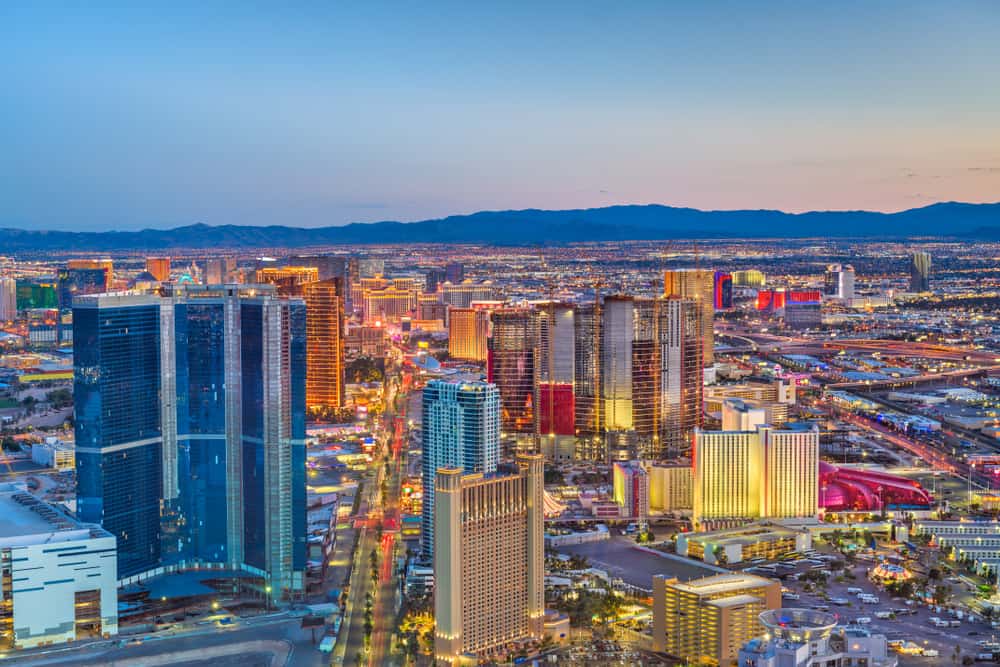
How Much Does Moving to Vegas Cost?
Las Vegas moving costs vary based on distance, home size, and more. A local move costs around $200 to $5,853, while long-distance moves range from $4,099 to $13,563.

Best Moving Companies in Las Vegas
Looking for the best professional movers in Las Vegas? We’ve vetted the top-rated local moving companies in Vegas to make your transition seamless. See options and grab a moving quote to get started.
Free & Cheap Moving Boxes in Las Vegas
Before you buy new moving boxes, check local sources for free or discounted materials. This guide covers the best places to find affordable moving supplies and free moving boxes in Las Vegas.
Las Vegas Self Storage & Moving Day Logistics
Between lease overlaps, home closing timelines, and staging needs, self storage is a practical option while moving to Las Vegas. Extra Space Storage has facilities throughout the greater metro to help bridge the gap.
Self Storage in Las Vegas
Extra Space Storage operates multiple locations across Las Vegas, Henderson, and North Las Vegas. Whether you need short-term storage during your move or a longer-term unit for overflow, you can find a facility close to your new address.
Choosing the Right Storage Unit in Las Vegas
Las Vegas conditions make a few storage factors especially important. Here's what to consider before reserving a storage unit in Las Vegas.
Climate Control: With summer highs regularly exceeding 100°F in Las Vegas, climate-controlled storage is strongly recommended for furniture, electronics, documents, clothing, and anything else sensitive to extreme heat. → Learn About Climate-Controlled Storage
Unit Size Guide: 5x5 (small closet or boxes); 5x10 (studio apartment); 10x10 (1-bedroom); 10x20 (2-3 bedrooms); 10x30 (large home or vehicle). → See the Full Unit Size Guide
Access & Security: Look for 24-hour or extended access hours, electronic gate entry, on-site management, and video surveillance. These are standard features at most Extra Space Storage facilities. → 24-Hour Storage Access
Lease Flexibility: Month-to-month leases let you avoid being locked into a long-term commitment—useful when move timelines shift. Upgrade or downsize your unit as your situation changes.
How to Use Storage in Between Homes
If there's a gap between your move-out and move-in dates, storage can simplify the transition. This is common in Las Vegas due to lease timing differences, delayed home closings, and staging needs. Our guide covers how to bridge that gap with a short-term storage unit. → Learn More About Storage for Moving
Explore Las Vegas: Neighborhoods, Cost of Living & What to Expect
The Las Vegas metro is expansive, spanning the city proper, Henderson, North Las Vegas, and a range of unincorporated Clark County communities. From commute times to cost of living, each area offers something different. Use these guides to find the right fit before or after your move.
Cost of Living in Las Vegas
Despite being a large city with tons of amenities, the cost of living in Las Vegas is 2% lower than the national average. Healthcare and goods and services are roughly 10-15% lower. See a full category breakdown and comparison against your current city.
Pros & Cons of Las Vegas
Affordable real estate, outdoor recreation, and mild winters make Las Vegas a good place to call home—but frequent heat waves and a limited job market are some things to consider before committing. Here are all the benefits and drawbacks of living in Las Vegas.
Things to Know About Vegas
A strong retiree community and things to do off the Vegas strip may not always show up in a quick search about the city, but our local guide covers the practical realities new Vegas residents need to know that don't appear right away once they're settled in.
Best Neighborhoods in Las Vegas
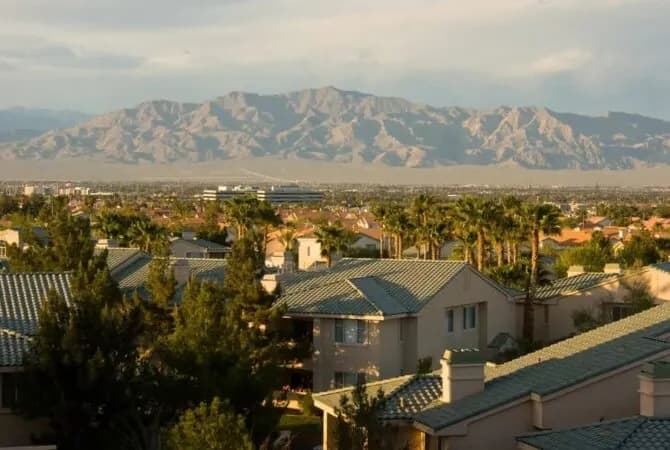
Safe, Affordable Neighborhoods in Las Vegas
Las Vegas has safe and affordable neighborhoods perfect for families, retirees, and young professionals, in areas like Centennial Hills, The Lakes, Lone Mountain, and more.

Best Neighborhoods in Las Vegas for Singles & Young Professionals
Las Vegas offers an affordable living and vibrant nightlife, making it appealing for singles and young professionals. Key neighborhoods include Downtown, Green Valley South, Paradise, and more.

Best Neighborhoods in Las Vegas for Families
Las Vegas offers family-friendly neighborhoods that combine affordability, safety, and plenty of activities. Centennial Hills, Green Valley Ranch, Summerlin, and other areas are great for families.
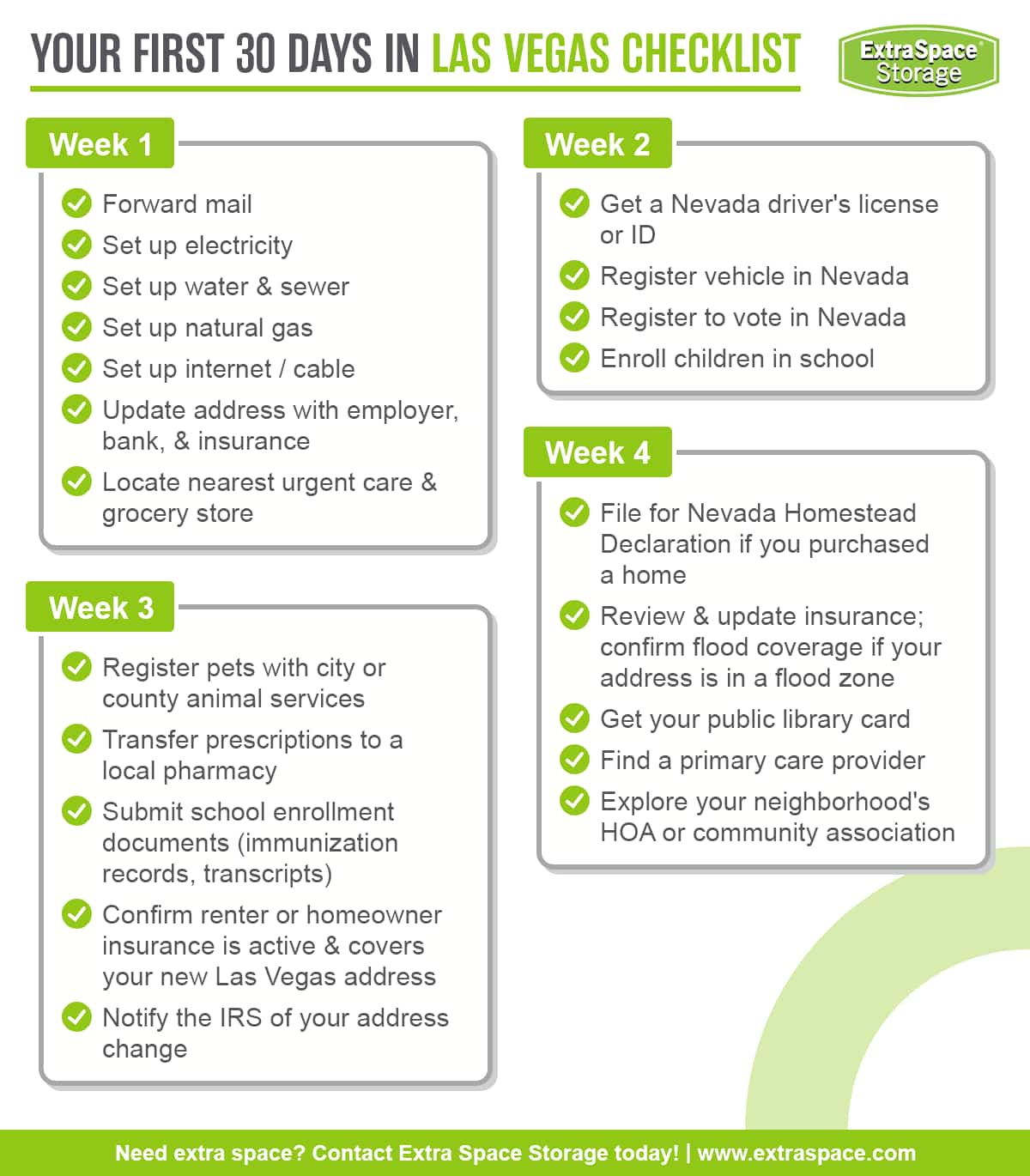
Your First 30 Days in Las Vegas: Quick-Start Checklist
Las Vegas has a specific set of administrative tasks that new residents need to complete quickly. From license registration to utility setup, there's plenty to cover. Use this Las Vegas moving checklist to stay on track during your first month.
Local Resources for New Las Vegas, NV Residents
This section highlights the essential setup tasks for new residents, from government registration and healthcare orientation to school enrollment and transportation. It also covers financial and legal considerations, emergency preparedness, employment resources, and ways to connect with the community.
Government & Administrative Setup in Las Vegas
Nevada requires new residents to transfer their driver's license, register their vehicle, and update voter registration within 30 days of establishing residency. Utility setup and pet registration vary depending on whether your address falls within city limits or unincorporated Clark County.
Driver's License | Nevada requires a new resident driver's license within 30 days. Required documents include proof of identity, proof of Social Security number, and two proofs of Nevada residency (lease, utility bill, etc.). Visit a Nevada DMV office. → Nevada DMV |
Vehicle Registration | Nevada vehicle registration is required within 30 days. Bring your out-of-state title, proof of Nevada auto insurance, and payment for registration fees. A VIN inspection is required and can be completed at most DMV offices or by a Nevada law enforcement officer. → Nevada Vehicle Registration |
Voter Registration | Register online, by mail, or in person through the Nevada Secretary of State. Nevada offers same-day voter registration at any Clark County Early Voting site or Election Day vote center. → Clark County Same-Day Voter Registration |
Utilities Setup | Las Vegas' primary electricity provider is NV Energy. For natural gas setup, use Southwest Gas. Water utilities are provided through Las Vegas Valley Water District. For internet and cable, use Cox Communications and Lumen. |
Toll Roads | Nevada has no toll roads. No transponder or toll account is required anywhere in the Las Vegas metro. |
Pet Registration | Pet licensing is required for dogs and cats in Clark County. →City of Las Vegas and →Unincorporated Clark County. |
Schools & Family Resources in Las Vegas
Clark County School District (CCSD) serves the Las Vegas metro as one of the largest school districts in the U.S. Enrollment is handled through the district's zone-based process, with magnet and specialty school options available at the application level.
K–12 Public Schools | Clark County School District (CCSD). Use the district's school finder tool to locate your assigned school by address. Enrollment requires proof of immunizations and address, as well as IDs from both parent and child. → CCSD School Finder |
School Enrollment | Required documents include proof of address (lease or utility bill), the child's birth certificate or passport, parent ID, and current immunization records. Contact your assigned school directly for magnet program deadlines and any specialty program application requirements. |
Charter & Private Schools | Nevada offers an Education Savings Account (ESA) program for qualifying families. For a directory of private schools, visit the NV Department of Education. → Nevada Private Schools |
Higher Education | Major universities and colleges in the metro include the University of Nevada, Las Vegas, College of Southern Nevada, and Nevada State University. UNLV requires 12 consecutive months of Nevada residency for in-state tuition eligibility. |
Child Care | Nevada's Division of Social Services administers subsidized child care assistance for qualifying families. The Nevada Child Care Resource & Referral Network provides local provider listings and referral support. |
Healthcare in Las Vegas
Las Vegas is served by several large hospital networks with facilities distributed across the metro. New residents should identify a primary care provider early, as demand for Las Vegas healthcare is high relative to provider supply, and appointment availability can vary.
Major Health Systems | Valley Health System operates nine hospitals and medical facilities across the metro, including: Valley Hospital Medical Center : St. Rose Dominican operates three campuses (Siena, Rose de Lima, and San Martín) (UMC) is Clark County's public hospital and Level I trauma center (HCA Healthcare) includes |
Finding a PCP | Use your insurance provider's online directory to locate in-network primary care physicians in Las Vegas. Nevada's health insurance market includes plans through Nevada Health Link, Anthem, UnitedHealthcare, and Aetna. |
Urgent Care | Major urgent care networks operating in the Las Vegas metro include Concentra and CareNow Urgent Care. Walk-in availability is generally offered at most locations; hours vary by facility. |
Mental Health | Crisis Support Services of Nevada provides 24-hour crisis support—988 (call or text). For non-emergency behavioral health referrals, Nevada 2-1-1 (call 2-1-1) can connect residents to local providers. |
Pharmacy | Walgreens and CVS have broad coverage across the metro. Use the Nevada Drug Card to get lower prices on your prescription. |
Transportation in Las Vegas
As a car-dependent city, Las Vegas public transit is relatively limited. While service is available through the RTC Southern Nevada bus network, most residents rely on personal vehicles for their daily commutes. Additionally, there are no toll roads in Nevada.
Toll Roads | Nevada has no toll road system. No transponder, toll account, or Toll-by-Plate enrollment is required. |
Public Transit | RTC Southern Nevada operates the metro bus network, including frequent-service routes on major corridors. The Deuce and SDX routes serve the Strip. For routes, schedules, and pass options: → RTC Southern Nevada |
Las Vegas Monorail | The Las Vegas Monorail connects several Strip resorts and convention centers. It does not extend into residential neighborhoods. |
Airport Access | Harry Reid International Airport (LAS) serves the metro with direct service on all major domestic carriers. Rideshare pickup is located in the designated ground transportation areas outside baggage claim at Terminal 1 and Terminal 3. Long-term parking is available in airport-managed structures. |
Major Roadways | I-15 runs north–south and is the primary spine of the metro. US-95 connects the northwest metro to downtown. I-215 forms the southern beltway and connects Henderson to the western and northwestern metro. I-11 provides a corridor south toward Boulder City and the Phoenix metro. |
Financial & Legal Setup in Las Vegas
Nevada has several state-specific financial and legal considerations that new residents should address early. The absence of a personal state income tax and the structure of Nevada's homestead protection are two items that commonly require action for residents relocating from other states.
State Income Tax | Nevada has no personal state income tax. Residents do not file a Nevada state income tax return. If you are relocating from a state with income tax, update your W-4 withholding with your employer to reflect the change. For California transplants in particular, consult a tax professional regarding establishing Nevada residency for tax purposes. |
Homestead Declaration | Nevada's homestead law protects up to $605,000 of equity in a primary residence from forced sale by unsecured creditors. This is a creditor-protection exemption, not a property tax reduction. To activate the protection, file a Declaration of Homestead with the Clark County Recorder's office. There is no annual deadline. → Clark County Recorder |
Homeowners Insurance | Nevada does not mandate windstorm or flood coverage as part of a standard homeowners policy. However, parts of the Las Vegas Valley lie within FEMA-designated flood zones related to desert wash areas—particularly near drainage channels that can flood rapidly during monsoon storms (June–September). Check your property's flood zone status before finalizing coverage. → FEMA Flood Map |
Vehicle Insurance | Nevada requires minimum liability coverage of 25/50/20: $25,000 bodily injury per person, $50,000 per accident, and $20,000 for property damage. There are no grace periods, so update your policy to meet Nevada's minimums before registering your vehicle. |
HOA Communities | HOA communities are prevalent throughout the Las Vegas metro, particularly in master-planned areas like Summerlin, Henderson, and Centennial Hills. Monthly HOA dues typically range from $75 to $300 or more. Review HOA documents and fee schedules as part of your home purchase or rental process. |
Address Updates | Notify the IRS (Form 8822), Social Security Administration, financial institutions, health insurance provider, and voter registration of your new Las Vegas address. |
Las Vegas Emergency Preparedness & Safety
New Las Vegas residents should be aware of two primary seasonal hazards: flash flooding during the summer monsoon season and extreme heat. Desert terrain does not absorb water quickly—flash floods can develop with little warning in low-lying areas and near drainage channels, even from storms occurring miles away. Registering for emergency alerts is recommended shortly after arrival.
Emergency | 911 |
Las Vegas Metro Police Non-Emergency | 702-828-3111 |
Las Vegas City Non-Emergency | 702-229-3111 |
Poison Control | 1-800-222-1222 |
Nevada Crisis Line | 988 (Crisis Support Services of Nevada, 24/7) |
Emergency Alerts | Sign up for Clark County's emergency notification system. → Las Vegas Emergency Alerts |
Natural Disaster Info | Primary seasonal risks: flash flooding (monsoon season, June-September) and extreme heat (summer highs regularly exceed 100°F). Secondary risks include high wind events and occasional winter freezes in elevated areas. → Clark County Emergency Management |
FEMA Flood Map | Check your address for flood zone designation; relevant for properties near desert washes or drainage channels. → FEMA Flood Map Service Center |
Employment Resources in Las Vegas
The Las Vegas economy is anchored by gaming, hospitality, and tourism, which collectively account for a large share of metro employment. Healthcare, construction, logistics, and technology, particularly data centers, are growing sectors. New residents can access state-managed job listings, workforce development programs, and unemployment benefits through the Nevada Department of Employment, Training, and Rehabilitation (DETR).
Major Industries | Gaming, hospitality, and tourism remain the largest employment sectors. Healthcare, construction, logistics and warehousing, and data center operations are additional significant employers. → Las Vegas Metro Chamber of Commerce — Economic Resources |
Top Employers | Major employers in the Las Vegas metro include MGM Resorts International, Caesars Entertainment, Wynn Resorts, Clark County School District, Clark County Government, and Nellis Air Force Base. |
Job Search Tools | LinkedIn, Indeed, and Glassdoor — filter by Las Vegas for a broad reach across industries. |
State Job Portal | EmployNV provides state-managed job listings, resume tools, and workforce training resources. → EmployNV |
Unemployment Benefits | Unemployment insurance in Nevada is administered through DETR. Note that eligibility is based on wages earned in Nevada—residents who relocated before finding Nevada employment may not qualify immediately. → Nevada DETR Unemployment |
Professional Networking | Vegas Young Professionals (VYP) and Las Vegas Metro Chamber of Commerce. Both offer events, peer connections, and resources relevant to the metro's economy. |
Staffing & Temp Agencies | Robert Half and Manpower both operate offices in Las Vegas and place candidates in contract and temp-to-hire roles across industries. |
Las Vegas Community Resources & Amenities
Public Library: The Las Vegas-Clark County Library District operates 25 branch locations across the metro. Obtain a free library card at any branch with proof of Nevada address. Digital borrowing through the Libby and Kanopy apps is available at no cost with an active card.
Parks & Recreation: City of Las Vegas Parks and Recreation manages parks within city limits. Clark County Parks manages facilities in unincorporated areas. Note: Henderson and North Las Vegas have separate parks departments for their respective city limits.
Neighborhood Associations & Civic Resources: The City of Las Vegas Neighborhood Services division connects residents to their local neighborhood association and provides civic resources, meeting schedules, and community contact information.
Local Media: The Las Vegas Review-Journal is the metro's primary daily newspaper. Local TV news stations include KTNV Channel 13 (ABC), KVVU FOX5, and KSNV NBC3 for ongoing local coverage.
Quinn Johnson
Quinn Johnson is a moving expert and author for Extra Space Storage. He's moved over 15 times, including internationally, and helped countless others between their own homes. He's happy to lift some boxes for a friend as long as he's paid in pizza. As a writer and content creator for Extra Space Storage since 2019, Quinn shares helpful moving tips and info to alleviate the common stresses of moving.