Helpful Relocation Resources for Chicago, IL Newcomers
Moving to Chicago, IL? This guide has the resources you need to make your relocation smooth—from moving cost estimates and storage options to a checklist for your first 30 days in the city. Here's what you need to know to help you get settled in Chicago.

Planning Your Move to Chicago

How Much Does a Chicago Move Cost?
For local or mid-range moves, professional movers typically cost between $200 and $6,103, while cross-country moves to or from Chicago average between $2,200 and $13,826. Get your detailed estimate now!

Best Moving Companies in Chicago
Moving to Chicago from a nearby metro area? We've researched the top moving companies in Chicago to help with your relocation. See our top picks like 2 Guys and a Van and get your custom quote today.

Free & Cheap Moving Boxes in Chicago
Looking for moving boxes in Chicago? Learn the best places to find free and low-cost moving supplies in Chicago—as well as where to recycle your boxes once you've finished unpacking—in our helpful guide.
Chicago Self Storage & Moving Day Logistics
Self storage can be helpful in a variety of situations when moving, from navigating lease gaps to home staging. See how storage can help during your transition and find a facility near you.
Self Storage in Chicago
Extra Space Storage has multiple facilities throughout Chicago and the surrounding area. Climate-controlled units are available and are a practical consideration in Chicago, since temperatures can drop well below freezing in winter and reach the 90s in summer—both extremes that can damage furniture, electronics, documents, and more in uncontrolled storage environments.
Choosing the Right Storage Unit in Chicago
Here are a few factors to keep in mind when selecting a Chicago storage unit:
Climate Control: Chicago's summers hit the mid-80s and winters drop below freezing—making climate-controlled storage worth considering. These units typically maintain temperatures between 55–80°F year-round, helping protect furniture, electronics, clothing, and documents from temperature damage. → Climate-Controlled Storage Guide
Unit Size: 5x5 (small closet/boxes); 5x10 (studio apartment); 10x10 (1-bedroom); 10x20 (2–3 bedroom home); 10x30 (large home or vehicle). → Storage Unit Size Guide
Access & Security: 24/7 or extended access hours, electronic gate access, on-site management, and video surveillance are included at most Extra Space Storage facilities in Chicago. → 24-Hour Storage Access
Lease Flexibility: Month-to-month leases mean you're not locked into a long-term contract—useful for moving timeline changes or delayed closings. Upgrade or downsize as your needs change.
How to Use Storage In Between Homes
Whether you've got a gap between leases, you're staging your home for sale, or you're waiting on a closing date, short-term storage can help. For a full breakdown of how to use storage during a move, see the guide below. → Learn More About Storage for Moving
Explore Chicago: Neighborhoods, Cost of Living, & What to Expect
The neighborhoods across Chicago's 77 community areas vary significantly in housing costs, school options, commute times, and character. Use these guides to identify areas that match your priorities before your move.
Cost of Living in Chicago
Chicago's cost of living runs 17.6% above the national average, with housing as the primary driver at roughly 44% higher than the U.S. average. For a full breakdown by category, see the full cost of living guide.
Pros & Cons of Chicago
Chicago's public transit network and cultural resources are commonly considered advantages. Harsh winters and above-average housing costs are frequently noted drawbacks. Discover more pros and cons of Chicago.
Things to Know About Chicago
From affordable housing and career opportunities to the city's best breweries and restaurants, our local guide explores everything you need to know about living in Chicago that don't always show up in a quick search.
Best Neighborhoods in Chicago

Best Neighborhoods in Chicago for Singles & Young Professionals
Chicago is an ideal city for singles and young professionals, thanks to its job market and public transit, including Lake View, Lincoln Park, and more.

Best Neighborhoods in Chicago for Families
Chicago is a fantastic city for families, offering excellent dining, affordable housing, and numerous family-friendly activities. Neighborhoods for families include Edgewater, Forest Glen, and more.

Best Places to Buy a Home in Chicago
Chicago offers a competitive real estate market, ideal for first-time homebuyers and families. Key neighborhoods to consider buying a home in include Beverly, Edison Park, Lincoln Square, and more.
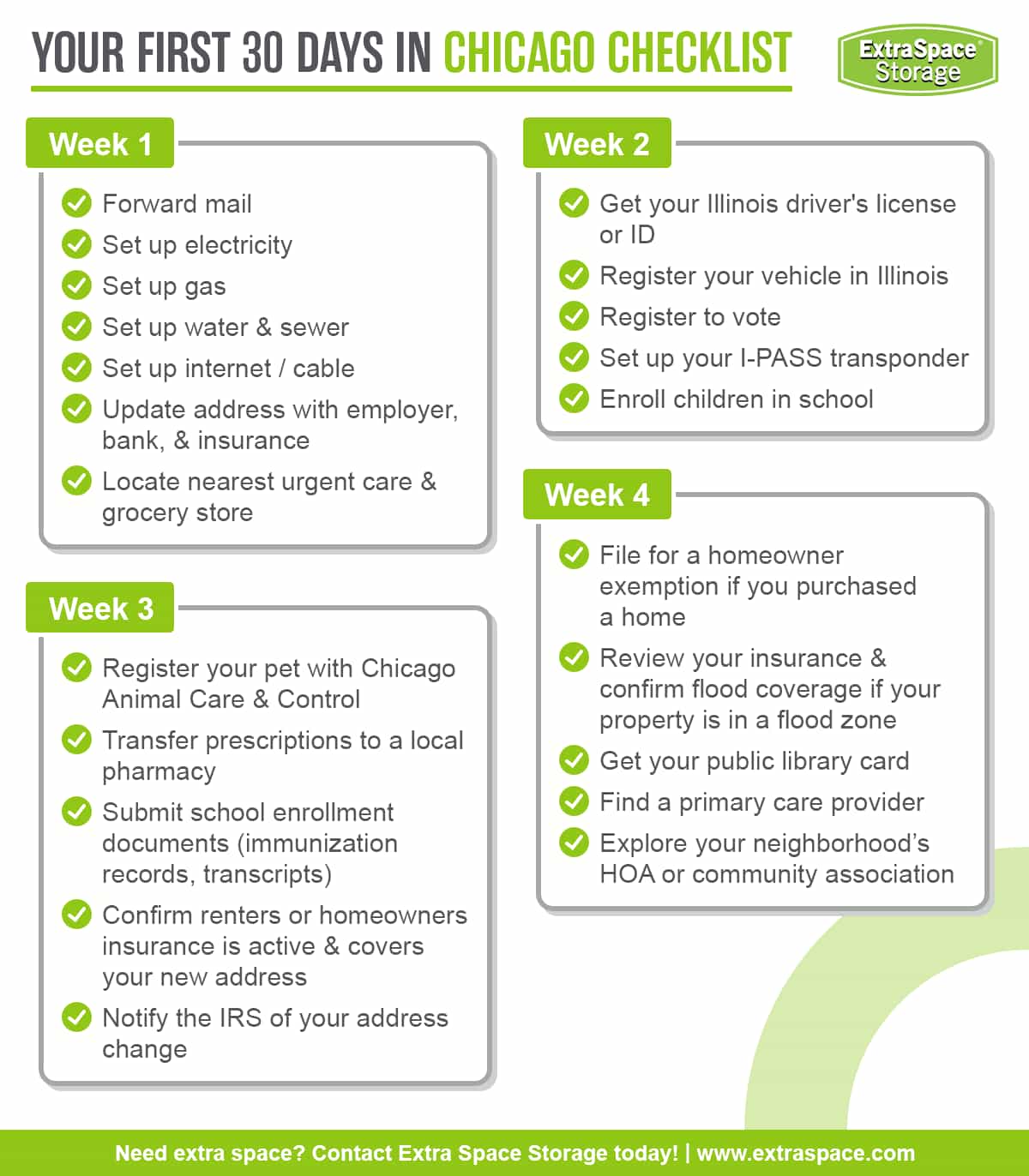
Your First 30 Days in Chicago: Quick-Start Checklist
Use this Chicago moving checklist to stay on track during your first month in the Windy City.
Local Resources for New Chicago, IL Residents
This section covers the practical steps most new Chicago residents need to complete—from setting up utilities, finding a doctor, and enrolling kids in school to understanding Illinois financial requirements and knowing where to turn in an emergency.
Government & Administrative Setup in Chicago
New Chicago residents need to get an Illinois driver's license and vehicle registration, update voter registration, set up utilities, and license any pets. Several of these have time-sensitive deadlines once Illinois residency has been established.
Driver's License | New Illinois residents must obtain a state driver's license within 90 days of establishing residency. Required documents include proof of Illinois residency, identity, Social Security number, and legal presence. Licenses are issued through the Illinois Secretary of State. → Driver's License |
Vehicle Registration | Vehicles must be registered in Illinois within 30 days of establishing residency. Required documents include the vehicle title, proof of insurance, and proof of residency. Registration is handled through the Illinois Secretary of State. → Vehicle Registration |
Voter Registration | Illinois allows same-day voter registration at polling locations on Election Day. Online registration is available through the Illinois State Board of Elections, as is in-person registration at county clerk offices. You must provide two forms of ID to register. → Illinois State Board of Elections |
Utilities Setup | Chicago's primary electric provider is ComEd, and the primary natural gas provider is Peoples Gas. Water and sewer services are handled by the City of Chicago Department of Water Management. Internet providers include Xfinity, AT&T, and Astound. |
Pet Registration | Dogs must be licensed annually in Chicago through Chicago Animal Care and Control—registration is required within 30 days of moving to the city. Dogs and cats over four months of age must have an up-to-date rabies vaccination. |
School & Family Resources in Chicago
Chicago is served by Chicago Public Schools (CPS)—one of the largest school districts in the United States—with neighborhood schools, magnet programs, and selective enrollment options across all 77 community areas. Chicago also has a range of options for charter and private schools, higher education institutions, and child care providers.
K–12 Public Schools | Chicago Public Schools (CPS) operates schools citywide. Use the CPS school locator tool to search schools by name or based on your address. |
School Enrollment | Enrolling in CPS requires proof of Chicago address, a birth certificate, and immunization records. If you're considering selective enrollment or magnet school programs, note that these have separate application deadlines—check CPS for current timelines before your move date. |
Charter & Private Schools | For private school options, the National Center for Education Statistics offers a searchable directory. For charter schools, see the CPS Charter and Contract Schools Directory. |
Higher Education | Major institutions in or near Chicago include University of Illinois Chicago (UIC), DePaul University, Loyola University Chicago, The University of Chicago, Illinois Institute of Technology, and Northwestern University. For in-state tuition, Illinois generally requires 12 months of established residency before you qualify. |
Child Care | Chicago-area families can access child care assistance and referrals through Illinois Action for Children, which administers the state's Child Care Assistance Program (CCAP) for Cook County. |
Healthcare in Chicago
Chicago has several major academic health systems with hospital networks throughout the metro. New residents should use their insurance carrier's provider directory to locate in-network physicians and facilities.
Major Health Systems | Major health systems in Chicago include Northwestern Medicine, Rush University Medical Center, University of Chicago Medicine, and Advocate Health Care—the largest health system in Illinois, with multiple hospitals across the metro area. |
Finding a PCP | Use your insurance company's online provider directory to find in-network primary care physicians. Most major carriers offer searchable directories by ZIP code, specialty, and language. Major Illinois insurers include BlueCross BlueShield of Illinois (BCBSIL), UnitedHealthcare, and Aetna. |
Urgent Care | Urgent care options in Chicago include Northwestern Medicine Immediate Care, Advocate Health Immediate Care, and GoHealth Urgent Care locations citywide. Most offer walk-in availability, although some locations use online check-in to manage wait times. |
Mental Health | NAMI Chicago offers mental health resources, education, and referrals in the Chicago area. The national crisis line is 988 (call or text, 24/7). |
Pharmacy | Walgreens and CVS have extensive location networks throughout Chicago. Jewel-Osco pharmacy locations are also widely available across the city. |
Transportation in Chicago
Getting around Chicago typically means setting up an I-PASS for toll roads and familiarizing yourself with the CTA network. For commutes into the Loop, most residents find public transit more practical than driving—downtown parking is limited and traffic congestion is consistent.
Toll Pass Setup | Illinois uses the I-PASS transponder system, compatible with E-ZPass across 19+ states—order online or by phone. Without a transponder, Toll-by-Plate applies at a higher rate per trip.→ I-PASS Setup |
Key Toll Roads | Chicago-area toll roads include I-90/94 (Kennedy Expressway/Dan Ryan Expressway), I-90 (Chicago Skyway), I-88 (Reagan Memorial Tollway), I-290 (Eisenhower Expressway), I-294 (Tri-State Tollway), and I-355 (Veterans Memorial Tollway). |
Public Transit | The Chicago Transit Authority (CTA) operates the Chicago "L" rail system (eight lines) and more than 100 bus routes citywide. Pay your fare with a Ventra card. The Metra commuter rail and Pace buses serves suburban routes. |
Airport Access | O'Hare International Airport (ORD) is the primary airport, accessible via the CTA Blue Line and Metra UP-NW line. Rideshare pickup is in designated lots. Chicago Midway International Airport (MDW) serves the Southwest Side and is accessible via the CTA Orange Line. |
Major Roadways | Key interstates for navigating the Chicago metro include I-90/I-94 (north-south through the city), I-290 (east-west through the city), I-55 (southwest corridor), I-88 (western suburbs), and I-294 (north-south bypass). |
Financial & Legal Setup in Chicago
Illinois has a flat state income tax rate, and Cook County homeowners may be eligible for a homeowner exemption. New residents should also confirm their insurance covers Illinois-specific requirements and review flood zone status if purchasing in certain areas.
State Income Tax | Illinois has a flat state income tax rate of 4.95%—there are no graduated brackets. New Illinois residents should update their withholding by submitting an updated W-4 (or IL equivalent) to their employer. |
Homestead Exemption | Cook County homeowners may be eligible for a homeowner exemption. After moving, apply with the Cook County Assessor's Office—the exemption renews automatically in subsequent years. |
Homeowners Insurance | Standard homeowners insurance policies do not include flood coverage. Chicago homeowners—particularly those near the Chicago River, the lakefront, or in FEMA-designated flood zones—should consider purchasing separate flood coverage. → IDOI Flood Insurance |
Vehicle Insurance | Illinois' minimum liability requirements are $25,000 for bodily injury per person, $50,000 per accident, and $20,000 for property damage. Uninsured and underinsured motorist coverage (UM/UIM) is required at the same 25/50 minimum limits. Illinois does not require Personal Injury Protection (PIP). |
Address Updates | Key parties to notify include the IRS (Form 8822), Social Security Administration (Form SS-5 or online), financial institutions, health insurance provider, and Illinois voter registration. → USPS Change of Address |
Chicago Emergency Preparedness & Safety
Chicago's primary seasonal risks are severe winter weather—heavy snow and ice are common from December through February—and thunderstorms in summer. Tornadoes do occur in Illinois but are most frequent in the central and southern parts of the state—serious events in the Chicago metro are relatively rare. Residents in flood-prone areas near the Chicago River or lakefront should verify their flood zone status.
Emergency | 911 |
Chicago Police Non-Emergency | (312) 744-5000 |
Poison Control | 1-800-222-1222 |
National Crisis Line | 988 (call or text, 24/7) |
Emergency Alerts | Chicago Office of Emergency Management and Communications (OEMC) → OEMC Alerts |
Natural Disaster Info | Illinois Emergency Management Agency (IEMA) provides guidance on severe weather preparedness including winter storms, tornadoes, and flooding. → Severe Weather Public Safety |
FEMA Flood Map | Check your property address to see if you're in one of the FEMA-designated flood zones. |
Employment Resources in Chicago
Chicago's economy spans finance, healthcare, technology, manufacturing, transportation and logistics, and professional services. The metro is home to a significant number of Fortune 500 headquarters and a growing technology sector.
Major Industries | Healthcare, technology, manufacturing, transportation and logistics, and business are among Chicago's largest employment sectors. |
Top Employers | Major employers in Chicago include Exelon, United Airlines, Boeing, Motorola Solutions, JLL, Abbott, Chicago Public Schools, and more. |
Job Search Tools | LinkedIn, Indeed, and Glassdoor all allow filtering by Chicago or specific ZIP codes for the broadest reach. |
State Job Portal | Illinois Department of Employment Security (IDES) provides state-managed job listings, workforce development programs, and labor market data. |
Unemployment Benefits | New residents who relocate before securing employment should review eligibility requirements at IDES. Eligibility considerations apply for those relocating from another state before finding work. → Unemployment Benefits |
Professional Networking | Chicagoland Chamber of Commerce and World Business Chicago are two starting points for professional connections in the metro. |
Staffing & Temp Agencies | Robert Half, Manpower, and Aerotek have Chicago-area offices and handle contract, temp-to-hire, and direct placement roles across multiple industries. |
Chicago Community Resources & Amenities
Public Library: Chicago Public Library (CPL) operates 81 locations across the city. A library card is free with proof of a Chicago address and includes access to physical collections, digital resources through the Libby app (eBooks and audiobooks), and streaming through Kanopy.
Parks & Recreation: The Chicago Park District manages more than 600 parks and 26 miles of lakefront.
Forest Preserves of Cook County
offers additional green space beyond the city limits.
Neighborhood Associations & Civic Resources: The City of Chicago Department of Planning and Development maintains neighborhood resource information. Many Chicago neighborhoods have active community organizations—contact your local alderman for neighborhood-specific groups and resources.
Local Media: The Chicago Tribune and Chicago Sun-Times are the city's two major daily newspapers. Block Club Chicago provides neighborhood-level reporting. For broadcast news, the main local channels are ABC7 (WLS-TV), NBC 5 Chicago (WMAQ-TV), CBS 2 (WBBM-TV), WGN-TV (Channel 9), and FOX 32 (WFLD).
Quinn Johnson
Quinn Johnson is a moving expert and author for Extra Space Storage. He's moved over 15 times, including internationally, and helped countless others between their own homes. He's happy to lift some boxes for a friend as long as he's paid in pizza. As a writer and content creator for Extra Space Storage since 2019, Quinn shares helpful moving tips and info to alleviate the common stresses of moving.