Moving Guide
Moving Truck Size Comparison: Dimensions, Cargo Capacity, & More
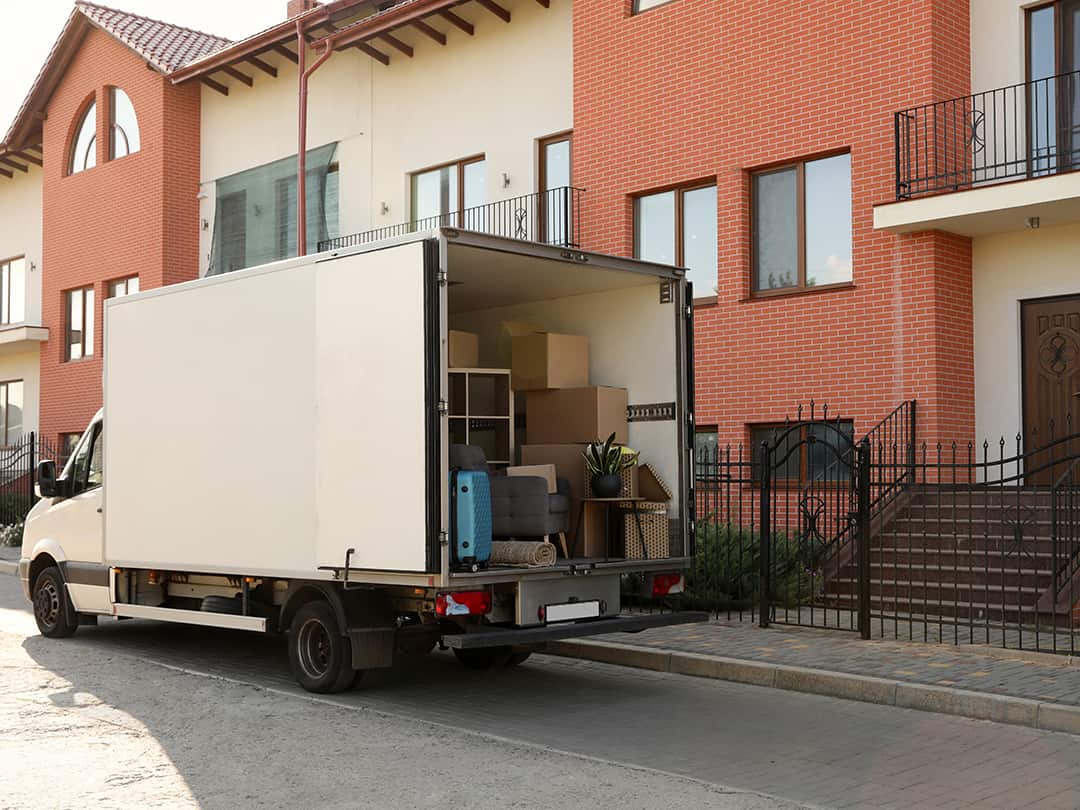
In addition to deciding between moving by yourself and hiring movers, choosing the right moving truck size is important for planning a move. If you rent a box truck that’s too small, you might be forced to make multiple trips or to leave belongings behind, while a moving truck rental size that’s too large could waste money and be harder to drive. Review our moving truck size comparison to find the right moving truck dimensions to rent.
Moving Truck Size Chart
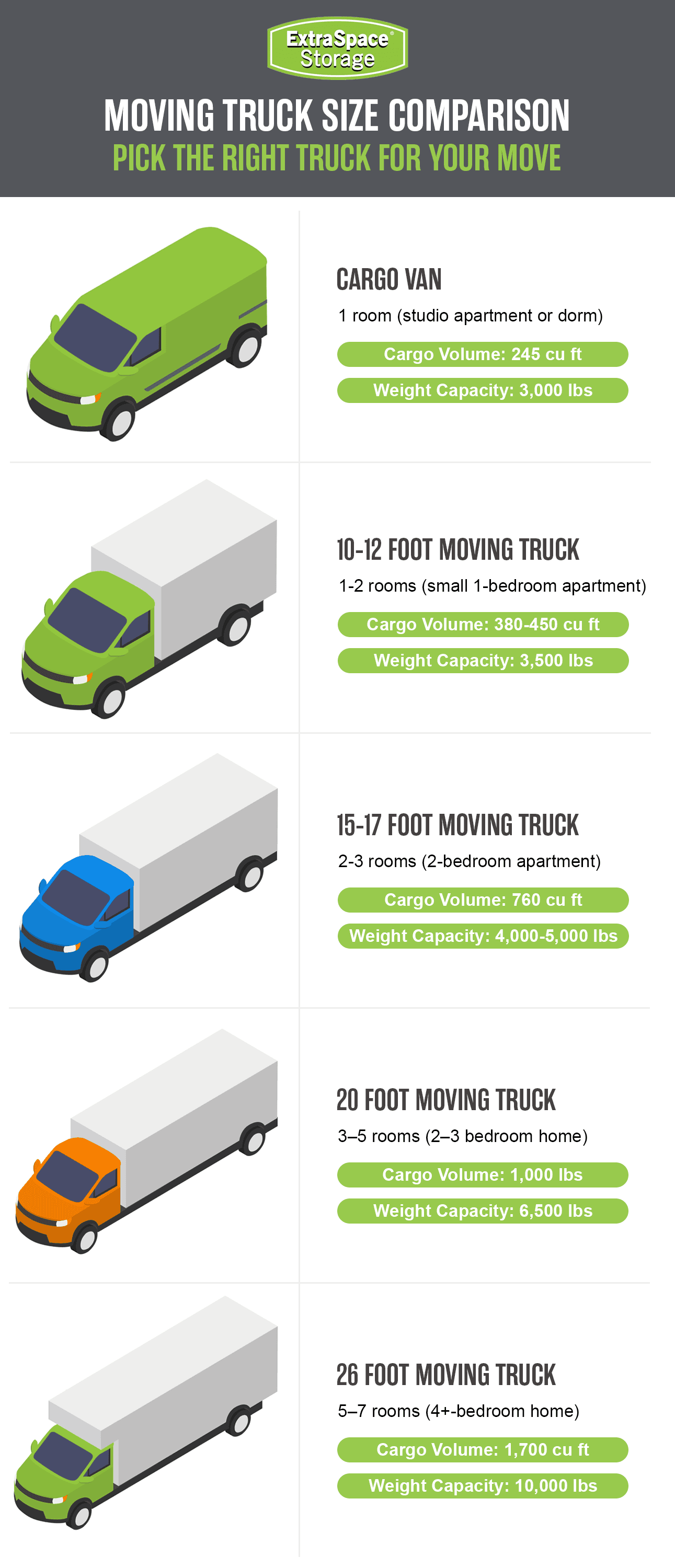
Moving trucks generally fall into a few standard size categories. When picking your moving truck type, consider its approximate cargo volume, weight capacity (may vary by rental company), and how many rooms of furniture they accommodate.
Truck Size | Approx. Cargo Volume | Weight Capacity | Room Capacity |
Cargo Van | ~245 cu ft | ~3,000 lbs | 1 room (studio apartment or dorm) |
10–12 Foot Truck | ~380–450 cu ft | ~3,500 lbs | 1-2 rooms (small 1-bedroom apartment) |
15–17 Foot Truck | ~760 cu ft | ~4,000–5,000 lbs | 2-3 rooms (2-bedroom apartment) |
20 Foot Truck | ~1,000 cu ft | ~6,500 lbs | 3–5 rooms (2–3 bedroom home) |
26 Foot Truck | ~1,700 cu ft | ~10,000 lbs | 5–7 rooms (4+-bedroom home) |
*Note: A 5 to 7-room capacity roughly equates to a 3 or 4-bedroom house when you include living areas and kitchen. Always consider the volume and weight of your specific belongings when deciding which moving truck size you need.
Cargo Van (Smallest Size)
Cargo vans are the most compact moving vehicles available. This moving van option offers about 240–250 cubic feet of space—roughly equivalent to a large walk-in closet—and can carry around 3,000 pounds of cargo. Cargo vans can usually hold a mattress set, a sofa or dresser, and a handful of boxes.
Pros:
Easy to drive (similar to an oversized van)
Much easier to park on city streets than box trucks
Cons:
Limited space requires careful packing to maximize every inch
Best Uses:
Cargo vans are ideal for very small moves, such as a dorm room, studio apartment, or a single large item.
They're perfect for students or anyone moving out of a small space with only one room’s worth of furniture.
They’re also handy for shuttling a few bulky items across town or for DIY projects.
If you only have a small load and want a convenient, budget-friendly option, a cargo van could be your best bet.
10 to 12-Foot Moving Truck (Small Size)
Small moving trucks in the 10-12 foot range offer a step up in capacity from a moving van. These trucks typically have about 350–450 cubic feet of interior space and hold around 3,000 to 3,500 pounds of cargo. When deciding, keep an eye on dimensions of the box truck, specifically the height and door clearance.
Pros:
Relatively easy to handle, perfect for local moves or shuttling items to storage
Cons:
Interior height of smaller box trucks may only be around six feet
Door clearance may not be high enough for your belongings
Best Uses:
A 10 or 12-foot moving truck is usually suitable for moving the contents of one to two rooms.
This moving truck size is great for individuals or couples moving out of a studio or small one-bedroom apartment.
In a 10-foot box truck truck, you can generally fit large items like a queen-size bed, a small sofa, a kitchen table, and chairs, plus dozens of boxes.
A 12-foot moving truck gives you a little extra length for an additional loveseat or maybe a desk.
15 to 17-Foot Moving Truck (Medium Size)
Medium-sized moving trucks around 15 or 16 feet long—with some up to 17 feet—are the most popular for apartment moves. These standard box truck sizes provide roughly 750–800 cubic feet of space and can carry about 4,000–5,000 pounds, which is perfect for moving the contents of two to three rooms.
Pros:
Sometimes feature over-cab storage areas for additional boxes or to separate fragile items
Extra height (often around seven feet high inside) and width for easier loading
Can stack couches on end or pile boxes high, utilizing the truck's full volume
Cons:
Lower weight limit than large moving trucks
More difficult to drive—take wider turns and be mindful of overhead clearances
Best Uses:
A medium moving truck size is a good choice for long-distance moves where a 10-foot moving truck might be too cramped.
A 15-foot truck can handle a couple of bedrooms’ furniture (beds, dressers, nightstands), a living room set (sofa, coffee table, chairs), a dining table, and boxes.
A 16-foot moving truck can typically accommodate a two-bedroom apartment, condo, or a small house’s worth of items.
20 to 26-Foot Moving Truck (Large Size)
For bigger households between two and five rooms, large moving trucks are available for rent in lengths of 20 feet, 22 feet, and 26 feet. A 26-foot box truck is often the largest moving truck available for DIY rental. 20-foot moving trucks typically have a cargo volume around 1,000 cubic feet and a capacity of 6,500 pounds, which makes it great for two to three rooms. 26-foot trucks typically have a cargo volume of 1,600-1,700 cubic feet and a capacity of 10,000 pounds, making it ideal for up to four rooms.
Pros:
Can move multiple bedroom sets, couches, appliances, lawn equipment, patio furniture, and more
Good balance between capacity and maneuverability
Cons:
Difficult to drive—anything with a larger capacity requires a commercial driver's license
13 feet tall—watch out for low bridges and tree branches
Best Uses:
Families with a moderate amount of furniture—two bedrooms, living room, dining set, and appliances—will find this large moving truck size convenient.
A 20-foot moving truck is ideal for a small house or large two to three bedroom apartment, including all the typical furniture (beds, couches, tables, appliances) plus many boxes.
A 26-foot truck handles a full three to four bedroom house worth of stuff in one load.
Find Affordable Self Storage Near You
Extra Space Storage has over 4,000 locations across the U.S. with friendly customer service, advanced security features, and affordable month-to-month rates.
- Save up to 40% off online
Why Choosing the Right Box Truck Size Matters
Selecting the correct moving truck size can make or break your moving experience. A truck that’s too small may not fit all your items. You could end up making extra trips or paying for additional vehicles, which means more time, fuel, and effort. On the other hand, renting a moving truck that’s larger than you need will leave empty space, and you’ll be paying for that unused capacity. Box trucks with larger dimensions also cost more to rent and can be harder to maneuver in traffic. The goal is to find a size that’s just right—big enough to hold all your belongings in one go, but not so big that it’s wasteful or unwieldy.
How to Determine the Right Moving Truck Size for Your Needs
Wondering what size moving truck you need? It comes down to understanding your own inventory and avoiding some common pitfalls. Here's how to determine the appropriate rental truck size for your next move.
Assess the Volume of Your Belongings
Take a thorough inventory of what you’ll be moving. Go room by room and list large furniture—like beds, couches, tables, and appliances—and estimate the number of boxes for books, clothes, kitchenware, and more. Don’t forget storage areas like basements, attics, or outdoor items. This inventory gives you a clear picture of the scope of your move. Once you have your inventory, try to estimate how much space it all will require. You can do this in a few ways:
Use an Online Moving Calculator
Estimate by Home Size
Measure Large Items
Consider Disassembly
Count the Number of Boxes
Use an Online Moving Calculator
Many moving or truck rental websites offer moving truck calculators where you input the size of your space and how many belongings you have. The calculator will estimate the total cubic feet your belongings occupy, which can tell you what size box truck you need based on that volume.
Estimate by Home Size
If you have a typical furnished two-bedroom apartment, expect to need around a 16-foot moving truck. If you have a densely furnished four-bedroom house, you’re likely in 26-foot truck territory. Use your bedroom count as a starting point, but also factor in other spaces like living rooms, attics, or garages that contain items.
Measure Large Items
If you’re unsure about certain pieces, measure them. Knowing that your sectional sofa is seven feet long and three feet wide will help you visualize how it can be arranged in the truck and if it will fit in a smaller truck’s cargo bay.
Consider Disassembly
Remember that some furniture—like bed frames and dining tables—can be taken apart to save space. If you plan to disassemble furniture, the pieces will be easier to pack tightly. However, items like big dressers or refrigerators can’t shrink, so they dictate a minimum truck size.
Count the Number of Boxes
Boxes can fill a truck quickly, especially if they are not efficiently stacked. If you have a large book collection or lots of kitchen items in boxes, factor that in. Ten medium boxes take roughly the same space as a sofa, for perspective. Make sure the truck can accommodate both your furniture and all your boxes.
Avoid Common Mistakes
Even with the best planning, there are some pitfalls that people run into when selecting box truck dimensions. Here are common mistakes and how to avoid them.
Underestimating Your Needs
Not Measuring Large Items
Choosing Too Small to Save Money
Ignoring Weight Limits
Forgetting Spare Space for Comfort
Not Considering Access to Destination
Underestimating Your Needs
Perhaps the biggest mistake is underestimating how much space your belongings will take. It’s easy to look at your rooms and think a small truck will do, only to find on moving day that not everything fits. Avoid this by taking the time to inventory and measure. It’s better to have a bit of room left over than to suddenly need to scramble for a trailer or plan a second trip.
Not Measuring Large Items
Don’t assume every item will fit through a truck’s door or inside its cargo area. Some smaller moving vans can’t accommodate a king-size mattress or an eight-foot sofa due to door dimensions or interior height. Failing to measure these large items in a move is a mistake that can lead to frustration when loading. Measure couches, wardrobes, and other bulky furniture ahead of time. If they’re too large for the truck’s opening or height, you’ll need to choose a bigger truck or find an alternative way to transport that item.
Choosing Too Small to Save Money
We all want to save money, but renting a smaller truck than you need can backfire. Overloading a small truck is also dangerous and sometimes not allowed if it exceeds weight limits. Don’t undersize your truck just to save a few dollars—it often ends up costing more in time, gas, and stress.
Ignoring Weight Limits
Volume isn’t the only concern—weight matters too. Each truck has a maximum weight capacity. If you load a truck beyond its limit, you risk mechanical problems (blown tires, axle issues) or unsafe handling. Do not overload the truck and distribute weight properly (heavier items toward the front). If you have a lot of dense, heavy stuff (like a home gym equipment or a garage full of tools), be mindful that even if it fits in volume, it might be too heavy for a smaller truck. In that case, a larger truck with a higher weight rating is necessary.
Forgetting Spare Space for Comfort
A subtle mistake is not leaving a little buffer space in the truck. Cramming everything wall-to-wall and floor-to-ceiling makes loading and unloading a nightmare and increases the risk of damaging your belongings. It’s wise to have some room to maneuver inside the truck, and space to pad and secure items. If your calculations show the truck will be exactly full, consider sizing up. This extra room also helps with ventilation and prevents items from rubbing too tightly during transit.
Not Considering Access at Destination
Maybe everything fits in a 26-foot truck, but when you arrive, that truck might not fit in your new neighborhood’s streets or driveway. If you ignore this, you could have to park far away and shuttle items or face other logistical problems. Think about where the truck will go at both your departure point and destination. If a very large truck can’t be accommodated, you might opt for a smaller truck and plan multiple trips or use a secondary smaller vehicle for final delivery. It’s better to choose a truck that can actually get close to your door than one that technically holds everything but doesn't fit when you arrive.
Additional Moving Truck Considerations
Selecting the right size truck is half the battle. Once you have the truck, you’ll also want to think about driving, parking, and safety when using it. Large moving trucks handle differently than regular cars, and there are a few precautions to keep in mind. Additionally, understanding weight limits and safe loading practices will ensure your move goes off without a hitch. Below are some extra considerations and tips for a smooth and safe move with your rental truck.
Driving & Parking Tips for Larger Moving Trucks
Operating a moving truck—especially if it’s your first time driving something bigger than a pickup—can be intimidating. Here are some tips to help you drive and park a big moving truck safely.
Allow Extra Braking Distance
Mind the Overhead Clearance
Take Wide Turns
Use a Spotter When Reversing or Parking
Drive at a Safe Speed
Take Breaks & Stay Alert
Plan Your Parking in Advance
Allow Extra Braking Distance
A fully loaded moving truck is much heavier than a car, so it takes longer to stop. Give yourself plenty of room and start braking sooner than you normally would. Keep a generous following distance from any vehicle ahead of you. This extra space will help you avoid hard stops and keep your cargo from shifting suddenly.
Mind the Overhead Clearance
Trucks are tall. The average moving truck may need up to 12 feet of clearance, so be cautious of low bridges, tree limbs, drive-thru awnings, parking garage entrances, and other overhead obstacles. Pay attention to clearance road signs on highways and local streets. If uncertain, find an alternate route rather than risk it. Many rental trucks also have a sticker on the dashboard reminding you of the vehicle height.
Take Wide Turns
When turning corners, especially right turns, swing out wider than you would in a car. The back wheels of a long truck will cut the corner tighter than the front. Go slowly and use your mirrors to ensure you’re not going to hop a curb or hit anything. If turning is tight in an urban area, you might even briefly occupy two lanes to make the turn—just do so carefully and signal your intentions to other drivers.
Use a Spotter When Reversing or Parking
Blind spots are much larger in trucks, and backing up can be tricky. If possible, have a friend get out and guide you when you need to reverse or fit into a parking space. They can alert you to curbs, poles, or pedestrians you may not see. If you’re alone, get out and check the area behind the truck before backing up, and back up slowly. Small obstacles like low posts or hydrants can be invisible from the driver’s seat, so double-checking prevents accidents.
Drive at a Safe Speed
It’s wise to stay at or under the speed limit in a moving truck, even if you’re an experienced driver. High winds or passing semi-trucks can make a large rental truck sway a bit. A slower speed gives you more control. Also, braking from high speed in a heavy truck takes much longer. So, plan for a slightly slower trip and enjoy the ride safely rather than rushing.
Take Breaks & Stay Alert
Driving a big truck can be more fatiguing than driving a car. The noise, vibration, and need for concentration can tire you out. On long moves, take regular breaks to stretch and stay fresh. Avoid driving late at night if possible. If you feel uneasy driving the truck, don’t hesitate to ask a friend or hire a driving service to help. Safety first.
Plan Your Parking in Advance
Think about where you’ll park the truck at your destination. For city moves, you might need to reserve a parking spot or get a permit to park on the street for unloading. When parking, always set the parking brake. On steep hills, angle the wheels toward the curb as you would with a car. Remember the length of the moving truck—be mindful of not obstructing driveways or roads.
Weight Limits & Safe Loading Guidelines
In addition to driving carefully, be mindful of the moving truck’s weight and how you load your items.
Know the Truck's Weight Capacity
Distribute Weight Evenly
Secure Your Load
Mind the Truck's Door & Ramp Weight
Keep Passengers Out of Cargo Area
If Unsure, Get Advice
Know the Truck’s Weight Capacity
Every truck has a gross vehicle weight rating (GVWR) and a payload capacity that's often listed on a sticker in the cab or door jamb. Make sure your load is under that limit. A 26-foot truck can usually haul around 9,000–10,000 pounds of cargo max. If you have a lot of heavy material, consider distributing weight or making two trips rather than exceeding the limit. All rental trucks under 26,000 pounds GVWR can be driven without a commercial license, which is why rental companies cap their largest trucks there. But it’s still up to you to not overload the truck beyond what it’s designed for. Overloading can strain the engine, brakes, and transmission, potentially leaving you stranded or causing an accident.
Distribute Weight Evenly
When loading, put the heaviest items on the truck floor and towards the front near the cab. This helps keep the truck’s center of gravity forward, which is better for stability and braking. If weight is all at the back, the truck can handle poorly. Also spread heavy items across the width—don’t pile all heavy items on one side. A balanced load is key to safe driving.
Secure Your Load
Use tie-down straps and rope to keep items from shifting. There are usually anchor points on the walls of the truck. After you load up, walk around and tighten straps on large items to the truck side rails. Fill in gaps with soft items or moving blankets so that nothing has room to tip or slide. Packing tightly and securely will protect your belongings and maintain the truck’s balance if you have to brake suddenly.
Mind the Truck’s Door & Ramp Weight
The loading ramp and the rear door also have weight limits. Don’t exceed them by, say, rolling an overloaded piano or safe that’s beyond the ramp’s capacity. If you have extremely heavy single items, check the rental specs or consult the company. Most household items are fine, but very heavy machinery or safes might be an issue.
Keep Passengers Out of Cargo Area
It may be obvious, but never let people ride in the back of the moving truck. It’s not safe or legal. All passengers should be in the cab. Most moving trucks seat two or three people at most, so plan your travel accordingly if you have a family of four or more.
If Unsure, Get Advice
If you’re uncertain about weight or loading, you can ask the rental company when picking up the truck. They can advise if your plan sounds okay. Also, once you load, you might consider stopping by a truck scale at a truck stop or waste facility to weigh the axles if you’re concerned—though this isn’t usually necessary for typical home moves that are under weight limits.
***
Need to store your items while moving? Plan a smooth relocation with moving guides from Extra Space Storage. For temporary storage during your transition, we have thousands of storage facilities located throughout the U.S. for your convenience. Find self storage near you!

Related Moving Resources

How to Choose the Right Moving Company
Whether you're on a budget, moving cross-country, or need full-service assistance, here's how to choose the right moving company for your relocation needs.

How Much Does it Cost to Move?
Learn the cost of moving, from hiring professional movers to cross-country moving costs and more, with our complete guide to moving costs.

Pros & Cons of Hiring a Moving Company
Preparing to move and considering hiring movers? Explore the pros and cons in this guide to determine whether you should hire movers or DIY your move.

Important Questions to Ask a Moving Company Before Hiring
Wondering what questions to ask moving companies? Review these helpful moving questions to avoid delays or damaged belongings for a smooth move.

How to Protect Your Furniture When Moving
Whether you're moving across the country or relocating to a nearby area, our tips to protecting your furniture can help you doing your move!
Author Profile
Quinn Johnson
Quinn Johnson is a moving expert and author for Extra Space Storage. He's moved over 15 times, including internationally, and helped countless others between their own homes. He's happy to lift some boxes for a friend as long as he's paid in pizza. As a writer and content creator for Extra Space Storage since 2019, Quinn shares helpful moving tips and info to alleviate the common stresses of moving.