Moving Guide
How to Pack Pots & Pans for Moving

Packing a kitchen is a major undertaking. Pots and pans are among the trickiest items to pack because they're heavy, oddly shaped, and come in a range of sizes that don't always cooperate with standard moving boxes. Without careful packing, you run the risk of scratched surfaces or dangerously heavy moving boxes. However, with the right moving supplies and a thoughtful approach, you can protect your cookware and ensure your kitchen is ready to use on moving day. Follow this step-by-step guide to packing pots and pans to streamline your move.
What You'll Need to Pack Pots & Pans
Gather all your packing supplies beforehand for a faster, more organized process. If you run out of packing paper, use dish towels, t-shirts, or linens as substitute cushioning for cookware.
Medium-Sized Moving Boxes: Best for most items, to keep the load light.
Heavy-Duty Dish Boxes: Best for heavier pots and pans.
Packing Paper or Unprinted Newsprint: Creates a scratch-protection layer for nesting non-stick pans and wrapping lids.
Bubble Wrap: Provides essential shock absorption for fragile items like glass lids and ceramic cookware.
Packing Tape: Vital for reinforcing the seams of heavy boxes.
Permanent Marker: Ideal for labeling boxes and keeping items organized with "this side up" for fragile items.
Dish Towels, Oven Mitts, or Pot Holders: Great alternatives to bubble wrap and other cushioning items.
How to Pack Pots & Pans for Moving
Follow these instructions to safely pack pots and pans for your move!
Clean & Dry Cookware First
Before a single pot goes into a box, make sure everything is clean and completely dry to avoid mold, mildew, or unpleasant odors. Residual moisture or food particles trapped inside packing paper can also lead to bacterial growth or rust. A few days before packing, run a dishwasher cycle or hand-wash and air-dry each piece, then pack.
Sort By Size & Declutter Kitchen Cabinets
Similar to packing dishes, you'll organize pots and pans by size: small, medium, and large. This helps you figure out how to group pieces and how many boxes you'll actually need. It's also a great opportunity to declutter any pots with missing lids, pans showing wear, or anything you haven't used in over a year. Consider donating or selling duplicate pots and pans in good condition.
Choose Sturdy Boxes
When choosing boxes for cookware, a medium-sized moving box is the right choice. For very heavy items—cast iron skillets, Dutch ovens, large stockpots—opt for a small or heavy-duty dish box made from thicker double-wall cardboard. These can handle the extra weight without bowing at the seams. A good general rule to follow is to keep any box containing pots and pans under 45 pounds. It might be tempting to consolidate everything into one large box to save space, but an overloaded box is harder to carry safely and more likely to be dropped. If you have a large roasting pan or stockpot that takes up significant space on its own, pack it in a dedicated box and fill the remaining space with lighter kitchen items.
Get a Free Moving Box & Packing Supplies Estimate 📦
Wondering how many moving boxes you need? Get a quick, free estimate using our moving box calculator for box size and quantity recommendations, as well as packing supplies suggestions!
Line the Bottom of the Box
Line the bottom of your box with 2–3 inches of crumpled packing paper or a folded dish towel. This cushioned base absorbs impact during transport and can keep the first layer of pots and pans from shifting. For extra stability, make sure the padding is firm enough to support the weight of your heaviest items without flattening completely.
Wrap Each Piece of Cookware Individually
Wrap pots and pans individually in a sheet of packing paper or other cushioned wrap. This is especially crucial for nonstick and ceramic cookware, as bare surfaces rubbing together during transit can cause permanent scratches or chipping.
For pots: Place the pot in the center of a large sheet of packing paper, fold the sides over, and tuck the corners in. Secure with tape if needed.
For pans: Wrap the same way, and give the handle extra attention—it can catch on other items and cause dents or dings.
For glass lids: Wrap each lid separately in two to three layers of bubble wrap. Glass lids are the most fragile part of any cookware set—don't wrap them with their pots. Pack them standing upright or flat with generous padding on all sides, and label the box "fragile."
Place the Heaviest Items on the Bottom
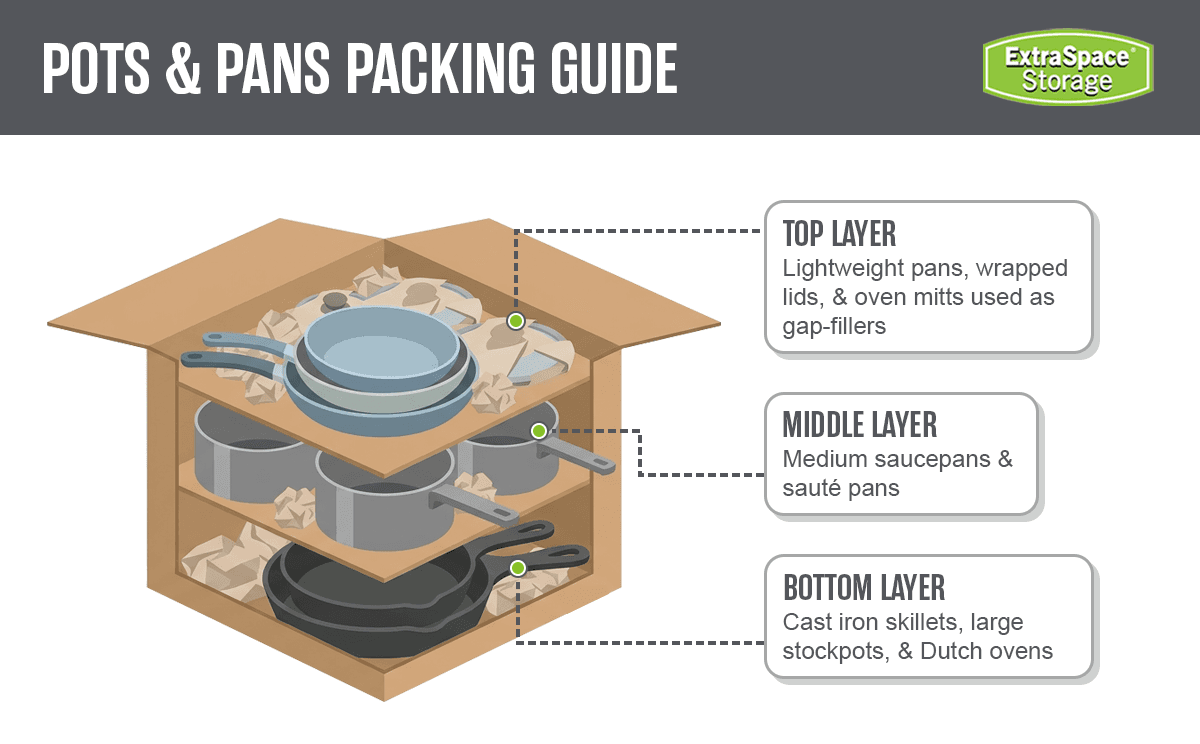
Arrange your moving boxes by placing heavy cookware like cast iron and Dutch ovens at the bottom, followed by medium saucepans and lightweight pans on top. To ensure safe, stable moving, avoid nesting more than three layers. Instead, use oven mitts or packing paper as gap-fillers to keep the load balanced and easy to carry on moving day.
Utilize the Nesting Method
Maximize space by nesting smaller pots inside larger ones, and place a layer of packing paper or a dish towel between them to prevent scratching or damage. Don't force pieces together. If they don't fit comfortably, wrap them separately.
Fill Remaining Gaps
Fill any empty space with crumpled packing paper, bubble wrap, or soft kitchen items like oven mitts and dish towels to prevent severe shifting during transit. Before sealing, give the box a gentle shake. If you can hear or feel movement inside, add more padding.
Clearly Label Boxes
Label the top and side of your moving box with "kitchen" and a specific list of contents, like "cast iron" or "stockpots." Be sure to clearly mark "this side up," "heavy," or "fragile" where appropriate to ensure safe moving. For a smoother move-in day, pack your daily essentials last and label those boxes "open first"—keeping one pot and pan easily accessible so you can cook a simple meal on your first night without unpacking the entire kitchen.
Find Affordable Self Storage Near You
Extra Space Storage has over 4,000 locations across the U.S. with friendly customer service, advanced security features, and affordable month-to-month rates.
- Save up to 40% off online
Best Ways to Pack Different Types of Cookware
Not all pots and pans require the same care. Here's what to keep in mind for specific materials:
Cast Iron: Pack individually in small, heavy-duty boxes at the very bottom.
Nonstick: Wrap individually and nest together between two layers of packing paper to absorb shock.
Enameled Cookware: Thoroughly wrap in bubble wrap to avoid scratches.
Stainless Steel: Wrap in packing paper and place layers in between to avoid dents.
Dutch Ovens & Roasters: Ideally packed in original packaging or placed in individual boxes to spread the weight.
Slow Cookers & Instant Pots: Disassemble and wrap the lid, cord, and ceramic insert separately. Use the original packaging if available.
Woks: Wrap in paper and store vertically with the handle pointing up, surrounded by plenty of padding
Frequently Asked Questions
How do you pack pots and pans for moving?
Wrap each piece individually in packing paper or bubble wrap, line the bottom of a medium or heavy-duty box with cushioning material, place heavier items at the bottom, nest smaller pots inside larger ones with padding between layers, fill all gaps, and seal the box securely.
Should pots and pans be packed in the same box?
Yes—packing pots and pans together in the same box using the nesting method is efficient and practical. Place padding between pieces and keep the overall box weight manageable. Pack glass lids separately with extra bubble wrap.
How do you prevent pots and pans from scratching during a move?
Wrap every piece individually before placing it in a box. Never allow bare nonstick or ceramic surfaces to touch each other. Place at least one to two sheets of packing paper or a dish towel between any nested items.
How do you pack a cast-iron skillet for moving?
Wrap the skillet in several layers of packing paper, place it at the bottom of a small or heavy-duty box, and don't stack heavy items on top. Cast iron is extremely durable but very dense—it's better to use a dedicated small box than to overload a larger one.
What do I do if I run out of packing supplies for pots and pans?
If you've run out of packing paper or bubble wrap, here are some alternative materials for packing cookware.
Dish Towels & Hand Towels: Wrap pots and pans exactly as you would with packing paper.
Oven Mitts & Pot Holders: Ideal padding for glass lids and between stacked pans.
T-shirts & Clothing: Good for lighter pans and filling gaps in boxes.
Paper Grocery Bags: Crumple them up for basic cushioning material in a pinch.
***
Ready to start packing? Find more helpful tips on the Extra Space Storage Moving Hub. And if you need a safe place to store items during your transition, we have thousands of conveniently located facilities across the U.S. Find a storage unit near you!

Author Profile
Quinn Johnson
Quinn Johnson is a moving expert and author for Extra Space Storage. He's moved over 15 times, including internationally, and helped countless others between their own homes. He's happy to lift some boxes for a friend as long as he's paid in pizza. As a writer and content creator for Extra Space Storage since 2019, Quinn shares helpful moving tips and info to alleviate the common stresses of moving.