Moving Guide
How to Set Up Utilities After Moving: Your Complete Guide

Planning a move? As part of your moving checklist, you'll want to remember to set up or transfer utilities at your new home or apartment. This guide walks you through what utilities you need, when to set them up, and how to tackle the process with ease.
What Utilities Do You Need for Your New Home?
Before you start contacting various utility companies, it helps to know which services you'll need. Here's a list of essential and additional utilities you may find—which can vary depending on whether you're a homeowner or renting an apartment.
Electricity: Activate before you move in, as it's necessary for lights, appliances, heating, and cooling. Search for your local electricity provider online, or contact your landlord or real estate agent. If you're moving locally, your current provider may service your new address.
Water & sewer: This utility provides running water and wastewater removal, and is often provided by the city or county. Contact your local water department, or search online and ask what's included when you call—water, sewer, and trash collection may be combined.
Natural gas: Natural gas heats many homes and powers water heaters, stoves, and dryers. Contact your gas provider with your new address, move-in date, photo ID, and possibly a deposit. Typically, your provider will send a technician to turn on service and safely light any pilot lights.
Trash & recycling: This utility removes waste from your property. Check whether your city provides trash collection or if you need a private company. In many areas, it's included in property taxes or HOA fees. For recycling, confirm pickup days and accepted materials. Some areas provide bins, while others require you to purchase them.
Internet service: Wifi keeps you connected for work, entertainment, and communication. Many providers bundle internet with cable TV for better rates.
Home security: Provides safety and may lower your insurance costs. Some systems require professional installation.
If you're renting an apartment, check your lease to see if it includes certain utilities in your monthly rent—like water, sewer, and trash collection. Homeowners may need to check with their local Homeowners' Association (HOA) for potential fees or restrictions.
Step-by-Step Timeline for Setting Up Utilities
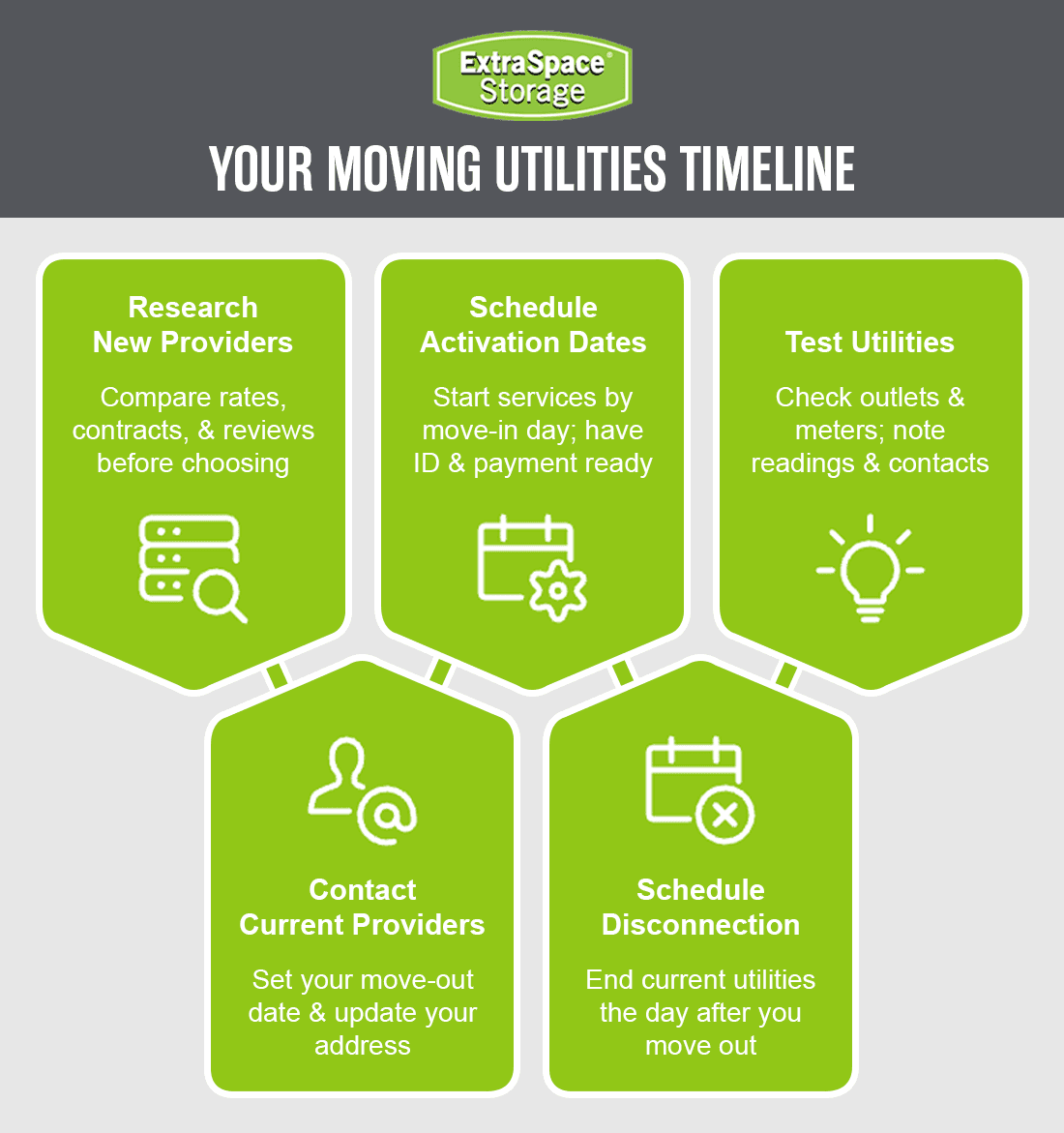
Utility service providers are key people to notify when moving, and timing makes all the difference when setting them up. It's recommended you start the process three to four weeks before you move. Here's how to tackle each task for a smooth transition.
Research new providers: Depending on the state you live in, you can either choose your electricity and gas providers, or one will be assigned to you. Take time to compare rates, contract terms, promotional periods, and customer service reviews.
Contact current providers: Let your current providers know about your move-out date and new address for final billing. If you're moving locally, transferring your utility services' current providers is a convenient and cost-effective option.
Schedule activation dates: Contact your utility providers to set up service starting on or before your move-in date. Gather and provide information like your new address, move-in date, driver's license, and payment method. Some providers may also require deposits.
Schedule disconnection: Arrange for utilities at your current home to shut off the day after you move out to prevent service gaps if your move gets delayed.
Test utilities: Verify that all utilities work by testing multiple outlets, faucets, and light switches. Take photos of electric, gas, and water meters showing their starting readings to ensure accurate billing. Save utility provider phone numbers in case you need to report issues immediately.

Find Affordable Self Storage Near You
Extra Space Storage has over 4,000 locations across the U.S. with friendly customer service, advanced security features, and affordable month-to-month rates.
- Save up to 40% off online
Setting Up Utilities for Different Moving Situations
Whether you're setting utilities up for the first time, moving to an apartment, or transferring services to a new home, here are the necessary steps for each type of move.
First-Time Setup
Focus on essentials first: Start with electricity and water. Internet and other services can wait a day or two if necessary.
Ask questions as needed: Providers work with first-time customers regularly. Don't be afraid to ask about deposits, payment options, billing cycles, and contract terms.
Budget for setup costs: First-time utility setup often requires deposits and activation fees. Plan for $300 to $500 in initial costs—this may vary by location and credit history.
Setting Up Utilities in an Apartment
Read your lease carefully: Many landlords include water, sewer, trash, and sometimes basic cable in your rent. Know what's covered before setting up accounts.
Check with your property manager: Some apartment complexes have centralized utility arrangements or preferred providers. Your property manager can provide specific contact information and account details.
Coordinate timing: Ask whether utilities need to be in your name by move-in day or if there's flexibility. Some complexes handle transfers between tenants.
Ask about shared utilities: In some buildings, utilities like heat or water may be shared and included in rent, while you handle electricity individually.
Transferring Utilities When Buying a House
Start after you have a closing date: Once you have a confirmed closing date—usually a few weeks before possession—you can begin setting up utilities.
Coordinate the transition: Utilities should transfer to your name on closing day. Confirm the seller is handling disconnection to prevent service gaps.
New construction needs more time: If you're buying a custom home, allow extra time. Utility infrastructure may need to be connected, requiring coordination among your builder, utility companies, and local authorities.
Understanding Utility Deposits & Costs
Part of setting up utilities will include budgeting, making deposits, and first payments. Deposit costs may vary based on credit history, property size, and estimated usage—customers with good credit may qualify for reduced deposits or autopay programs that waive deposits entirely. According to industry standards, here's what most residential customers pay:
Electricity deposits: $150 to $300
Gas deposits: $100 to $250
Water deposits: $50 to $150
Internet & cable: $50 to $150 for activation fee
Transfer fees: $25 to $50
Getting Your Deposit Back
The refund typically appears as a credit on your bill or as a check mailed to your forwarding address—most deposits are refundable after 12 consecutive months of on-time payments. If you move again, any remaining deposit is applied to your final bill, with the difference refunded within 30-45 days.
Your First Bills
Prorated charges: Your first bill usually covers a partial billing cycle, so it may be lower or higher than typical monthly bills depending on when you started service.
Overlapping expenses: You might receive final bills from your old address at the same time as initial bills from your new home, temporarily doubling utility costs.
Budget planning: Research average utility costs for homes similar to yours in your new area. Many providers share historical usage data for your address, helping you budget accurately.
***
Moving soon? Find moving checklists, packing tips, and more on the Extra Space Storage Moving Hub. And if you need temporary storage during your transition, we have facilities conveniently located across the U.S. Find self storage near you!
Related Moving Guides & Tips

Moving Insurance: A Complete Guide
Moving soon? Learn all about moving insurance—including types of coverage, costs, claims, and expert tips to protect your belongings during your move.

How to Move Heavy Furniture
Need to move heavy furniture? From safe lifting to smart tools, here’s how to make moving large items easier.

A Guide to Moving Out of State
Wondering how to move to another state? These interstate moving tips and moving out-of-state checklist can help you easily plan the best cross-state move!

Moving Truck Rental Requirements
Before renting a moving truck, you'll want to make sure you meet common requirements. Read our guide on how to rent a moving truck!

How to Declutter Before Moving
Planning a move soon and need to get rid of clutter? Check out this guide for decluttering tips before a move!

Donating Used Furniture During a Move: Places that Offer Free Donation Pick-Up
Moving soon? Here are the best places to donate furniture that offer free pick-up and drop-off!
Author Profile
Quinn Johnson
Quinn Johnson is a moving expert and author for Extra Space Storage. He's moved over 15 times, including internationally, and helped countless others between their own homes. He's happy to lift some boxes for a friend as long as he's paid in pizza. As a writer and content creator for Extra Space Storage since 2019, Quinn shares helpful moving tips and info to alleviate the common stresses of moving.