Moving Guide
Job Relocation Checklist: What to Consider When Moving for a Job

Accepting a new job in a different city is exciting, but the process of relocating for work can feel overwhelming. Knowing the required steps can simplify the process and significantly reduce moving stress. From negotiating your relocation package to updating your driver’s license, this relocating for work checklist can help you stay organized during the transition!
Negotiate Your Relocation Package
A relocation package—a set of benefits your employer offers to help cover the costs and logistics of moving—can make a big difference in how smooth and affordable your transition feels. Here's what most people want to know before they negotiate.
What Should I Ask About My Relocation Package?
Before accepting a relocation package from your employer, it's crucial to understand exactly what’s included—and, if necessary, negotiate for more. Here are some questions to ask your HR or benefits contact before you finalize your offer:
Is there a relocation package, and what does it cover?
Is the benefit paid as a lump sum upfront, or reimbursed after receipts?
Is there a repayment clause if I leave within a certain period?
What is the expected start date, and is there flexibility for the move timeline?
Many companies expect candidates to ask these types of questions, and the conversation is much easier before you’ve signed your offer letter than after.
What's Included in a Relocation Package?
Here's what you might find in a typical relocation package:
Moving cost coverage—full reimbursement, a lump-sum payment, or a managed move through a third-party relocation company
Temporary housing for 30-90 days while you search for permanent housing
Travel expenses for house-hunting trips before your start date
Home sale assistance or lease-break support for your current residence
Spouse or partner job-search assistance
Storage cost coverage for a transition period
How Much Is a Relocation Package?
Keep in mind that relocation packages vary widely by employer, role, and industry. Check out our table below to help you budget for your move.
Employee Level | Relocation Estimate |
Entry | $5,000-$15,000 |
Mid | $10,000-$25,000 |
Executive | $25,000-$50,000+ |
Cost estimates based on Rippling data.
Are Relocation Packages Taxed?
In most cases, relocation benefits provided by an employer are taxable income. If your relocation package includes a cash payment or reimbursement of moving costs, your employer might withhold state, federal, and Federal Insurance Contributions Act (FICA) taxes. This can affect your tax bracket for the year, so it’s worth asking your employer upfront whether they offer a gross-up to help offset the added tax burden—and adjusting your W-4 withholding once you know the package amount.
Plan Your Moving Budget
Your budget is one of the most important things to consider when relocating for a job. Moving can be expensive, even with employer assistance. Building a realistic moving budget ahead of time can help you avoid financial stress after the move.
Compare Your Cost of Living
Even a meaningful salary increase can feel neutral—or negative—if your new city costs significantly more to live in. Beyond housing, make sure to compare grocery prices, taxes, and transportation expenses between cities, as it all adds up. Use a cost-of-living comparison tool to help estimate how far your income will actually stretch.
Estimate Your Moving Costs
Moving costs for a job relocation vary widely depending on distance. For instance, the cost of hiring movers for a three-bedroom home is typically around $1,300 for a shorter move under 400 miles—or $15,250 or more for moves over 2,000 miles. Local moves under 100 miles generally run $1,000 to $2,000. Your final cost will also depend on household size, time of year, and the services you choose. Use a moving cost calculator to get a tailored estimate.
Get Quotes from Multiple Movers
If you're hiring movers rather than just renting a moving truck for a DIY move, getting quotes from at least three licensed companies before making a final decision allows you to assess what's right for you and your budget. Be wary of any quotes that are unusually low, as this may be a sign of an untrustworthy company. For long-distance moves, ask each mover to explain the difference between a binding and non-binding estimate—it can significantly affect your final bill.
Understand How Relocation Is Taxed
Under federal law, most employer-provided relocation benefits are considered taxable income. Exceptions may apply to active-duty military members relocating under a permanent change-of-station order and certain members of the U.S. intelligence community. For most other employees, relocation payments—whether provided upfront as a lump sum or paid as reimbursements—are generally included in taxable wages and reported on your W-2.
Your employer may offer a tax gross-up, which is an additional payment designed to help offset the taxes associated with your relocation benefits. Relocation assistance can also take the form of your employer paying a third-party moving company directly on your behalf. Even if you don't receive the money yourself, you may still have to pay taxes on the value of those moving expenses when you file your tax return.
Consider Budgeting for Storage During Your Job Relocation
When relocating for a job, you'll need to figure out what to do with your belongings—especially if you find yourself with a gap between your move-out date and the move-in date at your new location. Budgeting for self storage for moving is a great option, giving you a secure place to keep your items while navigating the transition. Extra Space Storage has thousands of convenient storage facilities across the country, with features like climate control, drive-up access, and vehicle storage to help make your move simpler.

Find Affordable Self Storage Near You
Extra Space Storage has over 4,000 locations across the U.S. with friendly customer service, advanced security features, and affordable month-to-month rates.
- Save up to 40% off online
Find Housing & Plan Your Move
For most people relocating for a new job, housing is the most complex piece of the puzzle. Ideally, you’d find your new home before your start date—but that’s not always possible, especially when timelines are tight or you're moving on short notice.
Research Neighborhoods Before You Visit
Start with online research to narrow down neighborhoods that match your commute needs, budget, and lifestyle preferences. Tools like Google Maps, NeighborhoodScout, GreatSchools.org (for families with children), and local community forums can give you an authentic sense of a neighborhood before you visit in person.
Plan a Pre-Move Visit if Possible
If your employer covers house-hunting trips, use them. Walking through neighborhoods, testing your commute, and seeing apartments or homes in person leads to better decisions than online listings alone. If an in-person visit isn’t feasible before your move, virtual tours and video walkthroughs have become much more common and can help you narrow your options.
Consider Temporary Housing
When your start date is fixed, but your permanent housing isn’t, temporary housing options like short-term furnished rentals, extended-stay hotels, or corporate housing can bridge the gap. Many relocation packages include 30-90 days of temporary housing coverage—ask your employer whether this applies to your situation. If it doesn’t, services like Furnished Finder or corporate apartment providers are worth exploring.
Decide What to Ship, Store, or Sell
Not everything needs to make the move on day one. When moving for a job, it's common to face a transition period where permanent housing isn’t set up yet. Items that won’t fit in temporary housing, extra furniture you’re not sure will work in the new space, or seasonal gear you won’t need right away can go into short-term storage rather than immediately being shipped or put on the moving truck.
Handle Your Current Housing
If you rent, review your lease terms carefully. Most leases require 30-60 days of written notice before move-out, and some include an early termination clause for situations like a job relocation. If you're a homeowner, start the process of selling your home or renting it out as early as possible—relocation timelines can be tight, and home sale timelines are unpredictable.
Hire a Licensed Moving Company
Once you've finished comparing moving companies, verify your chosen mover’s FMCSA registration before booking. Talk through the details and learn how the company handles delays or damage claims. Booking four to eight weeks in advance can also help you lock in better rates.
Update Your Records & Find New Providers
It can be easy to forget about updating your records—especially in the middle of a move—but letting them pile up can add to your moving stress. Here's a breakdown of the key accounts, records, registrations, and more to update when relocating for work.
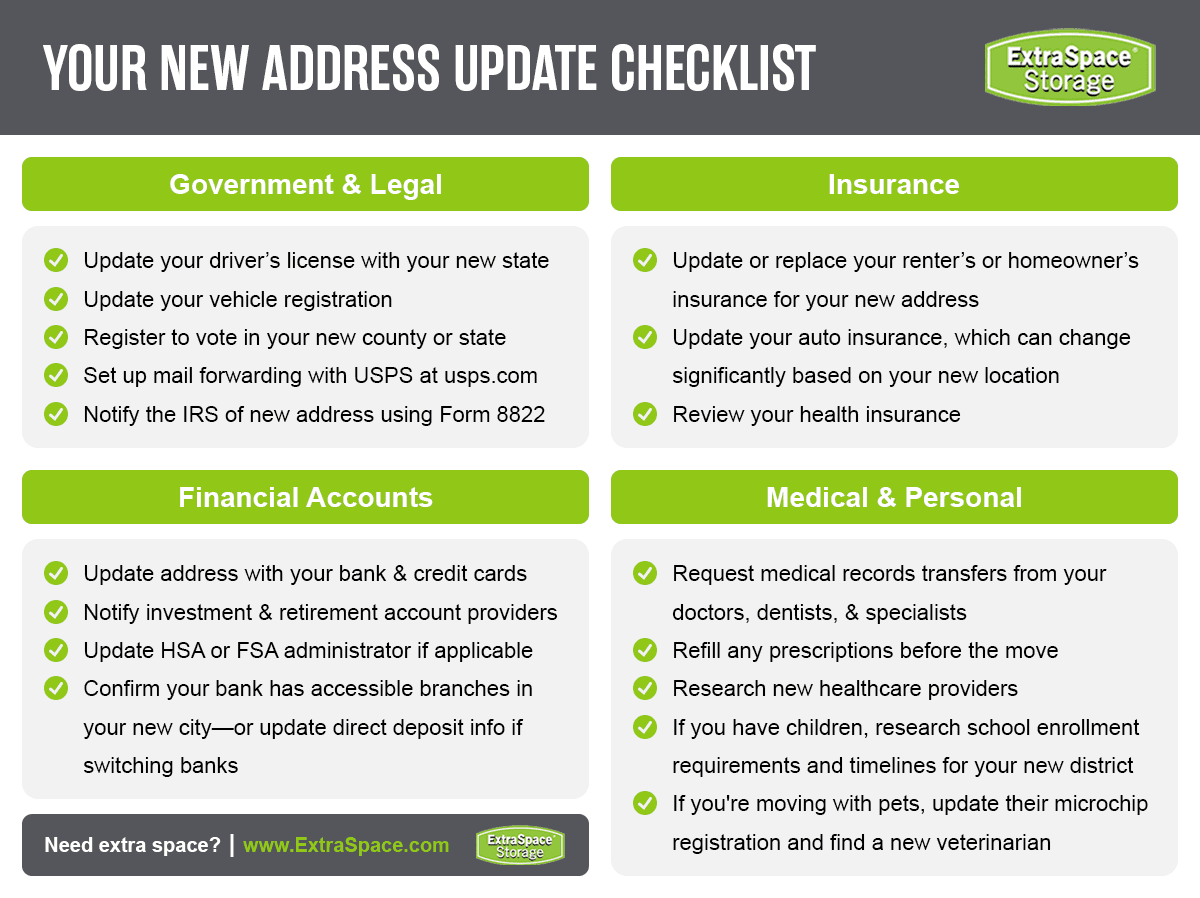
Licenses, Registrations, & Address Changes
Update your driver’s license with your new state (most states require this within 30-60 days of establishing residency).
Update your vehicle registration.
Register to vote in your new county or state.
Set up mail forwarding or a change of address with USPS.
Notify the IRS of your new address using Form 8822.
Financial Accounts
Update your address with your bank and credit card issuers.
Notify your investment and retirement account providers.
Update your HSA or FSA administrator if applicable.
Confirm your bank has accessible branches or ATMs in your new city—or switch to a bank with broader national coverage.
If switching banks, update your direct deposit information with your employer.
Insurance
Update or replace your renters or homeowners insurance for your new address.
Update your auto insurance, which can change significantly based on your new location and commute.
Review your health insurance—if your employer’s plan has a regional network, confirm your new city’s providers are in-network.
Medical & Personal
Request medical records transfers from your doctors, dentists, and specialists—and refill any prescriptions before the move.
Research new healthcare providers in your new city before you need them—your employer's HR department or employee assistance program (EAP) can sometimes help with provider referrals in a new city.
If you're moving with children, research school enrollment requirements and timelines for your new district.
If you're moving with pets, update their microchip registration and find a new veterinarian.
Settle Into Your New City
Once the boxes are unpacked, there’s still a period of adjustment that can take longer than most people expect. Being intentional about settling into your new city—not just your new job—can make the transition feel less disorienting. Here are a few things to add to your relocation checklist and prioritize in your first weeks:
Explore your neighborhood on foot: Getting familiar with your immediate surroundings can help a new place start to feel like home.
Declutter your new space: A self storage unit can help clear out excess furniture and seasonal items that don't fit so you can settle in more quickly even while focusing on work.
Introduce yourself to coworkers: Take them up on social invitations, even when it’s tempting to decompress after a big move.
Find one or two anchors in the new city: A regular coffee shop, a running route, or a local group can start to make your new city feel like home.
Give yourself some grace: Starting a new job while settling into a new city is a lot to manage at once—it's normal if it takes a few months to feel fully comfortable in both.
Frequently Asked Questions About Job Relocation
How much is a typical relocation package?
The amount of a relocation package depends on factors such as the company, your level of seniority, and the specifics of your move—including the total distance and whether you're renting or purchasing a home. Entry-level employees can generally expect anywhere from $5,000 to $15,000, while mid-level employees may receive $10,000 to $25,000. Executive-level employees may see $25,000 to more than $50,000.
Is relocation assistance taxable?
Relocation assistance is generally taxable. Federal income tax, state income tax, and Federal Insurance Contributions Act (FICA) taxes may be withheld when you receive a relocation payment or reimbursement from your employer. In some cases, you may also owe taxes when you file your tax return—particularly if your employer pays a third-party moving company directly on your behalf.
Can a job make you relocate?
No one can force you to relocate. However, your company may ask you to move as a condition of keeping your job or accepting a new role. If you have an employment contract, review it carefully for a mobility clause or any other relocation stipulations. If relocating isn't feasible, it's worth raising that early—some employers will negotiate remote or hybrid arrangements as an alternative.
How can I ship a car when relocating for work?
To ship your car when relocating for work, start by choosing between a broker and a direct carrier, then decide between open or enclosed transport. Before booking, verify your carrier's FMCSA status to make sure they're legitimate. Book two to four weeks in advance—this gives carriers more time to bid on your shipment, which can lead to more competitive rates.
Is it worth relocating for a job?
Whether relocating for a job is worth it depends on your situation. It can be a strong career move, especially if the new role offers better pay, growth opportunities, or a lower cost of living than your current city. On the other hand, moving is expensive and disruptive, so it's worth weighing the financial impact carefully—including whether your salary increase actually stretches further in the new city. If your employer offers a relocation package, that can make the decision a lot easier.
***
Moving for work soon? Extra Space Storage has self storage facilities throughout the U.S. to help make your work relocation easier. Find a storage unit near you!
Author Profile
Quinn Johnson
Quinn Johnson is a moving expert and author for Extra Space Storage. He's moved over 15 times, including internationally, and helped countless others between their own homes. He's happy to lift some boxes for a friend as long as he's paid in pizza. As a writer and content creator for Extra Space Storage since 2019, Quinn shares helpful moving tips and info to alleviate the common stresses of moving.