Moving Guide
Full-Service vs. Labor-Only Movers: Which Option is Right for You?

When you're planning a move, one of the first decisions you'll make is whether to hire full-service movers or labor-only movers. In this guide, we break down the difference between these moving service options—including what is covered, what it costs, and how to figure out which one fits your move.
What Full-Service Moving Includes
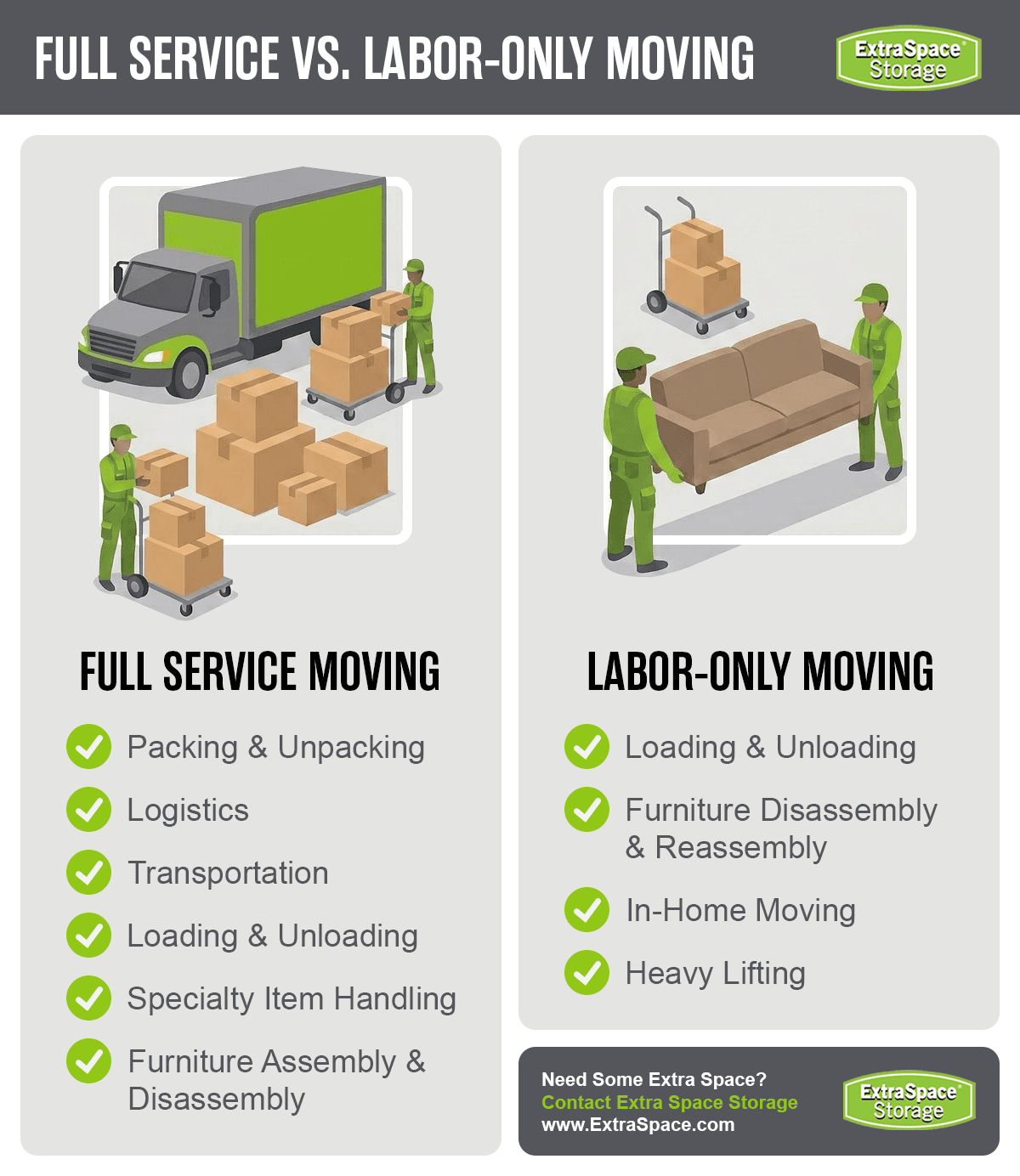
Full-service movers handle every stage of your move from start to finish, from the moment they arrive at your home to delivery at your new location. Here are the services you can expect from a full-service moving company:
Packing & Unpacking (Optional): For a completely hands-off experience, full-service movers can handle packing and unpacking the contents of your home
Logistics: Planning routes, scheduling, and coordinating the move
Transportation: Providing the moving truck and driving your belongings to your new home
Loading & Unloading: Safely moving items in and out of the truck and your home
Specialty Item Handling: Expert care for fragile items such as pianos and antiques
Furniture Assembly & Disassembly: Taking apart and reassembling larger items
What Labor-Only Moving Includes
Labor-only movers provide a crew for the physical work of your move—the heavy lifting, loading, and unloading—without supplying a moving truck, packing materials, or transportation. Those remain your responsibility. They are booked by the hour and typically require a minimum of 2 hours. Labor-only moving services include:
Loading & Unloading: Moving your belongings out of your home and into the truck, then unloading at your new home
Furniture Disassembly & Reassembly: Taking apart and putting back together furniture
In-Home Moving: Rearranging heavy furniture
Heavy Lifting: Handling large or bulky items
Full-Service Movers Costs vs. Labor-Only Movers Costs
Cost is usually the deciding factor between these two options, and the difference can be significant depending on the size and distance of your move. Here's a breakdown of what each professional moving service type typically costs, for both local and long-distance moves.
Full-Service Moving Costs
For local moves under 100 miles, full-service moving companies typically charge by the hour—around $80 to $100 per mover, per hour, with most jobs requiring a crew of two to four people. When you factor in all the elements of a full-service quote (labor, the truck, fuel, and basic equipment), here's what you can generally expect to pay by home size:
Home Size | Estimated Local Cost |
Studio/1-Bedroom | $200 – $600 |
2-Bedrooms | $700 – $1,400 |
3-Bedrooms | $1,000 – $2,000 |
4-Bedrooms | $1,500 – $3,000+ |
For long-distance moves over 100 miles, full-service movers often switch to a flat rate based on weight and distance, rather than charging by the hour, with total costs often ranging from $2,000-$10,000+.
Home Size | Estimated Long-Distance Cost |
1–2 Bedroom | $2,000 – $5,000 |
3–4 Bedroom | $5,000 – $10,000+ |
Large Home | Exceeds $10,000+ |
If you choose to add professional packing as part of your moving services, this will add to your total moving quote. Typically $280-$2,200 more, depending on the size of your home.
Labor-Only Moving Costs
Labor-only movers are priced by the hour, with rates typically ranging from $40 to $75 per mover per hour for a local move. Most jobs require a crew of two, putting the effective team rate between $80 and $150 per hour, depending on your market. Here's how labor-only costs typically break out by home size:
Home Size | Movers Needed | Estimated Hours | Estimated Cost |
Studio/1-Bedroom | 2 | 2–3 | $160–$450 |
2-Bedroom | 2–3 | 3–4 | $240–$600 |
3-Bedroom | 3–4 | 4–6 | $480–$900 |
4-Bedroom | 4 | 6–8 | $640–$1,200 |
On top of labor, you'll need a rental truck, which typically runs $20 to $100 per day for the base rate on a local move, plus mileage fees and fuel. For a typical local move of 30 miles or less, all-in truck costs generally range between $100 and $250 when mileage is included.
Valuation Coverage & Liability
One of the most important differences between these full-service and labor-only moving companies is moving insurance—how your belongings are protected if something goes wrong. When you hire a licensed, full-service moving company for an interstate move, federal law—enforced by the Federal Motor Carrier Safety Administration (FMCSA)—requires them to offer two types of valuation coverage. Released value protection (basic coverage) is included at no extra charge but provides minimal coverage: just $0.60 per pound per item damaged or lost. Full value protection costs more but requires the mover to repair, replace, or reimburse the item at its current market value.
With labor-only movers, the liability picture is less standardized. Because they're not driving or transporting your belongings, their responsibility is generally limited to damage that occurs during loading or unloading. Coverage terms vary significantly by company, so it's important to ask any labor-only provider about their liability coverage before booking. Regardless of which option you choose, it's also worth checking whether your homeowners or renters insurance extends to belongings during a move, as many policies do, with some limitations.
Hidden Moving Costs to Keep in Mind
Both moving options can carry unexpected fees that don't always show up in the initial quote. Here are some things to watch out for and plan for your moving budget:
Full-Service Add-Ons: Packing materials, long-carry fees, elevator fees in apartment buildings, and weight-based adjustments on long-distance moves are all common line items that can catch you off guard. Always ask for an itemized quote upfront so you know exactly what's included.
Travel Time: Labor-only movers often charge for drive time to and from your location, which can add up quickly if you're farther from their base. Some companies also build in a minimum hourly commitment, and rates may increase once that threshold is met.
Moving Truck Insurance: When renting your own truck for a labor-only move, insurance isn't automatically included—you'll need to purchase it separately through the rental company or your personal auto policy.
Packing Supplies: Whether you're hiring full-service or labor-only movers, packing materials like boxes, tape, and bubble wrap are rarely included in the base price. If your movers don't supply equipment like dollies or moving blankets, you may need to rent or buy those separately as well.
Time of Move: Peak moving season runs from May through September, and demand spikes on weekends and at the beginning and end of each month. Booking during these windows can add 15–20% to your quote, so flexibility in your move date can translate to real savings.
Tipping: Tipping movers isn't required, but it's a widely appreciated way to recognize movers for hard, physical work. A common guideline is $20–$50 per mover for a half-day job, or $50–$100 for a full day.

Find Affordable Self Storage Near You
Extra Space Storage has over 4,000 locations across the U.S. with friendly customer service, advanced security features, and affordable month-to-month rates.
- Save up to 40% off online
Pros & Cons of Full-Service Moving
As you decide which moving service is right for you, consider these pros and cons of full-service moving companies.
Pros of Full-Service Movers:
Convenience & Reduced Stress: Full-service movers handle every aspect of your move, from physical packing to logistics. For people with demanding schedules, large households, or moves that span hundreds of miles, this level of support can be well worth the cost.
Professional Packing & Item Protection: Full-service moving companies are trained in safe packing and loading techniques, and they are required by federal law to offer valuation coverage options that
Cons of Full-Service Movers:
Higher Cost: A key drawback is the cost of full-service movers, which is higher because you're paying for labor, a truck, fuel, and the company's expertise—all bundled into a single quote. For smaller, shorter moves, the cost may not be worth it.
Less Scheduling Flexibility: Full-service moving companies often need to be booked well in advance, especially during peak moving season. If your timeline changes or you need to reschedule, accommodating those changes can be difficult, especially with larger national chains that book far in advance.
Pros & Cons of Labor-Only Moving
Here are some advantages and drawbacks of labor-only moving, to help you narrow down what service is right for your move.
Pros of Labor-Only Movers:
Lower Overall Cost: Hiring labor-only movers and renting your own truck is almost always the less expensive option. With moving help by the hour, you only pay for the time the movers are on-site, and you control everything else—the truck size, the timing, and the pace of the move.
More Control Over Your Move: With labor-only moving services, you manage the schedule, choose the truck, and decide which items get moved and when. If you've already packed everything and just need help with the heavy lifting, this level of control can make the process feel more manageable and less disruptive.
Cons of Labor-Only Movers:
DIY Logistics & Transportation: You're responsible for reserving a rental truck, setting pickup and return times, driving to your new home, and sourcing any equipment or packing supplies you need. For most local moves, that's straightforward, but for longer relocations, driving a fully loaded truck across multiple states requires real planning and comfort behind the wheel.
Physical Constraints: Even with a labor crew handling the lifting, a labor-only move requires physical effort from you. Packing, lifting lighter items, and managing the pace of the move can be physically demanding, especially when working in tight spaces or on stairs.
When to Choose Full-Service Moving
Full-service movers tend to be the right fit when the complexity, distance, or demands of your move outweigh the cost premium. Consider hiring a full-service moving company if:
You're making a long-distance or cross-country move.
You have a large household.
You have specialty items like a grand piano.
Your schedule is tight.
You want stronger liability protection.
You prefer a hands-off experience.
When to Choose Labor-Only Moving
Labor-only movers are an excellent choice when you want professional help with the physically demanding parts of your move without paying for services you don't need. Consider labor-only moving services if:
You're making a local move.
You're working with a tight budget.
You're using a portable storage container.
You've already packed everything.
You're comfortable driving a moving truck.
***
Planning your move? Find helpful tools and resources on the Extra Space Storage moving hub. And for short-term storage between homes, we have more than 4,200 locations across the U.S. to help with your transition. Find a storage unit near you!

Author Profile
Quinn Johnson
Quinn Johnson is a moving expert and author for Extra Space Storage. He's moved over 15 times, including internationally, and helped countless others between their own homes. He's happy to lift some boxes for a friend as long as he's paid in pizza. As a writer and content creator for Extra Space Storage since 2019, Quinn shares helpful moving tips and info to alleviate the common stresses of moving.