Moving Guide
How to Save Gas While Driving a Moving Truck

Gearing up for a DIY move with a rental truck? While often cheaper than hiring movers, if you're relocating to a new state or moving across the country, fuel costs can start to add up quickly—especially since moving trucks tend to burn more gas than standard vehicles. Fortunately, with smart planning and mindful driving habits, it's possible to cut down on fuel usage and stick to your moving budget. Here's our guide on how to save gas when driving a moving truck!
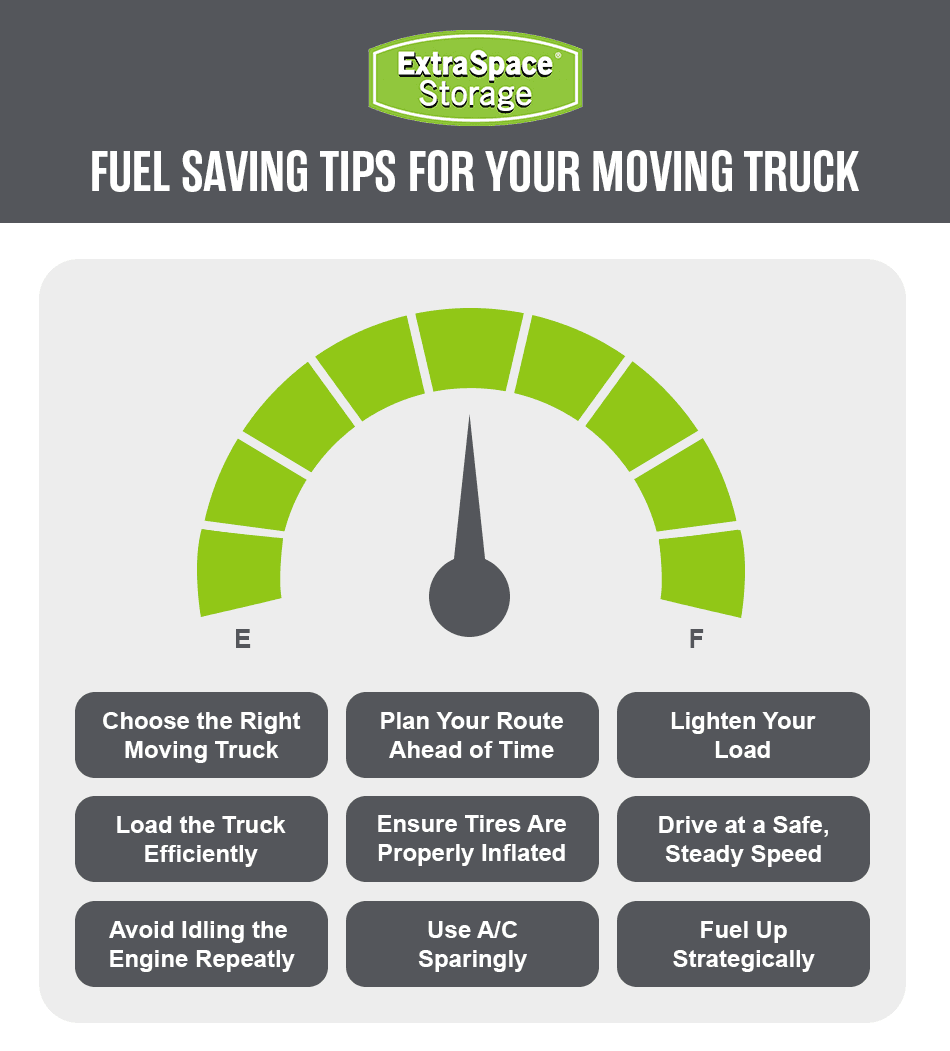
Choose the Right Moving Truck
Fuel efficiency starts with selecting an appropriate size moving truck. Smaller trucks and cargo vans typically get better gas mileage than larger models, so opt for the smallest moving truck size that fits all your items. Additionally, choose a moving truck that runs on unleaded fuel rather than diesel—diesel costs tends to run higher. If you can, find a newer vehicle, as recent models are generally more fuel efficient. Some moving companies also offer fuel-saving features on their vehicles like aerodynamic mirrors, rounded corners, trailer skirts, and fuel economy gauges—choosing a truck with these features can help reduce your overall fuel usage and keep costs down.
Plan Your Route Ahead of Time
To avoid driving extra miles, burning unnecessary fuel, and getting caught in traffic delays, map out the most fuel-efficient route to your destination before moving day. Use a navigation app or GPS to find the most direct path and identify any potential shortcuts. Try to hit the road during off-peak hours—like late morning or early afternoon—to skip stop-and-go traffic. Check your route ahead of time for road closures, construction zones, and other barriers that could slow you down. If possible, combine any planned stops for refueling, grabbing food, using the restroom, and stretching your legs. Remember that one continuous trip can be more fuel efficient than multiple shorter trips, so reducing the number of stops you make can help you save money.
Lighten Your Load
One of the best ways to save fuel is to have less weight in your vehicle. Every pound added can decrease your moving truck's overall fuel efficiency—and if you have lots of heavy furniture and boxes, weight can add up quickly. To reduce the weight in your vehicle, declutter before you move by selling or donating items you don't truly want or need. If you have friends or family members with a car who are willing to make the journey with you, pack some of the smaller items in their vehicle to reduce the weight of your truck and take advantage of cars' higher fuel efficiency.
Distribute the Load Evenly
How you pack your moving truck can have a big impact on fuel economy. An unbalanced load with most of the heavy items toward the rear can strain the engine while you drive and ultimately reduce gas mileage. Instead, pack heavier items like couches and bed frames near the cab and close to the floor to avoid shifting weight and excess sway. Pack other moving boxes next—stacking them on furniture to save space—and bring in your the lightest items last. Try to keep 60% of your cargo weight in the front half of the truck, balanced on either side, and use straps to secure items that may shift in transit. Additionally, avoid tying items to the outside of the truck or on the roof, since this can increase wind resistance and negatively impact your fuel economy.
Ensure Tires Are Properly Inflated
Under-inflated tires can make your moving truck burn more fuel than necessary. For every 1 psi drop in tire pressure, gas mileage can be reduced by around 0.2% due to increased rolling resistance—which requires the engine to work harder to keep up, and therefore, wastes fuel. That's why it's smart to double-check tire pressure before you embark on your move. Do a quick walk around the truck to ensure all tires are inflated to the psi recommended in the owner's manual.
Find Affordable Self Storage Near You
Extra Space Storage has over 4,000 locations across the U.S. with friendly customer service, advanced security features, and affordable month-to-month rates.
- Save up to 40% off online
Drive at a Safe, Steady Speed
Driving at high speeds reduces fuel economy for any vehicle—but especially for boxy moving trucks, which use more fuel to overcome wind resistance and rolling resistance. Gas mileage often drops at speeds above 50 mph, so keeping to a consistent, lower speed can help you save on fuel costs. Avoid sudden stops or bursts of acceleration, as stop-and-go driving can be hard on the engine and cause the vehicle to consume more fuel than needed. Instead, build up speed gradually before steep hills and let off the gas on the way down. Cruise control is a great way to maintain a safe, consistent speed on flatter highways—just be sure to turn it off in heavy traffic, around tight curves, or on steep grades where manual control is safer.
Avoid Unnecessary Engine Idling
Another driving tip to save fuel is to avoid letting the moving truck idle. After all, if the engine is running but you're not moving, the vehicle is getting zero miles per gallon. Cars left idling for one hour lose an average of 0.2 to 0.5 gallons of gas, and this rate only increases for larger vehicles like moving trucks. To save gas (and money), turn the engine off whenever you stop for more than a minute or two. For those moving in cold weather, this means you should also avoid idling the truck to “warm it up"—modern engines actually warm up faster when driven slowly, as opposed to sitting parked and idling, anyways!
Use Air Conditioning Sparingly
Relocating during summer? Driving an air-conditioned moving truck can be nice to keep cool, but over-using the A/C can significantly cut into your fuel economy in hot weather. Using the A/C puts extra load on the engine, causing it to consume more gas. The key is to use your A/C wisely and only as much as you need. At lower driving speeds or in tolerable heat, consider turning off the air conditioning and rolling down the windows instead. When you’re driving around town or stuck in slower traffic, open windows won’t hurt your fuel economy much, and you’ll save all the gas the A/C would have used. However, when you hit highway speeds, be mindful—having the windows open creates aerodynamic drag that can also lower your fuel economy, sometimes nearly as much as running the A/C would. A good rule of thumb is to keep your windows down at city speeds, and turn the A/C on at highway speeds—but only if you really need it.
Fuel Up Strategically
Where and when you fuel up can make a big difference in your moving costs. If possible, try to buy your gas on a Monday, Tuesday, Friday, or Sunday, which are the best days to save money on gas. Also, keep in mind that highway rest stops often charge more for gas than stations off the main route—check with gas apps or the blue highway signs to find less expensive options nearby. When crossing state lines, plan to fill up in areas with lower gas taxes if possible. Only buy as much gas as you need to reach your next stop or to return the truck at the required level—you typically won't be reimbursed for unused fuel. And avoid paying more for premium or diesel unless necessary!
***
Preparing for a move? Explore our moving calculators, tips, and other helpful moving resources, or find storage facilities across the U.S. to simplify your transition at an Extra Space Storage near you. Rent secure self storage today!

Related Cross-Country Moving Guides

How Much Does it Cost to Move Across the Country?
Wondering what it costs to move across the country? Here are estimated long-distance moving costs and factors that affect the total price you pay.

19 Packing Tips for Cross-Country Moving
Trying to find the best ways to move long distances? A cross-country move can take a lot of planning. Check out these packing tips for moving out of state!

Moving on a Budget: Affordable Ways to Move Across the Country
Explore affordable ways to move to another state, with moving budget factors, storage options, and more in this cross-country moving guide.
Cheapest Ways to Ship Boxes Across the Country
Need to ship moving boxes across the country? Explore the most affordable ways to ship boxes in this guide!
Guide to Shipping Furniture Out of State
Moving to a new state? If you're thinking of shipping your furniture, check out this guide to learn how to prep your belongings for transit!
Author Profile
Quinn Johnson
Quinn Johnson is a moving expert and author for Extra Space Storage. He's moved over 15 times, including internationally, and helped countless others between their own homes. He's happy to lift some boxes for a friend as long as he's paid in pizza. As a writer and content creator for Extra Space Storage since 2019, Quinn shares helpful moving tips and info to alleviate the common stresses of moving.