Moving Guide
PPM/DITY Move vs. Government Move: The Complete Military PCS Guide

Permanent change of station orders (PCS) tend to arrive without much warning, and the to-do list that follows can feel overwhelming—especially if this is your first military PCS move. One of the first decisions you'll face is whether to let the government arrange your move or handle it yourself, and it's a decision worth careful consideration—especially given significant changes to how reimbursements are calculated. In this guide, we cover how each option works and how to figure out which path makes the most sense for your military relocation.
What Is a DITY Move?
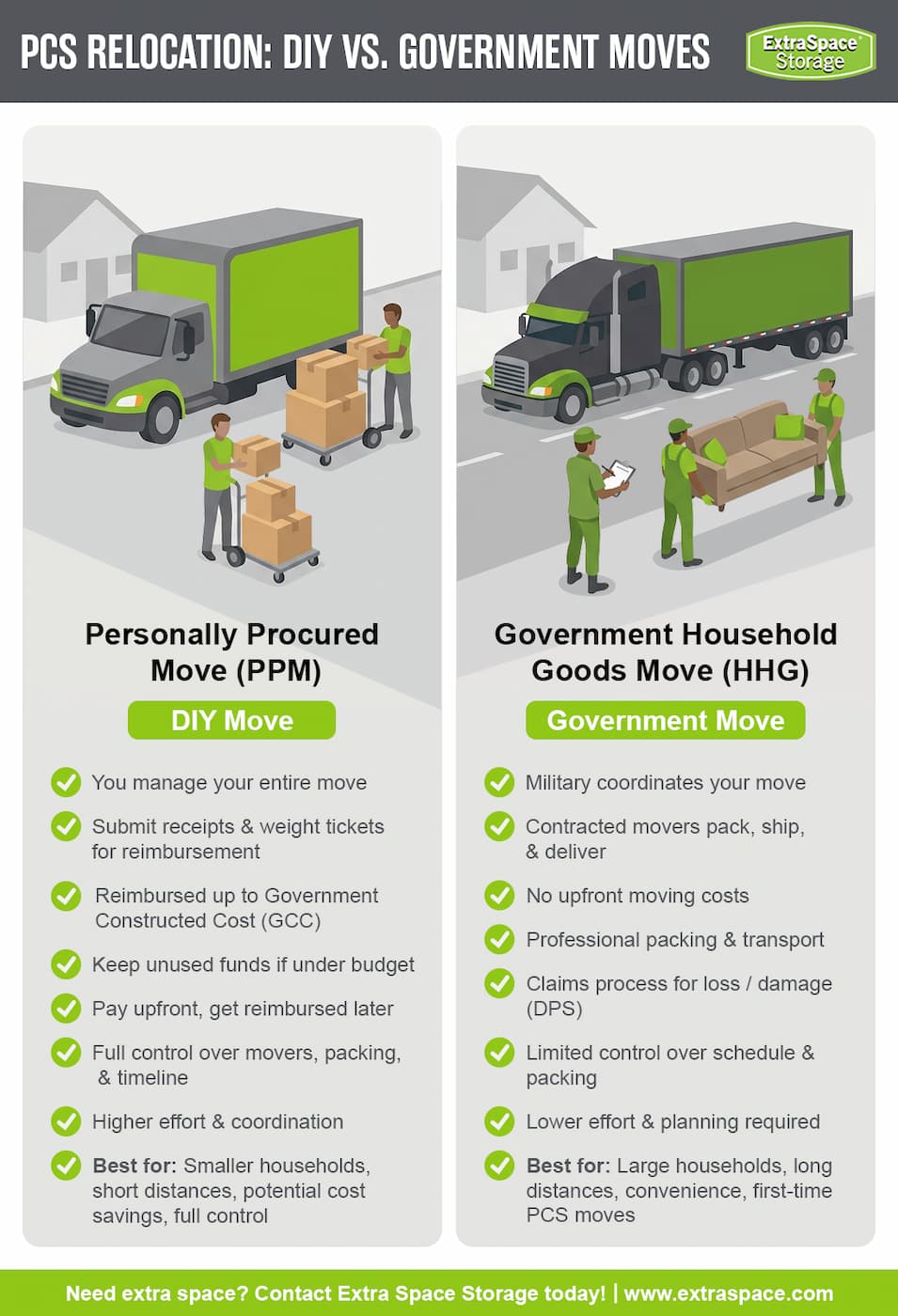
A DITY move, short for "do it yourself," is now called a Personally Procured Move, or PPM—both terms are used interchangeably. Essentially, you arrange and execute your own household goods move, then submit receipts and certified weight tickets to the military for reimbursement. You have flexibility in how you execute the move—whether that means hiring professional movers, renting a moving truck, shipping your items, or any combination of methods that works best for your situation. PPMs are most common for CONUS (continental U.S.) moves, but they may also be authorized for OCONUS (outside the continental U.S.) moves depending on your orders and circumstances.
Before proceeding, your PPM must be approved in advance by your installation's Transportation Office—do not begin your move before receiving that authorization. Under a PPM, the government typically reimburses you up to 100% of what it would have paid a contracted moving company to move your household goods. If your actual moving costs come in under that amount, you may keep the difference as an incentive payment. If they exceed it, the overage is your out-of-pocket expense. PPMs are usually handled in one of two ways:
Member-Elected PPM: You choose to manage the move yourself and are reimbursed at 100% of the government's estimated cost. This is the most common type.
Actual-Cost PPM: In limited circumstances—such as when government-arranged transportation is unavailable—you may be reimbursed based on your actual documented moving expenses. This option is less common.
What Is a Government Move?
A Government Household Goods move—commonly called an HHG or government move—is when the military arranges and pays for a contracted moving company to pack, transport, and deliver your household goods. You coordinate through the Defense Personal Property System (DPS), and a Transportation Service Provider (TSP) handles the logistics. This option is typically easiest, since professional movers do the heavy lifting, there's no upfront cost, and if items are lost or damaged, you have a formal claims process through DPS. The trade-off is that you give up control over packing quality and delivery timing, and the experience can vary considerably depending on your TSP.
How Recent PCS Changes Affect Military Moves
In 2024 and 2025, the military began rolling out the Global Household Goods Contract (GHC), an effort to modernize the PCS moving system by consolidating moves under a single contractor, HomeSafe Alliance. However, the rollout faced significant challenges, including delays, missed pickups, and capacity issues.
In June 2025, the Department of Defense terminated the HomeSafe Alliance contract after determining the company was unable to meet performance requirements. Following the cancellation, the military shifted back to its previous system while evaluating long-term changes to the PCS process.
Because PPM reimbursement is based on the Government Constructed Cost (GCC)—what the military estimates it would pay a contractor—rates can fluctuate as the system evolves. During the GHC rollout, some service members reported lower reimbursement amounts, but current payouts may vary depending on market conditions, route, and local moving capacity.
In the past, a PPM was often seen as a reliable way to earn extra money. Today, that’s less predictable. Depending on your move details, a PPM could result in savings, break even, or lead to out-of-pocket costs. Before committing, ask your Transportation Office for your estimated GCC, since that figure determines how much you may be reimbursed.
PPM vs. Government Move
Choosing between a PPM and a government-arranged PCS move can significantly impact your budget, workload, and overall moving experience. Each option offers different levels of control, convenience, and financial upside.
PPM (DITY Move) | Government Move (HHG) | |
Who manages logistics | You | Military-contracted TSP |
Financial upside | Keep remaining funds if costs are below reimbursement | None |
Financial risk | Pay out-of-pocket if costs exceed reimbursement | None |
Upfront cost | Yes—you pay first & get reimbursed later | None |
Control over packing | Full | Limited |
Control over timeline | Flexible | TSP-dependent |
Effort required | High | Low |
Claims process | Receipts & weight tickets to finance office | Formal loss/damage claims through DPS |
A PPM tends to work best for shorter moves, smaller households, and service members who can realistically keep costs well under the government rate. A government move tends to make more sense for longer distances, larger households, first-time PCS moves, or any situation where current reimbursement rates leave little margin for savings.

Find Affordable Self Storage Near You
Extra Space Storage has over 4,000 locations across the U.S. with friendly customer service, advanced security features, and affordable month-to-month rates.
- Save up to 40% off online
Understanding Your Weight Allowance
Whether you choose a PPM or a government move, your reimbursement and coverage are capped by your authorized weight allowance. Allowances are set by the Joint Travel Regulations (JTR) and are based on your pay grade and whether you have dependents traveling at government expense.
Exceeding your PCS move weight allowance on a government move can result in a bill for the excess weight drawn directly from your pay. For a PPM, going over means you can only be reimbursed up to the authorized amount. Either way, it pays to accurately estimate the weight of your household goods shipment. A PCS is also an opportunity to sell, donate, or store anything you won't need at the next duty station.
How PPM Reimbursement Is Calculated
Understanding how PPM reimbursement works and what elements affect the price can help you estimate your payout and avoid unexpected costs.
Moving Expenses vs. Government Constructed Cost
At its core, reimbursement is based on the Government Constructed Cost (GCC)—what the military would have paid to move your household goods. If your actual moving costs are lower than that amount, you keep the difference. If they exceed it, you pay the overage out of pocket. Your Transportation Office provides this estimate when your PPM is approved. Your total moving expenses should include all eligible costs tied to your move, such as:
Truck or portable container rental
Fuel & tolls
Packing materials & supplies
Labor, if hired
Weight ticket fees
Advance Payments & Travel Reimbursement
You can request an advance of up to 60% of your expected reimbursement to cover upfront costs such as truck rental and packing supplies. This must be arranged through your finance office before your move begins. Travel costs are reimbursed separately through the Monetary Allowance in Lieu of Transportation (MALT). MALT is paid at a set per-mile rate determined by the military and based on the official distance between duty stations—check current rates with your Transportation Office. This rate applies per vehicle, regardless of how many authorized travelers are inside.
Taxes, Documentation, & Deadlines
The portion of your PPM reimbursement that exceeds your actual moving expenses is considered taxable income, and federal taxes are typically withheld automatically. To support your claim, keep detailed records of every expense, including certified weight tickets, receipts, tolls, packing materials, and fuel. If your moving costs exceed what you’re reimbursed, the unreimbursed portion may be tax-deductible—consult a tax professional familiar with military moves for guidance. You should submit your claim and documentation as soon as possible—typically within 45 days of completing your move—to avoid delays or potential issues with reimbursement.
Weight Ticket Requirements
To receive reimbursement, you’ll need certified weight tickets showing both your empty and fully loaded weight. This typically means weighing your vehicle or moving equipment before loading and again after. Your Transportation Office can help you locate certified truck scales near your installation.
Other PCS Allowances to Know
A PPM reimbursement is just one part of the overall financial picture during a military PCS move. The military provides several additional allowances to help cover travel, lodging, and day-to-day expenses along the way. Understanding how these benefits work can help you plan ahead and avoid out-of-pocket surprises.
Dislocation Allowance
Dislocation Allowance (DLA) is a flat-rate, tax-free payment designed to help offset the incidental costs of moving that don't fit neatly into other reimbursement categories such as utility deposits, cleaning supplies, and new window coverings. DLA does not require receipts and is paid based on your rank and dependent status. DLA is available for most PCS moves where you're not moving into or out of government quarters, though eligibility depends on your specific orders.
Temporary Lodging Expense
Temporary Lodging Expense (TLE) helps cover the cost of hotels or on-post lodging when you're between homes at the start or end of a PCS. TLE is typically limited to 21 days for CONUS moves, though extensions may be approved in certain circumstances—such as housing shortages or base renovations. TLE covers lodging and a daily meal allowance, but does not include local transportation, pet boarding, or storage fees.
Partial PPM
A partial PPM move, sometimes called a partial DITY, lets you split your move between both options—you transport some of your household goods yourself while a government-contracted mover handles the rest. Your authorized PPM move weight allowance is divided between the two portions accordingly. A partial PPM move tends to be a practical middle ground when you want to personally manage specific valuables or fragile items while letting movers handle the heavy furniture. It's also worth considering if the full PPM math under current rates doesn't favor a complete self-move. Your Transportation Office will walk you through how to structure the weight split and which paperwork applies to each portion.
PCS Storage
Military moves don't always align cleanly with your report date. Early pack-outs, delayed household goods delivery, TLE periods while waiting for housing, and items that exceed your weight allowance can all leave you needing somewhere to put things temporarily—sometimes for weeks, occasionally longer. Renting military self storage near your new installation can help bridge that gap without requiring a long-term commitment. Climate-controlled units are especially useful during a PCS gap for furniture, electronics, and any other temperature-sensitive belongings.
***
Need secure storage during your military move? Extra Space Storage has locations near military installations across the country so you can safely store your items during your transition. Find a storage unit near you today!

Author Profile
Quinn Johnson
Quinn Johnson is a moving expert and author for Extra Space Storage. He's moved over 15 times, including internationally, and helped countless others between their own homes. He's happy to lift some boxes for a friend as long as he's paid in pizza. As a writer and content creator for Extra Space Storage since 2019, Quinn shares helpful moving tips and info to alleviate the common stresses of moving.