Moving Tips
Everything You Need to Know When Relocating for Work

Corporate relocations play a vital role in helping companies grow, but they also mark a major life transition for employees—one that can impact your work, lifestyle, and daily routine. Whether you're moving to a nearby city or across the country, a successful job relocation requires careful planning and coordination. From deciding if the move is right for you to evaluating relocation packages and arranging temporary housing, this guide will help you navigate each step of your corporate move with ease and confidence.
What Is Corporate Relocation?
A corporate relocation occurs when a company moves an employee—or group of employees—to a new city, state, or country for work. This typically happens to fill a business need or support overall growth, whether it's expanding into new markets, filling critical roles, or aligning talent with strategic priorities. Employers often provide a relocation package that may cover costs related to moving, travel, and housing to help employees transition smoothly.
How Does Corporate Relocation Work?
The employee relocation process varies by company, role, and distance, but generally follows these steps:
Receive a Job Offer: Once a new role or transfer is approved, the company provides the employee with details about the relocation, including benefits and timelines.
Review the Offer & Negotiate: The employee reviews the relocation package to understand what expenses are covered and what additional support is available. They may also choose to negotiate at this stage.
Accept or Decline the Offer: After evaluating the role, negotiating, and reviewing the final relocation package, the employee decides whether to accept or decline the offer.
Plan & Coordinate the Move: If the offer is accepted, the employee works with the employer (or relocation service provider) to coordinate logistics. This can include scheduling movers, taking a pre-move house-hunting trip, arranging temporary housing, and more.
Move & Settle In: Once preparations are complete, the employee relocates their belongings and travels to the new location. Many companies provide support for finding permanent housing, setting up utilities, and adjusting to the new community.
What Does a Relocation Package Include?
A corporate relocation package can vary widely depending on the company, industry, role, and individual circumstances. These benefits are often shaped by company-wide relocation strategies and budgets. Most packages cover the cost of moving, temporary housing, and travel. Some employers also provide home sale or purchase assistance, lease break coverage, and help with finding housing in the new location. More comprehensive packages—often reserved for high-value or senior employees—may include more extensive support, such as cost-of-living adjustments or settling-in services.
Here's a breakdown of what a typical relocation package might include:
Package Benefit | What It Covers |
Moving Expenses | Relocating household goods (e.g., professional movers, moving truck rental, shipping) |
Temporary Housing Costs | Accommodations until permanent housing is secured |
Travel Expenses | Airfare, fuel, and/or mileage reimbursement |
Home Sale or Lease Break Assistance | Real estate fees, legal expenses, and/or lease cancellation penalties |
House-Hunting Trip Allowances | Travel and lodging for pre-move visits to find housing |
Miscellaneous Support | Settling-in support like school searches or spousal job support, and other relocation-related expenses (e.g., utility setup fees, tax gross-ups) |
Note that some companies provide a one-time lump sum rather than itemized benefits, or require employees to pay upfront and submit expenses for reimbursement.
What Is a Typical Relocation Package Amount?
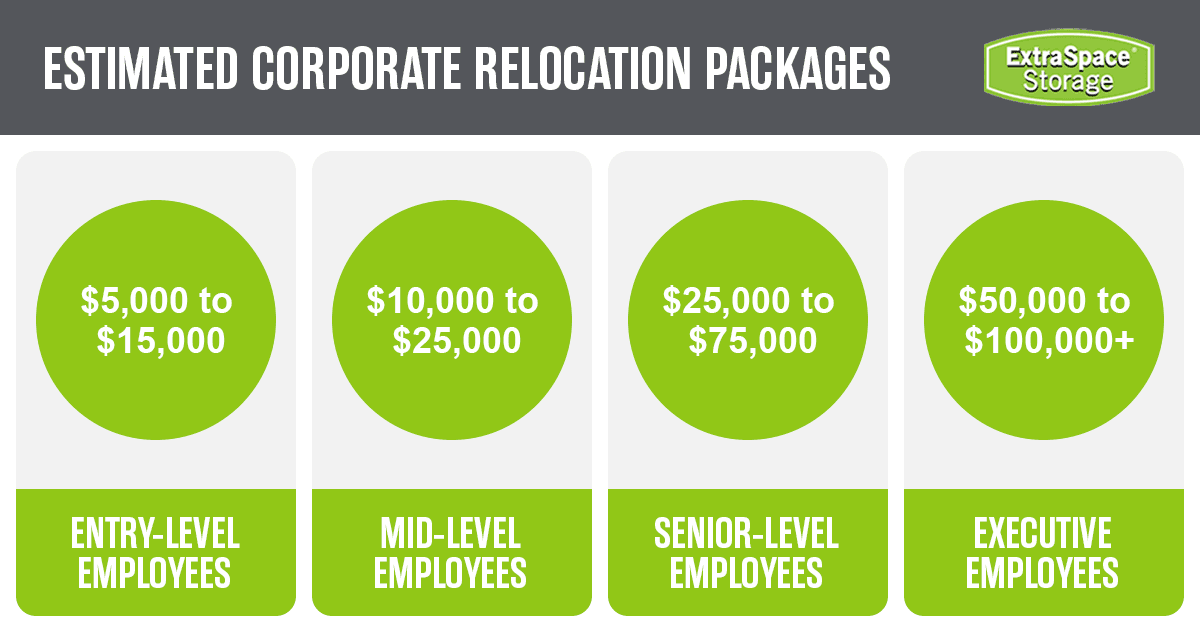
The total value of a relocation package depends on factors such as your homeowner status, the distance of your move, and your role level. Homeowners typically receive larger packages than renters to account for the cost of selling a home. Long-distance moves also tend to result in higher amounts to cover transportation, temporary housing, and travel costs. Your role and seniority can also influence the package amount, with more comprehensive support often associated with executives or specialized employees.
Here are estimated ranges for corporate relocation packages:
Entry-Level Employees or Renters: $5,000–$15,000
Mid-Level Employees: $10,000–$25,000
Senior Employees or Homeowners: $25,000–$75,000
Executive Employees: $50,000–$100,000+
How to Negotiate a Relocation Package
Your initial offer should be viewed as a starting point rather than a final decision—many employers are open to tailoring benefits to your specific needs if you approach them with a clear, well-researched counteroffer. To ensure a smoother move, consider these tips for effectively negotiating relocation packages:
Know Your Needs & Ask for Specifics: Focus on targeted adjustments that matter most to you, such as extending temporary housing or increasing the moving allowance, rather than requesting a vague lump sum. Practical, specific requests are often easier for employers to evaluate and approve.
Consider Tax Implications: Relocation benefits are usually taxable, which can reduce your take-home value. Ask about a tax gross-up to cover the taxes on your benefit and ensure the move doesn't negatively affect your finances.
Clarify Repayment Terms: Carefully review the
clawback clause. If you're confident about the role but want protection against circumstances out of your control, ask for language that distinguishes voluntary departures from layoffs or company restructuring.
Present Your Case Professionally: Frame requests as solutions that will help you transition smoothly and be productive faster. Support your asks with cost estimates or research, and approach negotiations collaboratively.

Find Affordable Self Storage Near You
Extra Space Storage has over 4,000 locations across the U.S. with friendly customer service, advanced security features, and affordable month-to-month rates.
- Save up to 40% off online
Tips for Handling a Job Relocation
When it comes to handling a corporate relocation, staying organized is crucial. Follow a comprehensive job relocation checklist to make sure you don't overlook any important details. Here are some helpful starting points:
Prioritize Financial Planning: Set a moving budget based on your relocation package, compare costs of living, estimate moving costs, get mover quotes, and plan for taxes.
Figure Out Housing & Logistics: Research neighborhoods, do a pre-move visit, find temporary housing, and handle current housing early. Decide what to move, store, or sell, and
book movers early. Develop plans for moving with family,
pets, or large items to ensure a smooth transition.
Check Off Administrative Tasks: Update your address for your license and vehicle registration. Set up mail forwarding. Update bank, credit card, and insurance info. Transfer medical records.
Address Personal Details: Refill prescriptions and find new doctors. Arrange school enrollment, update pet info, and find a new vet, if needed.
Adjust & Settle In: Focus on settling into your new city by exploring your neighborhood, taking coworkers up on social invitations, and giving yourself time to adjust.
Navigating Corporate Relocation Housing
Figuring out housing—both temporary and permanent—can be one of the most stressful parts of relocating for work. By preparing for a brief overlap between move-out and move-in, you can ensure a smoother transition for you and your family. Here are some tips for finding the right place to live during a work relocation:
Review Your Relocation Package: Confirm what housing support is included in your relocation offer—like temporary housing, rental or home-buying assistance, or moving-related reimbursements.
Arrange Temporary Housing If Needed: Consider whether you'll need temporary housing options—such as corporate apartments, short-term rentals, or extended-stay hotels—while you search for permanent housing.
Plan Buying or Selling a Home: If you own a home, see if your package covers agent fees, closing costs, or lease break penalties. Schedule your move carefully to avoid housing gaps or overlaps, if possible.
Explore Rentals: Carefully research rental markets, pricing, availability, and lease terms in various neighborhoods—evaluating factors like commute times, schools, safety, and local amenities. A pre-move visit may be included in your package, which can help you make informed decisions.
Utilize Storage Options: If there's a gap between moving out and settling in, consider using short-term storage for furniture or personal items to reduce stress and simplify logistics. This helps keep your belongings accessible while allowing you to settle in at your own pace.
Is Relocating for a Job Worth It?
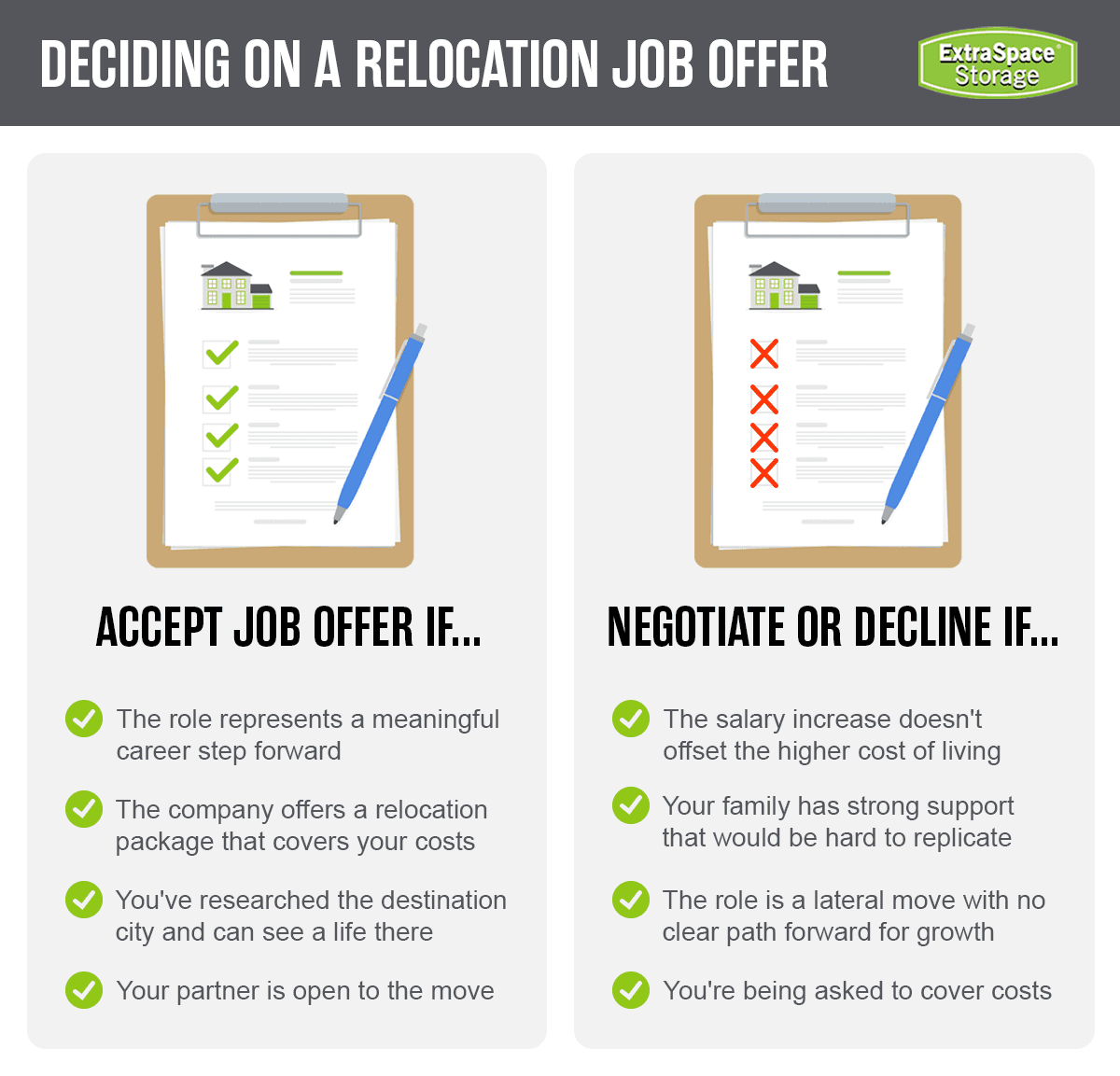
Deciding whether a corporate move is the right decision often depends on personal circumstances, long-term career goals, and the details of the offer. To determine if moving for work is worth it for you, consider the following factors:
Career Trajectory: A lateral move to a new city may not justify the disruption. However, a significant promotion or opportunity to work in a key industry hub could make the move far more worthwhile.
Compensation vs. Cost of Living: Evaluate both your current salary and the proposed offer in the context of your current location vs. the new location. Even a 20% raise can be offset if living expenses are significantly higher in the new area. Before making a decision, use a cost-of-living calculator to compare differences.
Relocation Support: The structure of your relocation package matters. A limited or unclear package could leave you covering substantial out-of-pocket expenses during an already stressful transition.
Family Considerations: A relocation can affect more than you and your career. Factors such as a partner's job, children's schooling, and overall family stability may outweigh even a strong relocation offer.
Consider accepting the offer if… | Consider negotiating or declining if… |
The compensation aligns with—or improves—your standard of living in the new location | The salary increase doesn't adequately offset a higher cost of living |
The role represents a meaningful step forward in your career | The role is largely lateral with limited opportunity for growth |
You've researched the destination and can genuinely see yourself building a life there | You're expected to absorb a significant portion of relocation costs out of pocket |
Your partner is open to the move | Your family has strong ties (e.g., schools, care needs, support systems) that would be difficult to replace |
Frequently Asked Questions About Corporate Job Relocations
What is the average relocation package amount?
Average domestic relocation packages in the U.S. typically range from $15,000 to $75,000, though this can vary based on seniority, distance, and homeowner status. Some employers provide a lump sum payment, while others provide itemized benefits or reimburse actual expenses.
Is relocation assistance taxable?
Most relocation packages are considered taxable. Relocation benefits must be reported on your tax return, though some employers add a gross-up to cover the tax burden. Some states still allow tax deductions for moving expenses, so it’s worth checking your state’s regulations and consulting a tax professional for eligibility criteria.
How long does it take to relocate for a job?
Relocating for a job can take anywhere from one to six months, depending on factors such as your company's size, the distance of the move, housing availability, and personal circumstances. Working with your company on a clear, personalized timeline can help you ensure a smooth transition—even for short-notice moves.
***
Moving for work soon? Find helpful tips and resources on the Extra Space Storage moving hub. And if you need a place to temporarily store your belongings during a corporate relocation, we have storage facilities located throughout the U.S. to help simplify your transition. Find a storage unit near you!

Author Profile
Quinn Johnson
Quinn Johnson is a moving expert and author for Extra Space Storage. He's moved over 15 times, including internationally, and helped countless others between their own homes. He's happy to lift some boxes for a friend as long as he's paid in pizza. As a writer and content creator for Extra Space Storage since 2019, Quinn shares helpful moving tips and info to alleviate the common stresses of moving.